A serial killer's taunting letter led police directly to his door, where the walls of his home were found saturated with the blood of numerous women. The sheer volume of blood splattered throughout the otherwise spotless house had turned the paint an "unusual" blue.
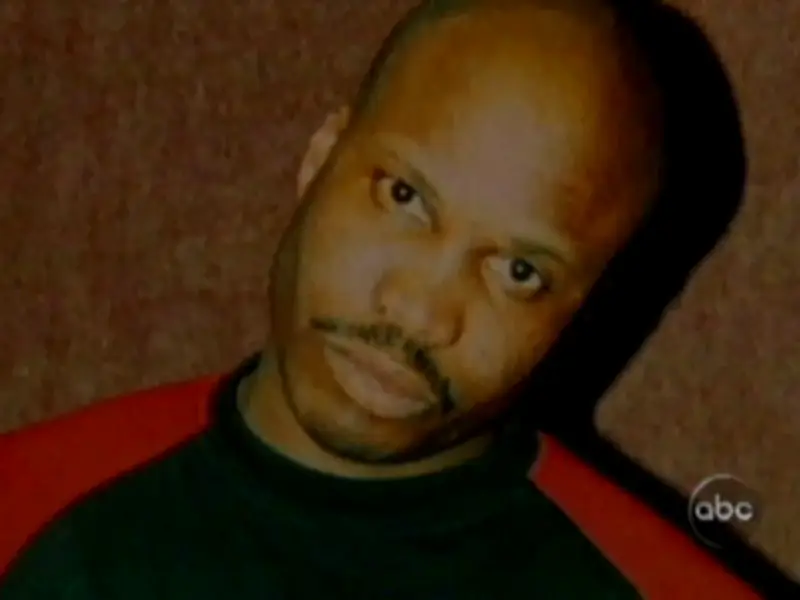
Maury Travis murdered and dumped countless women in the St. Louis area, luring no less than 12 victims to his home in Ferguson, Missouri. He filmed many of the assaults on sex workers, many of whom struggled with substance issues. Detective Jana Walters of the St. Charles County Sheriff's Office described Travis, a likeable food server who tied up, tortured, and degraded his victims, as "pure evil".
Discovery of the Victims
In May 2001, in St. Charles County, Missouri, a lawn mower discovered a dead naked body near the curb of a road. A distinct upper dental plate helped identify her as Teresa Wilson, a beloved daughter who struggled with addiction. Investigators believed she was not killed where she was found. Just one month later, less than 20 feet from where Wilson was discovered, missing Illinois woman Verona Thompson was found.
"This was horrendous," said Walters. "These are women, regardless of what their trade is. They are mothers, daughters, sisters, aunts … They don't deserve to die this way." Missouri and Illinois State Police found similarities in the murders of Wilson and Thompson to victims Alysa Greenwade and Betty James, both left in East St. Louis over the state border.
"By the end of the summer, it was one after another after another," said former St. Louis Police Department Captain Harry Hegger. "We were really shocked by the monthly occurrence that a sex worker — found nude, sometimes undetermined cause [of death] or strangulation — would turn up in a multitude of jurisdictions."
The Letter That Broke the Case
FBI Agents John and Melanie Jimenez were called in to help, and federal, state, and local law enforcement agencies joined forces. In the autumn of 2001, experts found the suspect's DNA when the bodies of Yvonne Crues and Brenda Beasley were discovered in East St. Louis. In early 2002, investigators found three more Jane Does. The next big break came in May 2002 when a reporter at the St. Louis Post-Dispatch wrote an empathetic article humanising murder victim Teresa Wilson.
"It showed that even though she was a sex worker, she did have a life," said St. Louis P.D. Detective Kenneth Dye. "She had friends, and she had family, and she fell into a rut, and she couldn't get out." Then, someone claiming to be Wilson's killer wrote a demanding letter to the media outlet, along with a map of where authorities could find his alleged 17th victim.
The chilling letter, dated May 25, 2002, read: "Nice sob story about Teresa Wilson. Write one about Greenwade. Write a good one, and I'll tell you where many others are. To prove I'm real, here's directions to number seventeen. Search a 50-yard radius from the X. Put the story in the Sunday paper like the last." The map led police to the bodies. "In the middle of a field, very visible by a little gravel road, we did see that it was a sun-bleached skull," Walters told Unknown Serial Killers of America. "And, upon looking further into the area, there were scattered bones, remains of a skeleton."
The Search and Its Aftermath
A forensic examination of the note showed a St. Louis postmark with a return address that led to an adult website, but there was no DNA. Agents John and Melanie Jimenez had the mapping website subpoenaed, and a digital investigation led to an IP address in Ferguson, Missouri. This was Travis's home. The 36-year-old had been paroled since his 2000 release from prison for robberies in the late 1980s.
The task force watched his movements and noticed Travis regularly took out the trash at his single-family home. "They stopped the trash man about a block or so over and said, 'Hey, we wanna ride with you and pick up trash; we wanna get trash from this one house,'" Hegger said. "So, they picked it up, and inside the back of the trash truck was this brand-new, empty container that we dumped all the trash into." Within a day, DNA recovered from a discarded plastic spoon matched the DNA found with the bodies of Crues and Beasley.
Authorities executed a warrant to search Maury Travis's home on June 7, 2002. The inside was chilling — the home was without "a speck of dust," according to Dye. In the basement was a floor-to-ceiling bookshelf lined with VHS tapes, and further down was a locked door. "When they opened the door, the overpowering aroma of the blood and bodily fluids quickly overcame the investigators," Dye said. "Travis had tried to use room deodorant down there and everything, but the smell was too strong."
The room was painted an "unusual" blue, with dark carpeting and a mattress on the floor. There was a bag with a stun gun, restraints, and duct tape. Blood spatters were found on the walls of a closet. According to Dye, "there were chains, ligatures, boards with blood on them … you could see it was a chamber of horrors." FBI crime scene technicians found blood within the layers of paint covering the walls. "There was so much blood hidden in the walls," Walters said. "He painted over it. He killed. Blood. Paint. Killed. Blood. Paint. This went on for layers and layers."
Travis's home videos showed him degrading the victims, often forcing them to refer to him as "Master" or ridiculing them as mothers. In one video, Travis said: "First kill is 19 years old," he said. "Name? I don't know. I don't give a f--k." Police who watched the videos were given counselling. "Maury Travis had a rather ritualistic way that he would kill his victims," said psychological criminologist Bryanna Fox. "He would tell them they were going to die, make them confess for their sins, or make them say that they were happy to be his servant."
Travis never faced the full force of justice. In June 2002, he hung himself with a bedsheet while sitting behind bars. In a suicide note left for his mother, Travis confessed, "I've been sick for a long time (sick in the head) since I was 14." Investigators believe Travis killed upward of 20 women in total, possibly dozens. Det. Dye believes there is "damn sure more than 20" based on the frequency of the killings. Former Mayor Powell said Travis's crimes weren't widely reported because people "turned a blind eye" to the victims due to their lifestyles. "The families are still hurting, and everyone needs closure," she said.