
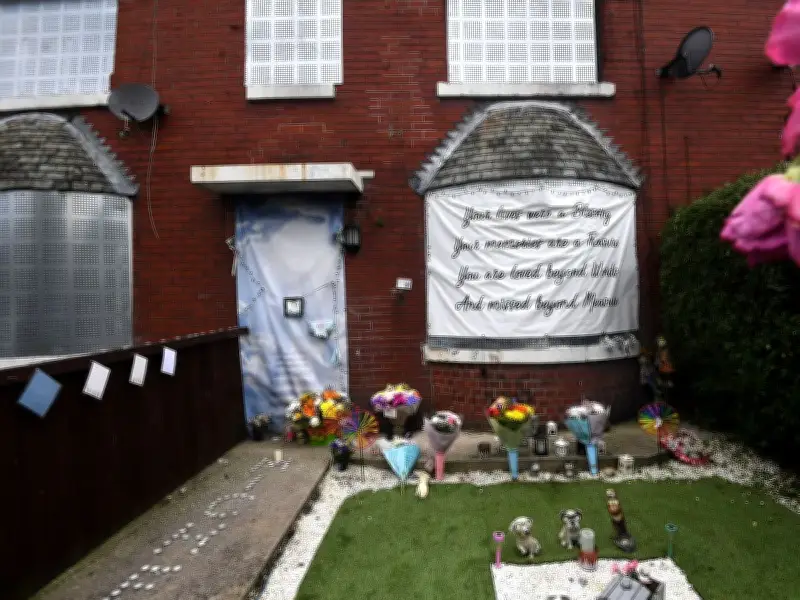
A police officer has told an inquest he could have arrested killer Zak Bolland hours before he murdered a mother and four children in an arson attack on their Walkden home.
PC Mick Grundy, at the time a probationary officer with Greater Manchester Police (GMP), was called to the Salford home of Michelle Pearson after she made a 999 call in December 2017. The 37-year-old's teenage son had been threatened and her Jackson Street home had come under attack by Bolland and his associates.
Officer admits arrest was possible
Bolton Coroner's Court was told 26-year-old Bolland was in a feud with Ms Pearson's son and had already daubed 'Grass' on her house, smashed her windows, set her wheelie bin on fire and threatened to firebomb the house. Around 12.40am on December 11, Bolland and others damaged her home again and threatened to 'do the house', so Ms Pearson called police again.
PC Grundy and colleague PC Gemma Quinn, who gave evidence yesterday, took a statement from her and left the property at around 3.20am. But they went back to the station to do the paperwork and did not go to arrest Bolland immediately. He is understood to have been at his home at the time, around 350 yards away.
Fatal attack and missed opportunities
Bolland returned to Jackson Street at just before 5am with accomplice David Worrall, 28. They smashed Ms Pearson's windows at the back of the house and tossed in petrol bombs. One 'exploded' near the stairs, blocking the only exit to the ground floor and trapping the family inside. Sleeping upstairs along with Ms Pearson were her children: Demi Pearson, 15; her brother Brandon, eight; and sisters Lacie, seven, and Lia, aged three. All the children were killed as flames quickly engulfed the property. Ms Pearson suffered 68% burns to her body and 'clung on to life' until she died, 20 months after the attack on August 25, 2019.
On the seventh day of evidence at the inquest into the deaths, Anna Morris KC, representing the Pearson family, questioned PC Grundy. Ms Morris said the family were concerned it would only have taken a few minutes to go to Bolland's home. "I did not think about him coming back and doing what he did," PC Grundy said. Ms Morris continued: "He could've been arrested that night from the timings and information you had available to you?" "Yes," the witness replied.
Ms Morris said all the family received was a crime reference number by text message. She added: "But what else did you put in place to keep them safe that night?" "Nothing," the officer replied.
Earlier call and police response
The court then heard of another possible 'missed opportunity'. Two days before the fatal attack Ms Pearson had called police when her wheelie bin was set on fire and 'Grass' spray painted on her home. Andrew O'Donnell, a police constable with GMP, was called to the house. Ms Pearson named Bolland as the culprit, the same person who had broken her windows two weeks before and threatened to firebomb her home.
PC O'Donnell told the hearing Ms Pearson did not actually see Bolland setting the wheelie bin on fire or spraying the graffiti. He said he made some house-to-house inquiries, but could not trace any eye-witnesses or CCTV opportunities and he concluded there were no further lines of inquiry to pursue. Laura Nash, counsel to the inquest, asked PC O'Donnell: "So as far as you are concerned, it's case closed. And it was case closed. You closed this crime the same day." "It is, yes," the officer replied.
Ms Nash asked where the officers' 'professional curiosity' was to link Bolland to this latest attack. The officer said he took 'reasonable and proportionate' inquiries and at the time it was regarded as a low-level crime so crime scene investigators would not have attended to look for evidence. Ms Nash said one way to deal with any risk from Bolland was to arrest him. "On what evidence?" the officer replied. Ms Nash replied: "Your inquiry started and stopped on the same day."
Reasonable lines of inquiry
Sophie Cartwright KC questioned the officer as to why he did not go to Bolland's address to check the CCTV there, adding: "This is basic policing." The officer replied: "Putting somebody near the scene or three streets away, does not put them at the scene." He said they had no evidence on which to arrest Bolland at the time.
Ms Cartwright said there was a 'chain of events' linking him to the crime and he could have been checked for any paint, smoke smell or fire damage to his clothing. She added: "The very least you could have done was go and find Zak Bolland. These are reasonable lines of inquiry." PC O'Donnell replied: "Ok. They would be, if we could have put him at the scene."
Timothy Brennand, senior coroner for Manchester West, asked the officer, given that 48 hours later, Bolland would murder the family in a firebombing, what his reaction was and if he had thought about what he could have done differently. The officer replied: "Yes. That's a natural thing to do. At the time we had done everything we could. Obviously, what has happened, has happened."
In 2018, Bolland and Worrall were both given four life sentences and told they would serve a minimum of 40 and 37 years respectively for the petrol bombing. Bolland's girlfriend, Courtney Brierley, 20, was jailed for 21 years for four counts of manslaughter. Ms Pearson had called police on at least five occasions in the two weeks before the firebombing and had begged to be re-housed, the murder trial at Manchester Crown Court heard. The inquest continues.




