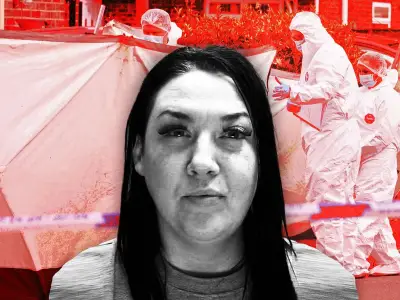
The nanny of Lindsay Clancy's children has testified at her murder trial, giving an insight into what the mum was really like before the tragic deaths. Elaine Rossi took the stand on day seven of the high-profile trial, where Clancy — who faces life without parole — is charged with three counts of first-degree murder over the deaths of her three children.
Clancy fatally strangled Cora, five, Dawson, three, and Callan, eight months, with exercise bands in the basement of their Duxbury, Massachusetts home on January 24, 2023. However, Clancy is pleading not guilty to the charges, with her defence team arguing that she was not criminally responsible due to suffering from extreme postpartum psychosis. Prosecutors say that Clancy planned the killings and deliberately sent her husband Patrick out of their home on the day of the deaths, giving her enough time to strangle the children to death before attempting to take her own life.
Nanny's testimony
Now, Rossi has provided the jury with a positive character reference for Clancy — a former labour and delivery nurse — describing her as a 'wonderful mother.' The experienced nanny began working for the Clancy family in September 2022 after responding to a job advert. Her initial role was to look after Callan when Clancy returned to work, which was expected to be around Thanksgiving.

According to the nanny, Clancy would leave a sleep schedule for Callan in a yellow notebook, as the mother was reportedly worried about his sleeping and feeding at the time. Rossi testified that she was never concerned about Clancy's treatment of her children, or worried about them being left alone with her. When asked this question, Rossi replied: 'Not at all. She was a wonderful mum.'
Parenting style
Rossi then gave an example of Clancy's parenting style. She recalled a situation when Dawson, who she said was 'full of energy,' struck his younger brother. Clancy reportedly removed Dawson from the room and made sure her baby son was OK. Rossi said Clancy then spoke with Dawson about his unacceptable behaviour. 'I observed a wonderful mom who loved her kids,' Rossi said, adding: 'I did love Lindsay, yes.'
Rossi also provided her perspective of Clancy's mental health at the time. She said that the mother of three had confided in her about her decision to stop breastfeeding Callan so that she could start taking medication. Rossi recalled Clancy also talking to her about her 'postpartum and insomnia' struggles.
Understanding postpartum psychosis
According to the NHS, postpartum psychosis is a rare, severe mental illness that causes hallucinations, delusions, and extreme mood swings. It affects about 1 in 1,000 mothers and is a medical emergency that needs quick hospital care. Symptoms include hallucinations, delusions, mania, a low mood, or a mixture of both, and feeling very confused.
The day of the murders
On the day of the murders, Clancy attempted suicide by jumping from a second-story window. Clancy had asked her husband, Patrick, to collect medicine for their children and a takeaway after she said she'd had an exhausting day. However, less than an hour later, at around 6pm, Patrick returned to find blood on the floor of the couple's bedroom, a bloody knife on a bedside table and an open window. He discovered Clancy on the frozen ground outside, having jumped around 20ft from the window. She had also cut her wrists and neck. Clancy's fall caused spinal injuries which left her paralysed. She now uses a wheelchair.
Upon finding his wife on the floor, Patrick said Clancy told him that she'd tried to kill herself and said that the children were in the basement. Cora and Dawson were pronounced dead at the scene, while Callan was airlifted to hospital and died several days later.
Last week, jurors heard Patrick's heartbreaking testimony, in what marked the first time he'd seen his now-ex-wife since the deaths of their children. Patrick — who has publicly forgiven Clancy — was visibly emotional on the witness stand, recalling how she was a devoted, loving mother who suffered from severe mental health issues. If Clancy is found not guilty, she will likely face an indefinite stay in a secure state mental health facility. The trial continues.