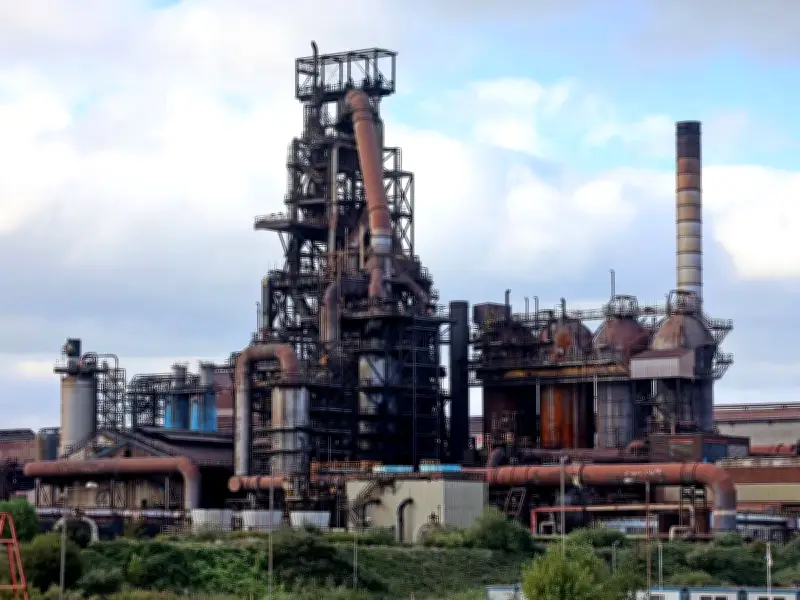
The jury in the trial of Tata Steel over safety failures at its Port Talbot steelworks has retired to consider its verdicts. The company faces two counts of failing in its legal duty to ensure the safety of staff and others after a release of toxic gases from a blast furnace left two workers needing oxygen on site and hospital treatment.
Prosecution alleges inadequate risk assessments
The prosecution argues that Tata failed to carry out adequate risk assessments around the release of such gases, while the firm insists that all reasonably practicable steps had been taken to reduce risk. The trial at Swansea Crown Court concerns an incident on February 14, 2022, when the blast furnaces in Port Talbot were still operating.
On that day, a "blower" pushing air through heaters, known as "stoves," and into blast furnace number four failed, triggering an emergency procedure to stop gases flowing back down the pipes and into the blower, where they could cause significant damage. The procedure, introduced after a blower failure in 2007 that caused an explosion, involved opening a "snort valve" to vent gases into the atmosphere until system pressure dropped enough for a hot gas isolation valve to shut and stop gas flow from the furnace completely.
Incident details and gas monitor readings
The court heard that venting via the snort valve typically took about three minutes to reduce pressure enough for the isolation valve to close fully. In February 2022, a blower feeding furnace four had been out of action for an upgrade and came back online on February 11. Two days later, it failed, and the emergency procedure was initiated, venting gas through the snort valve—on that occasion, nobody was working in the area around the valve, about 16 metres above ground level.
The blower was brought back online but failed again at 9.30pm on February 14. The court heard that "many, many, many red alarms" were triggered in the control room, and staff initiated the emergency procedure once more. This time, 15 men were working in the area: two Tata employees and 13 workers from York Linings, who were working on one of the stoves. All 15 wore personal gas monitors, and the monitors on the Tata employees were triggered—they radioed the control room and were told to evacuate. The two Tata employees did not leave immediately but stayed to ensure all contractors, eight of whom were inside the giant stove, got out safely.
The two Tata employees were given oxygen on site before being taken to hospital for blood tests. The court heard that the safe short-term limit for exposure to carbon monoxide in the air is 100 parts-per-million, but the personal gas monitors on the two workers recorded levels of 1,408 and 1,860 parts-per-million.
Defence cites hindsight and burden of proof
Prosecution barrister Rebecca Griffiths told the jury that had a proper risk assessment been done when the emergency procedure was introduced, toxic gases would never have been released into an area where people could have been working, and that the risks of venting via the snort valve were "reasonably foreseeable." She noted that after the 2022 incident, Tata changed the emergency procedure to vent gases through the top of the blast furnace rather than through the snort valve.
The defence maintains that "suitable and sufficient" risk assessments were undertaken by experienced staff with relevant skills, and that staff were properly trained, equipped, and understood emergency procedures. Dominic Adamson KC, for Tata, told the jury to consider the chronology of events, saying criticisms of the emergency procedure were being made with the benefit of hindsight.
The jury has heard that in regulatory offences, the burden of proof is on both parties—the prosecution must make them sure of the alleged failings to the criminal standard, and if they are sure beyond reasonable doubt, the defence must prove on the balance of probabilities that it was not reasonably practicable for the firm to do more than it did to meet its legal duties.