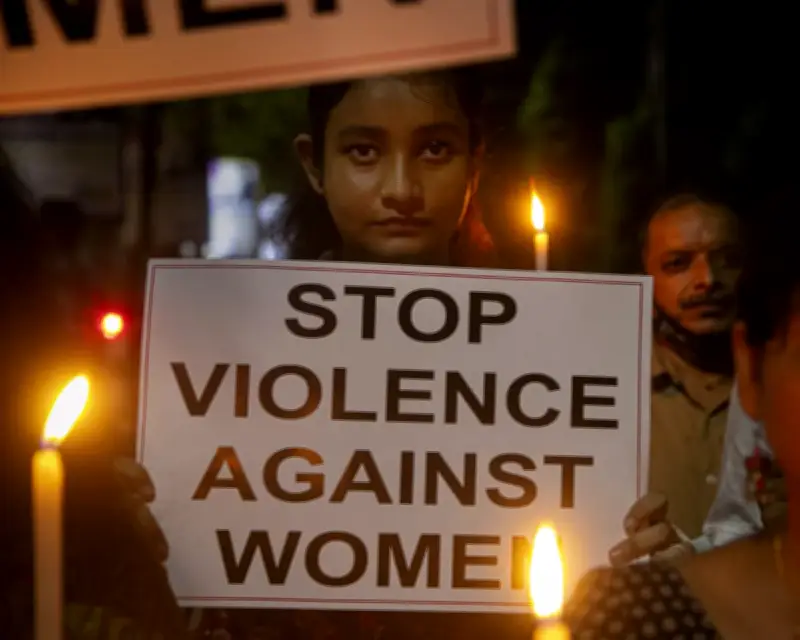
Indian women are pushing back against restrictions imposed after sexual violence incidents, demanding safer public spaces instead of curbs on their freedom. The demand follows two viral incidents: a video showing men allegedly harassing two teenagers in Bihar's Jamui, and the alleged gang-rape of a 17-year-old in a Delhi park by men posing as police.
In response, authorities in Delhi restricted access to public parks, and Lady Shri Ram College (LSR) briefly moved classes online. Women in Bihar told Outlook that such incidents trigger greater controls and pressure on them. This pattern, activists say, places the burden of safety on women rather than addressing the root causes of violence.
Activists decry 'moral policing' of women
Feminist activist Kavita Krishnan has described this phenomenon as “perhaps the most widespread form of gender-based violence in India”. Instead of examining why sexual violence remains entrenched, women are expected to take up less public space, she notes. Feminist author Meena Kandasamy says regulating women is easy because “it does not require any institutional cost and, most of all, it sends the signal to concerned parents that the problem is being handled”.
Kandasamy, whose novel Fieldwork As a Sex Object explores a woman's life upturned by a deepfake video, argues that the target audience of such measures is “not the young women who feel unsafe but the rest of society”. She describes women being treated as a “problem to be handled” – “like a diamond that has to be locked up to prevent theft”.
Students demand safer public spaces
Students from Delhi University have come out on the streets demanding more street lighting, usable public toilets, housing, and scholarships for female students. Vedayana, 20, an LSR student, says locking up parks is not the solution: “If you are not putting up safety measures to make it accessible to women, then it is as good as saying that the park is only for men.”
A recent survey of more than 4,000 women in New Delhi and Bengaluru found that 65% in New Delhi and 29% in Bengaluru experienced harassment in public spaces in the past year. A 2024 study from India and Pakistan found women's mobility remains low, tied almost entirely to education, employment, or unpaid care work, with leisure mobility practically nonexistent.
Political responses criticised
A female minister from Bihar, commenting on the molestation video, said: “Moral policing can be done in a more decent and elegant fashion.” Another minister from the state drew fire for calling it an “isolated” incident. Vedayana wants political parties to pledge not to give tickets or positions to anyone accused of sexual harassment: “We don't want the leaders sitting at the top to perpetrate and preach rape culture.”
Parliament is not immune to accusations either. BJP politician Brij Bhushan Singh, formerly head of the Wrestling Federation of India, was accused of sexual harassment by six female wrestlers – he denies the allegations and was acquitted by a magistrate, in a case undergoing appeal. An analysis of 2024 parliamentarians by the Association for Democratic Reforms found 15 winning candidates declared cases related to crimes against women. Vedayana believes changing mentality must begin with families: “If you are in a position of authority, use it to influence people by speaking out against patriarchy and groom your sons first.”