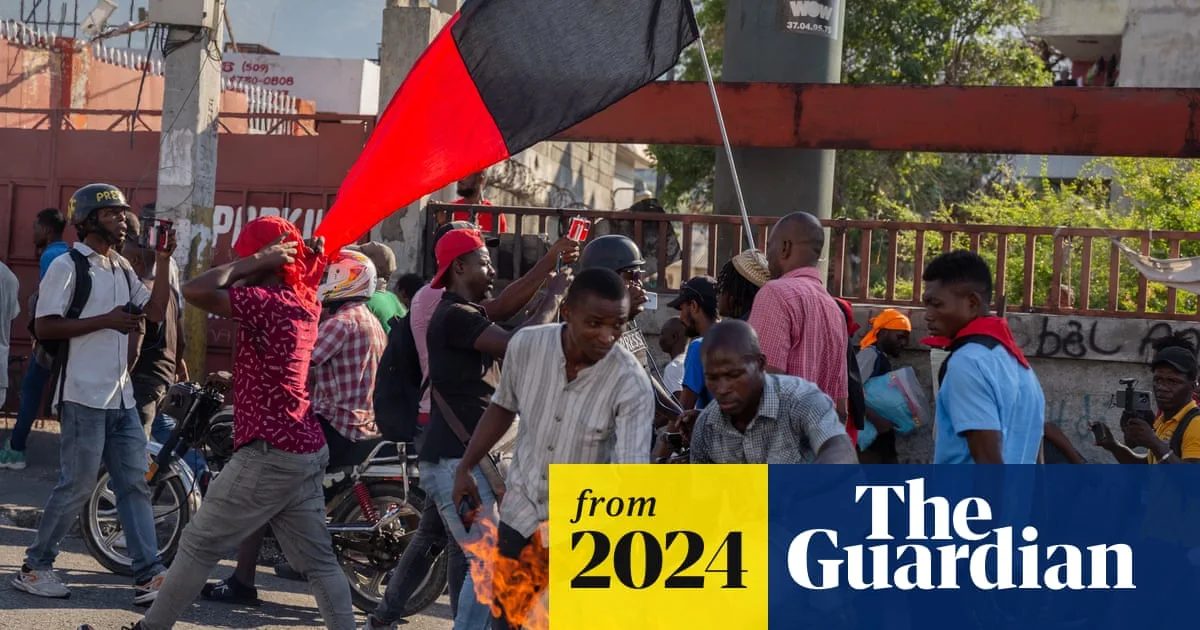
Ariel Henry, Haiti's prime minister and acting president, has announced he will resign after two weeks of gang-led violence that brought the capital Port-au-Prince to a standstill. Gangs stormed prisons, seized the main port, torched police stations and businesses, and laid siege to the international airport. The unrest began on 29 February while Henry was visiting Kenya, and he has been unable to return. In a video address from Puerto Rico, he said his government would step down and urged Haitians to remain calm until a transitional council could be formed, but gave no timeframe.
The immediate trigger for the chaos was the stated aim of the gang coalition to oust Henry, whom they accuse of anti-democratic rule. However, the crisis has deeper roots, stretching back to the 2010 earthquake, the decades-long Duvalier dictatorship, and the heavy reparations Haiti was forced to pay France after independence in 1804. The assassination of President Jovenel Moïse in 2021 and the absence of elections for seven years have left a political vacuum. Daniel Foote, a former US special envoy, blamed consistent international meddling for making Haiti a 'failed state'.
The humanitarian situation has deteriorated sharply. According to the UN, nearly 4,000 people were killed and 3,000 kidnapped in gang-related violence last year, with more than 1,100 attacks on women. Over 300,000 people are displaced, and half the population lacks sufficient food. The economy has contracted for five consecutive years. Hospitals are overwhelmed with gunshot victims and short of staff and supplies, with the health service nearing collapse. Jean-Marc Biquet, head of Médecins Sans Frontières in Haiti, said his Haitian colleagues felt 'lost' and feared what might happen next. Security expert Romain Le Cour, who was in the country when the uprising began, described the situation as 'devastating'.
Gangs are estimated to control more than 80% of Port-au-Prince, operating through two rival coalitions: the G9, led by Jimmy 'Barbecue' Chérizier, and Gpèp. The police force is severely under-resourced, with about 10,000 active officers for a population of 11.7 million, compared with the estimated 26,000 needed. Some 1,600 officers stepped down last year. A UN-backed multinational security force, approved in October, has not yet deployed, and experts say the prospect of its arrival may have aggravated the violence.
Henry submitted his resignation to the Caribbean Community (Caricom) regional bloc after an emergency meeting. Guyana's president and Caricom chair, Irfaan Ali, said a presidential council with seven voting members would appoint an interim successor. He indicated the council would draw representatives from the private sector, but further details were not provided.