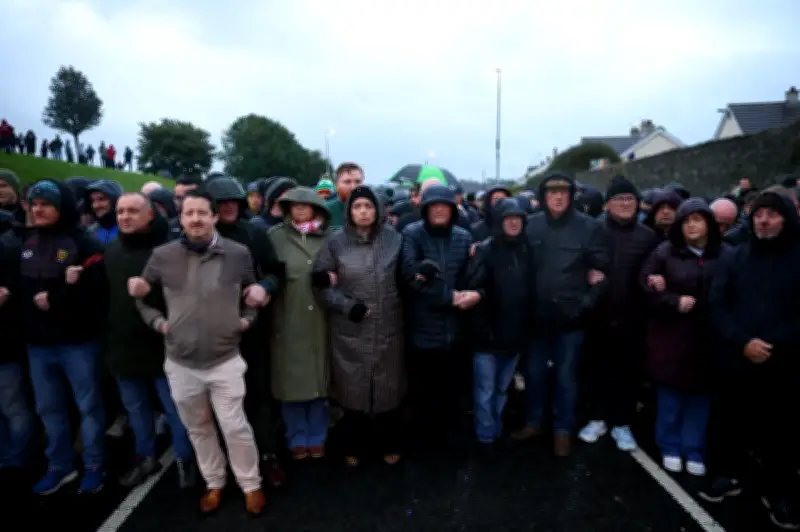
Thousands of protesters blocked the predominantly nationalist Garvaghy Road in Portadown on Sunday morning in a bid to prevent a contentious Orange Order parade from passing. The demonstration delayed the scheduled 8am start of the parade, with protesters, many wearing balaclavas, gathering in large groups in heavy rain along the road.
The protest came just hours after a ruling by the Parades Commission adjudication body permitting the march from Drumcree Church was upheld in an “unprecedented” late-night sitting of the High Court in Belfast. The Drumcree parade, associated with violent clashes during the Troubles, had been banned since 1998.
Political leaders gather on the road
Sinn Féin leaders were among those gathered on the road. Party president Mary Lou McDonald and vice-president Michelle O’Neill were present. First Minister and Sinn Féin vice-president Michelle O’Neill said the reignition of the Drumcree dispute “brings into question how this whole peace process works”.
Mary Lou McDonald called on Northern Ireland Secretary Sir Chris Bryant to intervene to ban the parade. She said the people of the Garvaghy Road would “not be drawn back to the past”. Ms McDonald said: “We have spent all night here, all night talking to people, listening to people, seeking to reassure people that actually this can be resolved, and it must be.”
“So here is what needs to happen now – the Secretary of State needs to intervene. The chief constable of the PSNI needs to intervene and put a stop to this. This is madness. This, in fact, is primitive treatment of any community in the year 2026. It is intolerable, and it will not be tolerated,” she added.
Police warnings and appeals for calm
Police repeatedly notified protesters through a loudspeaker on Sunday that they are liable for arrest for taking part in an unnoticed parade. The Press Association understands more people entered the road in the belief the police were sending reinforcements. The group of Orangemen due to take part in the parade assembled early on Sunday at nearby Drumcree Church.
DUP leader Gavin Robinson said: “A First Minister’s duty is to uphold lawful decisions, not inflame opposition to them. The rule of law cannot apply only when Sinn Féin likes the outcome. Our institutions are founded on respect for the police, the courts and the rule of law.”
Prime Minister Andy Burnham appealed for “calm on all sides” over the Orange Order parade, saying there have been “big gains made in Northern Ireland, and we don’t want to see things go backwards”. The Irish Government said it is “very concerned about the situation”. A Government statement said: “Our primary concern remains to avoid a return to the divisions of the past, recalling the significant progress made over many years in furthering reconciliation under the Good Friday Agreement.”
Court ruling allows march to proceed
The march was finally given the go-ahead at a hearing which concluded at 2.15am on Sunday after opposing legal teams outlined their arguments. The hearing was one of three separate emergency legal cases heard before the courts in Belfast across Saturday and into early Sunday. The final time-limited sitting, which began at 12.20am on Sunday, was heard before Justice Michael Humphreys.
During proceedings he acknowledged the “unusual if not unprecedented circumstances as it is now 1.45am, with a parade scheduled to begin in just over six hours’ time”. Outlining his decision, Justice Humphreys cited case law that as a public body the courts must respect the commission’s judgment and “their decisions will not be lightly interfered with”.
He said: “The picture painted here is of a public body which took evidence from the relevant sources, weighed up the key issues which were in play and arrived at a reasoned decision. The jurisdiction to impugn (a) public body’s decision on that basis is necessarily limited to cases where no reasonable decision could arrive at that outcome and in my view, in this case that threshold has not been met.” He added: “This court cannot substitute its own view or anyone else’s view for that of the commission.”
Earlier, Northern Ireland’s most senior judge, Lady Chief Justice Siobhan Keegan, also described the situation as “unprecedented” as she presided over the second challenge. Justices Keegan and Humphreys joined Lady Justice Denise McBride in the Court of Appeal which, in the late hours of Saturday, upheld an appeal by Portadown Orangeman Alan Hynes to allow the march to go ahead. That appeal was heard after a temporary injunction was issued in the first legal challenge on Saturday that would have prevented Sunday’s parade happening as scheduled.
In that initial ruling, Justice Patricia Smyth blocked the Parades Commission’s decision, saying the “long-running dispute has the potential to escalate” across Northern Ireland. The stand-off at Drumcree made headlines in the 1990s, with nationalist residents of the Garvaghy Road opposed to the parade passing through the area, leading to violent clashes for several summers and political tension necessitating a major security operation. The Orange Order has unsuccessfully applied for more than a quarter of a century to complete its 1998 walk along its traditional route.
On Friday, the commission reversed its long-running determination, to the welcome of unionist parties and outrage of nationalist and republican parties. Permission was granted for a parade subject to strict restrictions, including a limit of 35 participants and the 8am start time.