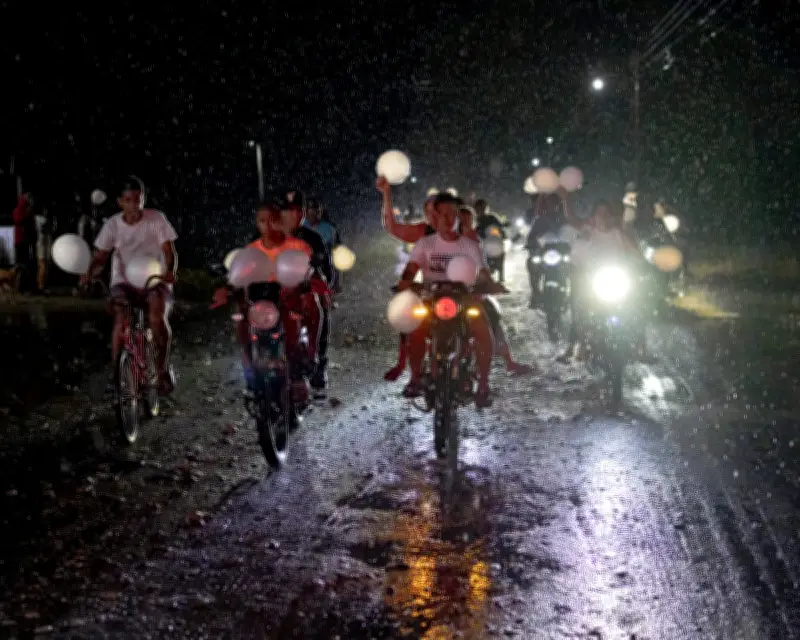
The Guedez García family spent 18 days searching for their missing daughter in La Guaira, Venezuela, after devastating earthquakes last month. When her body was finally found, the family and volunteers from their village of Poblado Uno travelled back home to lay her to rest.
Family's Ordeal
In a mountainside cemetery high above Caracas, far from the chaos of Venezuela's earthquake-lashed coast, a family of three huddles in the back of a pickup truck coming to terms with their loss. "At first, it will be difficult," says Adolfo Guedez, tears rolling down his cheeks as his eldest daughter, Carmen, hugs a wooden cremation box containing the ashes of her sister, Alexandra. "But she will help us get through this," Guedez comforts his wife and daughter, motioning to the urn holding their second child's remains. "She will help us."
Alexandra Yarismar Guedez García, a 23-year-old physiotherapist, is one of more than 5,000 Venezuelans who were killed when the country's north coast was devastated by two earthquakes on 24 June 2026. Last Sunday, after 18 days searching for their missing daughter in the wreckage of her collapsed apartment building, the Guedez García family finally found Alexandra's body, buried in the sitting room, and started the journey back home to Poblado Uno (Village Number One), the small farming community where she was born and raised.
Community Response
"It's a nightmare – it never went through my mind that I would have to live through a nightmare like this," the victim's despondent father said as his family prepared to set off from the temporary shack where, for nearly three weeks, they had squatted by the ruins of Alexandra's home in Caraballeda, a beach town that was one of the worst-hit areas. From Caraballeda, the Guedez García family drove south to a picturesque mountaintop settlement called El Junquito, where they collected her remains in a graveyard with stunning views over Venezuela's capital. For a while they sat there, absorbing the reality of Alexandra's departure to the sound of sparrow song.
As night approached, they left the cemetery and sped southwest towards their rural home in Portuguesa state, Venezuela's agricultural heartlands, passing police checkpoints emblazoned with propaganda exalting Hugo Chávez's "Bolivarian" revolution and the slogan "Doubting is treason", and billboards demanding the return of Chávez's successor, Nicolás Maduro, who was abducted by the US in January.
When the convoy reached Poblado Uno, a hamlet of seven dirt streets and three avenues, it was just after 1.30am. Torrential rain hammered down on the agricultural community. But residents had turned out in force to pay their respects to Alexandra – and to salute the local farmers who, despite having no experience in rescue work, travelled to Caraballeda and spent a fortnight burrowing into the ruins of her fallen 14-storey tower in an attempt to find her.
Gratitude and Grief
"Welcome back! Thanks to your efforts and bravery, you managed to bring Alexandra home, allowing us to say a final farewell," read one banner village children had produced to celebrate the tireless volunteers they nicknamed "the moles of Poblado Uno". "Your support in the midst of so much pain was an act of kindness we will never forget." Many mourners carried white balloons to symbolise their grief. Motorbike riders honked their horns.
Guedez, 56, voiced anger at what he called the government's sluggish and incompetent response to the disaster that took his daughter's life. In the crucial hours and days after the earthquakes razed scores of buildings along the coast around Alexandra's tower, survivors claimed government rescuers were nowhere to be seen. Troops stood by with rifles in an apparent attempt to prevent the unrest the country's authoritarian rulers seemed afraid the quakes might generate. "I don't blame the government for this disaster … I blame it for its inefficiency," Guedez complained.
But he and his family were also filled with gratitude for their village's 18 "moles" – 16 men and two women who fought day and night to recover his daughter – and to the other volunteers who fed them as they tried to find Alexandra. "Not everyone was bad," said Alexandra's mother, Yaritza García, 51. "We have met wonderful people too … I'm thankful to my God because he did not fail us," she added, although she was adamant the government had.
Political Discontent
At Alexandra's wake, there were hints of the profound political discontent magnified by the natural disaster as dozens of locals packed the front room of the Guedez García family's simple bungalow to visit a small altar decorated with photographs, religious images and candles. When the local mayor – a member of the ruling socialist party – showed up, many mourners walked outside, a discreet but revealing protest against an unpopular political movement, which many Venezuelans blame for their country's economic and social collapse since Chávez won power more than a quarter of a century ago.
Alexandra, part of a generation who knew nothing but Chavista rule, had left Poblado Uno late last year after obtaining a degree in physiotherapy. Her parents recalled scrimping and saving – and sometimes going without food – in order to pay for her studies despite the pauperisation of their once affluent oil-rich country. "And we would do it all again," said her mother, who is a teacher. Adolfo Guedez, who makes a living harvesting maize from the rusty soils of Venezuela's plains, said he had only ever been to the university of life. "But he's a decent man – a good father," added his wife.
Relatives said Alexandra had dreamed of setting up her own physiotherapy practice in Venezuela's capital. Her older sister, Carmen, had trained as a surgeon. Alexandra's dreams were snuffed out by June's earthquakes, which turned the apartment block where she lived for less than a week into a mass of debris.
Hope Amidst Pain
Guedez felt unsure about the future after his youngest child's death. "Half of my heart has died. I have the other half left, which is my other daughter … And I will fight hard for that little girl I still have: to love her, to cherish her, and to find a way not to give up," he vowed. As for Venezuela, Guedez felt confused. He recalled his happiness after hearing of Maduro's capture by US special forces on 3 January this year, hoping that would finally bring political change to a nation crippled by years of misrule, economic crisis, authoritarianism and foreign meddling. But that joy has now evaporated as regime opponents adjust to the unexpected decision by the US to back Maduro's allies under the command of his former vice president, Delcy Rodríguez.
"At least now we can speak our minds and they don't come after us or arrest us," Guedez said of the fledgling post-Maduro political thaw, which has seen hundreds of political prisoners freed from jail and foreign journalists allowed back into the country for the first time since Maduro stole the 2024 election. "But this isn't everything. We want a free Venezuela, as it was before."
Guedez was determined not to abandon his country, as nearly 8 million Venezuelan migrants have done in recent years to escape economic strife and dictatorship. "My country is a paradise. We have it all here … oil, diamonds, iron, aluminium … and such humane people … It's just such a shame that we have such an awful, second-rate government," he said. In spite of everything, Guedez still felt hope – a sentiment reinforced by the backbreaking travails of those who rescued his daughter's body from her collapsed building and by the affectionate, if devastating, homecoming afforded to Alexandra by the citizens of Village Number One. "These people have given me one surprise after another," Guedez reflected as he sat in the sunshine near his home smoking a cigarette, one day after returning home with his dead child. "I didn't expect it. I never expected it at all."