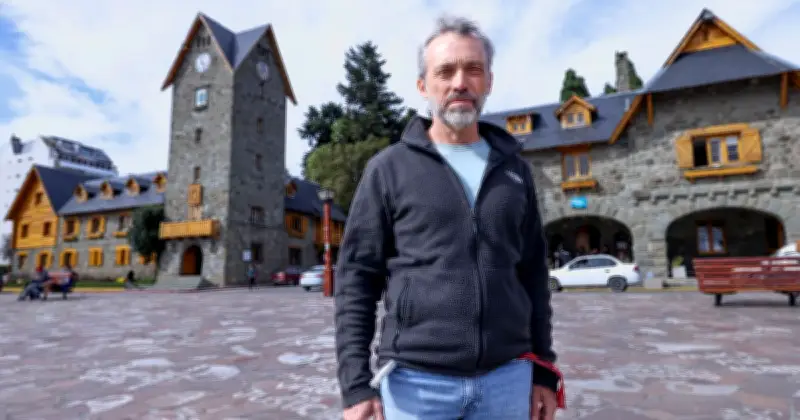
An Argentine Falklands War veteran has said there must not be another war with Britain over the archipelago. The 1982 conflict was a “crime”, José María Rodríguez, 63, said.
Speaking to the Express in Bariloche, he said violence happening around the globe today is “total savagery”.
Veteran's wartime experience
“What is happening with wars in the world — with Iran, with Pakistan, with all these conflicts — I don't feel good about it, and I don't understand it,” Mr Rodríguez, who was an anti-aircraft soldier stationed near Moody Brook to protect an airstrip, said.
“How, in today's society, having learned everything we are supposed to learn, can there still be military careers where you learn how to kill somebody by following an order? Everything else you can study nowadays is to help humankind be better, for the planet, for everything. The only career that teaches you how to kill another human being is in the military. I don't understand how it can still exist.”
He was living in Mar del Plata when he was conscripted at the age of 18, while finishing high school and preparing to attend university to study electronics. The soldiers' unit was hunted by British forces because their radar systems emitted strong signals, making them easy to detect and attack.
Physical toll and aftermath
Mr Rodríguez, who now works as a sound engineer, went 66 days without changing his clothes, had only a single bath, and suffered from severe hunger. His weight dropped from 64kg to 50kg. He did not understand military ranks and had to learn how to fight “the hard way”.
Mr Rodríguez also described how Argentine troops endured physical violence and corporal punishment from superiors. After the war ended, he co-founded a local centre for veterans. Two of his friends took their own lives after returning to Argentina.
Mr Rodríguez is frustrated by what he judges to have been no support for ex-combatants. “The only thing I wanted when I was in the war was for it to end,” he said. “I didn't care why or how.”
Patriotic values were “far below” this wish, he added. “[...] Because the Malvinas War was a crime. Constitutionally, in Argentina, to declare war requires the Chamber of Senators and the Chamber of Deputies to be in agreement with the executive branch. Because we were living under a de facto military dictatorship, Congress was nonexistent. So it was a crime right from the start.”
Reflections and current tensions
He visited the Argentine Military Cemetery in Darwin in 2014. Mr Rodríguez said: “I asked my friends who are buried there, and I asked myself if I were buried there: would we have given our lives for our country? My answer was that you can do a lot of things for your country, but not give your life for it. I think it goes too far.”
It comes as Argentina’s president, Javier Milei, has sought to sanction companies operating in the islands, and has reasserted his belief that they belong to the South American country. Donald Trump has also hinted that the United States may look again at its position over British administration of the islands.
On whether Argentina could invade the Falklands again, Mr Rodríguez added: “My opinion is that we've learned. We've learned. As citizens, we wouldn't go back to war.”
He added: “War is not the way to peace. Peace comes from somewhere else, and wars happen because of politicians and those in power. If people were allowed to talk or converse amongst each other, wars would probably be nonexistent. One hour after the Malvinas War had ended, we were talking to British soldiers as though we had just met — as if we could be friends. [...] Never again a war. No conflict is solved with violence.”
Bariloche has a museum about the Falklands War, which opened last year. Mr Rodríguez said: “For me, the museum is not a good museum because it is full of arms. War should teach us that there should be no more wars. That kind of museum that talks about military history, patriotism, and honour for the country — for me, that is nonexistent, especially regarding this war, which was fought under a military regime.”
He added that an Argentine fighter jet on a stand outside unnerves him, as it contains a fake pilot and reminds him of when he accidentally fired his first shots during the war at a friendly aircraft, which passed within 100 meters of him. Mr Rodríguez remembers making eye contact with the man flying it.
The veteran quoted Ernest Hemingway, saying: “Never think that war, no matter how necessary or how justified, is not a crime. Ask the infantry and ask the dead.”