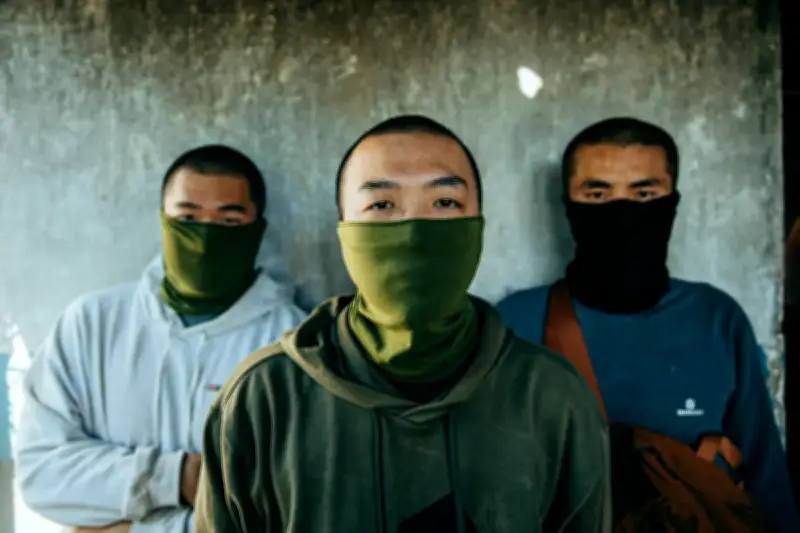
Despite the risks, a number of soldiers from China, the country seen as Russia's biggest backer, have found their way to Ukraine to fight. They face scrutiny from Chinese authorities, which could make it difficult to return home, yet they have joined Ukrainian military units, drawn by a commitment to democracy and sovereignty.
Drone Workshop on the Frontlines
On the makeshift workbench in the cramped front room of a cottage near the frontlines of the Russia-Ukraine war, there are all the accoutrements of a drone workshop. The walls are lined with pliers and rolls of duct tape; the table is cluttered with screwdrivers and piles of wire. Propped up against the wall are two kamikaze drones. Only one item looks out of place in this Ukrainian village house: a pot of Chinese longjing tea, the leaves wilted from repeated top-ups.
Good tea is one of the many things that Tim misses about his life in China. His parents post monthly supplies to Ukraine. "I think about all of it," the 44-year-old said, of his home country. "It brings back memories and emotions."
Recruiting Chinese Soldiers
Tim, who asked to be referred to by his English name, is the lead volunteer in a Ukrainian military unit that this year launched an unusual project: to recruit soldiers from China. Many Ukrainian military units have their own brands and public presences as they compete with each other for funding and new recruits. But in this case, the commander of the unit, which focuses on reconnaissance, asked that its identity be withheld because of the sensitivity of the Chinese volunteers project.
"It's for their sake first and foremost," said the commander, known by the call sign Muse. "For their own safety and that of their families." Muse said five Chinese men who had joined his unit had returned to China after completing their training because of pressure from the Chinese authorities. "We'd put our heart and soul into them," he lamented. He is fearful that more Chinese soldiers – there are about a dozen so far in the unit – could quit if their identity is revealed. He asked that none of his soldiers' faces be shown in photographs.
Manpower Shortage and Foreign Recruits
Ukraine's military is facing an acute manpower shortage. Most of those willing to volunteer to fight have done so, and are fatigued, while some civilian men have gone into hiding to avoid being mobilised. That has turned attention to another pool of potential recruits: foreigners. There are about 16,000 foreign fighters in Ukraine, making up less than 3% of the armed forces. Before being sacked as defence minister in July, Mykhailo Fedorov passed several reforms designed to make foreign recruitment easier. He predicted that 50% of frontline service members or assault troops could be foreign citizens.
But Chinese volunteers present a unique challenge. On the one hand, they are uniquely vulnerable to pressure from their own government. The Chinese authorities keep close tabs on their citizens. Chinese law does not specifically forbid citizens from joining foreign armies, but several Chinese volunteers in Ukraine said security services had questioned them or their relatives about their work. A spokesperson for China's foreign ministry said it had issued multiple security alerts "to ask Chinese nationals to stay away from areas of armed conflict … and, in particular, avoid participation in any party's military operations".
Mixed Views and Motivations
On the other hand, the Chinese soldiers hail from a country that has provided overwhelming support for Russia during the war in Ukraine. Although China claims to be neutral, Beijing has increased trade links with Moscow to record levels since 2022 and provided diplomatic support on numerous occasions. There have also been reports, denied by China, of high-level military cooperation between the two countries. Some people worry that the Chinese soldiers in Ukraine could provide useful military intelligence to Beijing. An officer from another brigade said he would "think twice" before taking someone from China.
Muse, however, is unbothered. "In this situation, for us commanders, for the Ukrainian people, anyone will do. Because there aren't enough people," he said. Plus, he added, the Chinese work hard. Tim's main job in the unit is repairing drones. In one week he repaired about 10 Mavics and 15 first-person view (FPV) drones. Impressed, Muse joked that "it is better to have one Chinese person than 10 Ukrainians".
Chinese volunteers find their way to Muse's unit through social media and word of mouth. Although there are cursory background checks done by central authorities in Kyiv, Muse entrusts Tim to do the main screening, through a series of interviews. Tim said the main qualities he looked for were a commitment to Ukraine's democracy and sovereignty and an ability to communicate well. He added: "I am firmly against accepting someone who is driven simply by hatred for his own country." He said he had already rejected more than 30 Chinese applicants since joining the unit himself in January, and that he attempted to screen out people with criminal records as well.
Volunteers' Stories and Consequences
Vanya, a 36-year-old from central China's Hubei province, joined the unit over the summer. Sitting under a trellis of grapevines outside a cottage near the frontlines, stalked by Russian FPV drones, he said life in China had become "suffocating". Using a VPN to jump over China's firewall of internet censorship, he had read about the war in Ukraine, and become familiar with "ideas about democracy and freedom". That awakening coincided with China's own economic downturn. His own income, working in home renovations, fell by as much as 50% in some months. He had long been interested in the military, but was too old to enlist in China. The decision to come to Ukraine "didn't come out of the blue", Vanya said. "It was the result of a lot of things building up over time: my weariness of my previous life, my longing for democracy and freedom, as well as my views on Ukraine."
Other members of the unit claim a more fervent ideology. Nero, a 37-year-old from Fujian province, spent years posting online in support of Ukraine, becoming a well-known influencer. Several of his accounts were deleted; Nero thinks this was in response to his pro-Ukraine views. He said the blowback he got from suspected Russian spam accounts for his support for Ukraine propelled him towards volunteering. "I thought: the world shouldn't be like this. Why should I suffer or go through all this just for speaking the truth?" His move, which he publicised on social media, led to more harassment. As he arrived in Ukraine, a Russian-language "wanted" poster, which included his real name, date of birth, and picture, appeared online. The poster, which appeared to be faked, accused him of "participating in an armed conflict as a mercenary" and "illegally crossing the state border of the Russian federation". Nero suspected it was produced by a Chinese propaganda agency working on behalf of Russia, and denied making it himself, saying that revealing his identity endangered him. Until recently a project manager earning a decent salary in China, Nero is now training to be an FPV drone pilot. "I want people to know that not all Chinese people support Russia's aggression. Many Chinese people, like me, are kind and want to help Ukraine," Nero said.
All of the volunteers agreed that scrutiny from the Chinese authorities would make it difficult to return home. "If I go back now, it would be hard to leave again," said Jinmu, a welder by trade, now working as an electrical engineer, specialising in explosives and batteries. Whatever contribution they may ultimately make towards peace, or to war, as Chinese nationals their decision is likely to have consequences that last beyond the conflict that they are now a part of. On 23 September, one of their Chinese comrades in the unit was killed in a Russian attack. Upon hearing the news, one volunteer, a doctor, decided to leave. The rest, said Nero, insisted on staying.