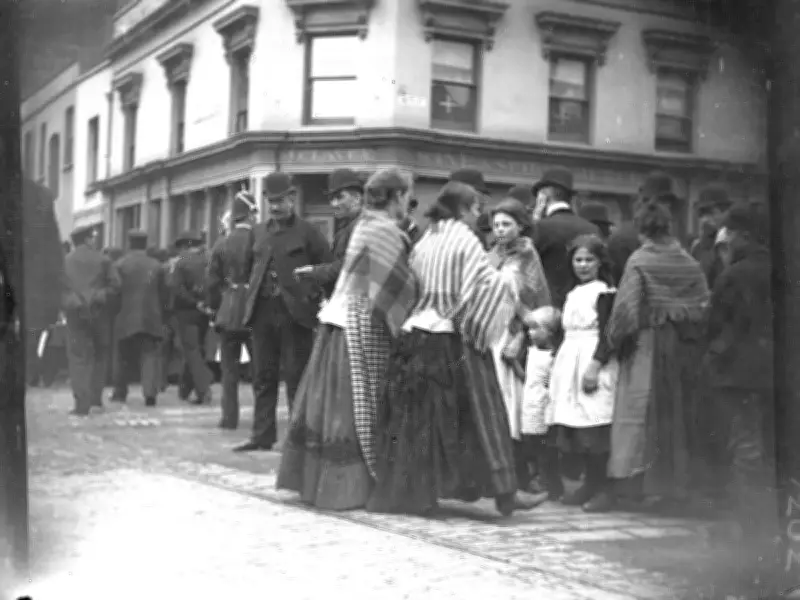
Two Cardiff streets so crime-ridden they were wiped from the map in the late 1800s have been revealed as the city's first red-light district. Charlotte Street and Whitmore Lane, which operated from the 1830s until the 1870s, were described as "dens of infamy, shoeless feet, broken heads and flat noses" where "every stone of the pavement had been stained at one point with human blood".
A hidden chapter of Cardiff's history
Almost 200 years ago this small corner of Cardiff was crammed with brothels, public houses, and disreputable characters. The two thoroughfares were deemed so infamous they were entirely erased from the map during the late 1800s.
Today, the same spot is surrounded by towering modern buildings as ever-growing traffic moves through the city. The Golden Cross pub remained as the only survivor from that chaotic era until it closed earlier this year.
Life in the Victorian red-light district
The two former streets were home to a community of pimps and prostitutes, criminals, and rogues with nicknames such as Kitty Pig Eyes, Mary the Cripple, The Notorious Jack Matthews, Swansea Sue, Alec The Devil, Mrs Prothero, Billy Shortlegs, Sarah Nips, and Harry Kickup.
The Glamorganshire canal – known as The Black Ribbon – snaked its way beside the two streets, with numerous boatmen serving double duty as 'bullies' (the Victorian term for pimps). Brutal by any standard, figures like Ned Llewellyn, Liverpool Dick, and the aptly-named John Thomas would, according to an 1847 Cardiff Merthyr Guardian report, "kick and knock the poor girls about as a boy would a football".
As a result the waterway became infamous for suicides, with reports of prostitutes throwing themselves into its waters in desperate bids to escape their hellish lives. Newspaper reports also document countless unwanted babies found in the water over the years – some drowned, others suffocated beforehand.
The most harrowing incident described how one newborn's mutilated body was seen floating and had to be pulled out with a spade by the unfortunate labourer who discovered it.
Researching a hidden chapter
Artist Anthony Rhys, from Beddau in Rhondda Cynon Taff, penned a book about the inhabitants of Charlotte Street and Whitmore Lane, uncovering what was previously a hidden chapter in the city's history. Speaking to WalesOnline previously he said: "There was nothing on the web about Charlotte and Whitmore, no books about them either, so it's been a slog – some the stuff I found out was very disturbing, especially the amount of violence that existed towards women."
He continued: "The newspapers of the day wouldn't publish bad language so they didn't give an accurate indication of how people spoke, most of whom were very rough. Luckily Glamorgan Archives have all the Petty Session books, the court transcribers of which were kind enough to write down loads of the obscenities used."
Shifting to the docks
After these two streets were wiped from the map, Cardiff's red-light district shifted to the docks. Fuelled by the "black gold" mined from the nearby Valleys, trade flourished and by the 1880s Cardiff had transformed from one of Wales' smallest settlements to its biggest. During this period, its port was handling more coal than any other country.
Yet alongside its commercial prosperity, it also gained a notorious reputation for its red-light district, illegal gambling dens, rowdy pubs, and opium houses. An account from an 1870 newspaper depicts the darker side of the locality. It stated: "A sketch of Bute Street would not be complete without another feature, and that the most unpleasant of the whole. The curse of this street in particular, more than any other in Cardiff, is the horde of debased women who parade its pavements, and are everywhere and always to be seen."
Author and historian Neil Sinclair, who was himself raised by the docks, previously explained: "Tiger Bay's seedy and criminal side tended to be along Bute Street. Mothers would make up reasons for their kids not to play on there. 'There's too much traffic,' they would say. There could have been something going on in one of the cafés parents didn't want us to see."
Even so, the sense of community remained strong. "If a lady of the night lived in the local area she held the respect of her fellow sisters," Neil explained. "Children were told to call her 'aunty' without knowing her nightly endeavours. But it was tolerated as long as you lived with respect."
Later patterns of prostitution
Academic Simon Jenkins, in his PhD research examining prostitution in Cardiff, found that until the mid-1920s multiple neighbourhoods throughout the city were recorded as hubs for prostitution, though two areas were particularly prominent: the city centre and Butetown. He observed: "Evidence from petty sessions registers indicates that, until the early-1920s, commercial thoroughfares in the city centre were the most prominent spaces of street prostitution. Lined with banks, businesses, shops, hotels, theatres, and public houses the thoroughfare of St Mary Street offered opportunities for prostitutes to target potential clients."
His investigation uncovered that during 1915 to 1919, St Mary Street represented the most frequent location for arrests, with 177 recorded from a citywide total of 698. During the period 1920 to 1924, magistrates processed 203 women apprehended on St Mary Street from an overall total of 663 arrests across the district.
Westgate Street emerged as the second-most-prevalent street linked with prostitution in the city centre. Throughout 1910 to 1914, a total of 677 arrests relating to street prostitution offences were documented in the dockland, making it second only to the city centre's 782 arrests. Bute Street appeared less regularly in records during 1915 to 1919 as operations shifted to other dock areas.
While the statistics reveal where arrests occurred, they don't present the full story and frequently mirror where police resources were concentrated or where officers habitually patrolled. For instance, under the 1824 Vagrancy Act, a constable merely needed to identify a 'common prostitute' to effect an arrest, indicating that a proportion of arrests don't necessarily correspond with where prostitution genuinely took place. Mr Jenkins went on to say: "There are, therefore, clear difficulties in identifying the spaces of Cardiff's prostitution and the spatial uses of those who sold sex. While elements of prostitutes' spatial practices can be inferred the evidence mainly offers a map of police concerns over particular areas that were linked to prostitution but not continually driven by a perception of prostitution as a distinct problem."