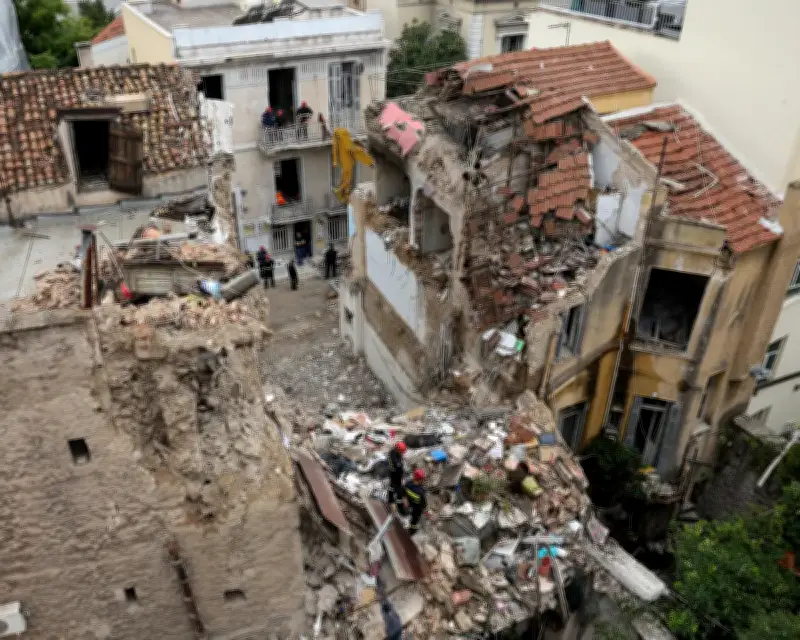
Greek authorities are trying to determine what caused a two-storey apartment block in the historic Plaka district of Athens to collapse “in a matter of seconds”, killing six people. The victims, including four American tourists, were discovered on Saturday, more than 24 hours after the early morning explosion.
Victims recovered from rubble
Emergency teams found the bodies of three women and three men, according to the fire service, which stopped short of identifying them. Among the dead were a Briton and his Greek wife, aged 77 and 78, who lived in a flat on the building’s upper floor.
“The bodies have been taken to the morgue where postmortems will be conducted,” said Paris Charlaftis, the city’s vice-mayor, in a telephone interview from the blast scene. “Our focus now is on the explosion’s cause. What could have happened to bring the building down in a matter of seconds?”
Search and rescue efforts
Rescuers used thermal cameras and geophones, which detect deep subsonic frequencies, in the hope of finding survivors. Earth-moving machines and specially trained search dogs were brought in to move and comb mounds of rubble through the night.
Before the bodies were pulled from the ruins, police had put the missing at six, saying four were Americans staying in a short-term rental on the building’s first floor. Two brothers and their wives, all four were due to fly to the US on Friday, just hours after the explosion.
“When they failed to turn up for the flight they had checked into only a day earlier, that gave us a further lead,” a source said. “It became clearer that they must have been there when the blast occurred.”
Investigation and speculation
The Briton, described by Charlaftis as partially disabled, lived with his wife on the second floor. “He had kinetic issues, and it was thought likely they, too, were in the building [at the time of the blast].”
Plaka, nestled around the foot of the fifth-century BC Acropolis, is especially popular with tourists, drawing thousands of visitors daily. The mayor of Athens, Haris Doukas, who rushed to 15 Lysikratous, where the mid-20th-century building had once stood, described the incident as an “unprecedented disaster”.
At least three people were injured when the explosion occurred at 7.30am, shattering windows of nearby buildings and scattering debris. A motorist driving down Lysikratous described how his car was lifted into the air by the force of the blast, which some likened to an earthquake, others to a bomb. Emergency workers were seen hastily removing two women on stretchers from a building next door who had been wounded by flying debris.
Speculation is rife that a gas leak triggered the collapse, but officials said there were many “cogent theories” at play. Fears of a leak emanating from the first-floor short-term rental were among them.
As part of efforts to address a burgeoning housing crisis, Greece’s centre-right government has sought to ban short-term rentals in Plaka, clamping down on permits and tightening regulations. On Saturday, criticism grew over the ability to “properly control” establishments that were often unregulated.
“This awful incident will fuel further debate over who inspects short-term rentals that no one who lives in Plaka wants anyway,” said Giorgos Zafeiriou, an architect who heads the local residents’ committee. “Hotels have chambers that regulate them but who inspects and controls Airbnb and serviced apartments that often may not be up to par?”
Civil protection crews and emergency disaster management teams have been ordered to remain on site until the cause of the explosion is found, officials said. “It was a huge explosion, so getting to the bottom of it must now be the priority,” added Zafeiriou. “Six people have lost their lives.”