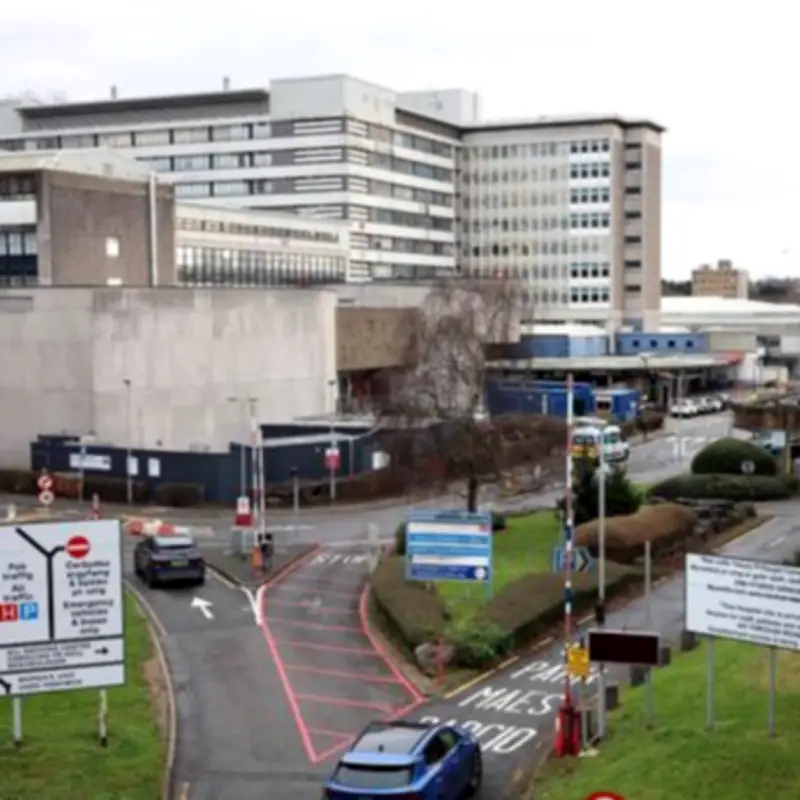
Procedures in operating theatres and post-surgery recovery rooms have been tightened at Wales' largest hospital after a patient unexpectedly deteriorated and died, an inquest heard.
A police investigation was launched when bowel cancer patient Donald Gough died at the University Hospital of Wales (UHW), Cardiff, and unexplained high levels of insulin were found in his system. Mr Gough was not diabetic and there was no reason for him to have been given the drug.
Senior UHW nursing and pharmacy managers told the sixth day of the inquest into his death insulin is no longer stored in fridges in the anaesthetists' room. It is now kept in the post-operative recovery area with other stocked drugs.

Mr Gough died in the hospital's ICU on November 5, 2022, after the operation to remove secondary tumours in his liver. Surgeons had assessed his risk of dying from the surgery as 5% at most.
The pathologist recorded the cause of Mr Gough's death as encephalopathy – a broad term for a condition causing brain impairment – caused by hypoglycemia (low blood sugar). But it remains a mystery as to how unexplained high levels of insulin got into his system, the hearing at Pontypridd Coroners' Court has heard.
Giving evidence on Monday, June 8, Clare Wade, director of nursing for the clinical surgery board at Cardiff and Vale Health Board, added that patient handovers after surgery have also been tightened. When patients are handed over by the consultant anaesthetist for their surgery to recovery unit doctors they must now log handover on a form to keep all records clear, the inquest was told.
Requests for blood gas readings, the results of those tests, and who requested and analysed them must also be recorded.
Over the last week the inquest has heard Mr Gough's consultant anaesthetist break down as he admitted his handover of his patient's care was inadequate. Dr Benjamin Holst admitted he should not have left Mr Gough until he had woken from surgery. He, and other staff, denied administering insulin mistakenly and said it was unknown how it had come to be in Mr Gough's system.
The 77-year-old patient was treated for hours with drugs to counteract opioid effects when he failed to wake from liver surgery to remove secondary tumours. Medics thought Mr Gough was not waking from surgery owing to the opioid fentanyl given as a local painkiller at the end of the procedure. It was only later that he was found to have been mysteriously injected with insulin.
Cardiff and Vale University Health Board contacted South Wales Police and a joint investigation was launched when Mr Gough was found to have unexpected high levels of insulin in his system. Police liaised with the Crown Prosecution Service but there is currently no criminal investigation, the force has confirmed.
Chief inspector Matthew Powell, who was involved in the police probe, and has attended the hearing but will not be called to give evidence, was asked by the coroner David Regan if he wished to say anything having heard six days of evidence from medics and hospital managers. Mr Powell told the hearing on Monday he had heard nothing in the inquest which suggested criminality.
He said he was still waiting to hear back from the suppliers of the insulin and a local pain relief drug administered to Mr Gough as to whether they ever shared the same production line. Asked whether it would be possible to muddle vials of insulin with other drugs during Mr Gough's surgery, or afterwards, nurses, consultants, the lead surgeon, and theatre staff all insisted it was not. However it has been acknowledged that at some stage high levels of insulin came to be in his system for no medical reason and with no explanation.
On Monday the coroner also called Dr Abraham David Theron, UHW clinical board director of surgery and consultant anaesthetist, to give his expert opinion on how drug vials are used and what they look like. Dr Theron, who had no direct role in Mr Gough's care, said he did not believe that the contents of drug containers, once stored, could be tampered with. While local anaesthetic given to Mr Gough was in one-off ampules, insulin is stored in quantities for more than one use but in clearly-differing containers. No other drug comes in a bottle with a bung like insulin, Dr Theron told the hearing.

The coroner admitted he was 'trying to understand how this patient received insulin, on the basis of agreed evidence, probably towards the end of his surgery.' He asked Mr Theron: 'Is there any way you could understand how this patient came to have received, during that procedure, insulin in injectable form?' Dr Theron replied: 'No.'
Counsel for Mr Gough's family, Bramble Badenoch-Nicolson, raised the issue of UHW theatre staff shortages. The surgeon and consultant anaesthetist in charge of Mr Gough's eight-hour operation had not had breaks or junior staff cover. Liver surgeon Girogio Alessandri had already told the hearing that he would usually have a junior doctor registrar throughout but one was only available for part of the procedure. Consultant anaesthetist Dr Holst, who was at times tearful in his evidence at the start of the inquest, told how he could take neither food nor comfort breaks as there was no assistant anaesthetist as there should have been.
Asked about this, Ms Wade insisted: 'There is always an opportunity for someone to call for a break, if needed, during surgery. It is up to them to decide if they need a toilet break or break for food.' She said there is a 24-hour theatre with two anaesthetists, one of whom is usually available to help, and 'there is some flexibility.'
Pressed by Ms Badenoch-Nicolson on how safely drugs are stored in UHW's operating theatres, she added: 'The health board is doing as it is advised and following the medicines code of conduct for storage.' She said controlled drugs are locked up and checked. Insulin, though not a controlled drug, is also locked up. 'I think we are doing all the checks we need on storage,' said Ms Wade.
Asked why the surgeon carrying out Mr Gough's operation had gone home afterwards to get equipment for the educational video of the procedure, and then returned to check his patient in the recovery room, Ms Wade said UHW now has 'a new process' so that all the recording kit is at the hospital. In short, she denied UHW had staff shortage issues, problems with staff being unable to take breaks during surgery, or problems with drug storage and educational filming of operations.
However, she said post-surgery handover and blood gas test procedures have been tightened and insulin is now stored in the recovery rather than anaesthetists' room. The hearing continues.