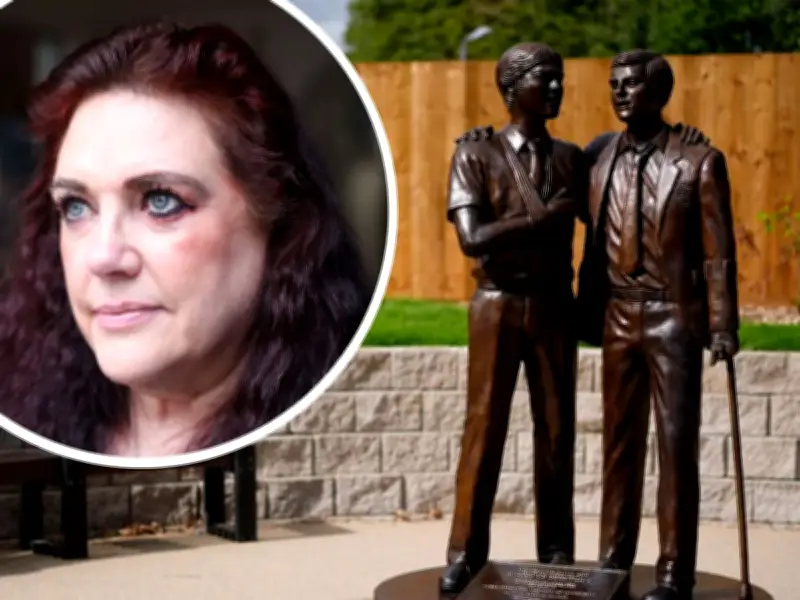
Carol Grayson, a campaigner from Jesmond, described the unveiling of a memorial to haemophiliacs, including her late husband and his brother, as a "very emotional and poignant day". The memorial was unveiled at Lord Mayor Treloar's College, where Carol's husband Peter Longstaff and his brother Stephen both attended as boarders during the 1970s and 1980s.
The new memorial honours 122 haemophiliacs who attended the school, the majority of whom have died as a result of the contaminated blood scandal. This saw patients with the blood clotting disorder given NHS blood products that contained lethal viruses such as HIV and hepatitis.
Youngsters like Peter and Stephen were told their treatment at the school would be "nothing but good". Carol's research, however, revealed how youngsters like them had in fact been subject to "experimentation".
Inquiry findings on Treloar Boys
Sir Brian Langstaff's final report from the independent Infected Blood Inquiry found that "very few" of the haemophiliac pupils who attended the school during the 1970s and 1980s "escaped being infected". The report concluded that the pupils, commonly referred to as the Treloar Boys, had been treated as "objects of research" and highlighted how they were experimented on without their knowledge by NHS clinicians, who knew the dangers it posed.
The memorial at the school is a statue depicting two pupils, one with a sling and another holding a cane, embracing each other. The inscription at the bottom reads: "Remembering 122 haemophiliac pupils of Treloar's. Infected as children, victims of unethical research." It also features a quote from Sir Brian Langstaff, chairman of the public inquiry, which says: "This disaster was not an accident."
Campaigner's personal account
Carol, whose husband Peter died at just 47 in 2005, more than a decade after his younger brother Stephen, told ChronicleLive: "Today is a very emotional and poignant day as I will be watching livestreamed the unveiling of a memorial statue to the 122 haemophiliacs that attended Lord Mayor Treloar College, Hampshire in the 1970s and 1980s and who received Contaminated Blood. Many have since died."
She added: "Both my husband Pete and my brother-in-law Stephen were pupils at the school and were the subjects of unethical research after receiving imported US factor concentrate injections to treat their inherited condition where their blood did not clot properly. Both boys were infected with HIV and hepatitis viruses which led to their deaths and a great deal of heartache for our family who also experienced immense prejudice and discrimination."
Carol recalled how, in the 1990s, her own research alongside Peter had revealed the extent of the experimentation and clinical trials taking place at the school. This included a tranche of documents discovered in a Newcastle solicitors' office, which Carol returned to the Government and made public. She added that when she first revealed aspects of this publicly, she was subject to abuse and derision.
Carol continued: "The decades of campaigning for truth and justice have taken a significant toll on my physical and mental health which is why I am unable to attend today in person."
Survivors' memories and memorial funding
Carol also highlighted, along with the Journal in the Bad Blood campaign during the 2000s, how the experimentation which went on had breached the Nuremberg Code. She added: "I hope the memorial at Lord Mayor Treloar and recognition of the boys suffering will finally bring peace to the families of those who died and those haemophiliacs who remain alive but whose lives have been affected forever."
Sir Brian's inquiry report found that from 1977, medical research was carried out at Treloar's "to an extent which appears unparalleled elsewhere" and children were treated unnecessarily with concentrates, particularly commercial ones rather than alternative safer treatments. The report found there is "no doubt" that the healthcare professionals at Treloar's were aware of the risks of virus transmission through blood and blood products.
Sir Brian said: "It is important that we keep a spotlight on the lessons of the inquiry and never forget the human tragedies at the heart of this scandal which has left long scars, not only in this Hampshire community but across the UK."
The memorial has been funded through the Cabinet Office, with additional support from Candour Productions, which created a documentary about the events at Treloar's, The British Blood Scandal - Poisoned at School, shown on ITV in May 2025.
Former Treloar pupils Adrian Goodyear, Steve Nicholls, Gary Webster and Richard Warwick spoke ahead of the unveiling. Adrian, 55, said that when he first attended the school it felt like a "new dawn", adding: "When I first arrived here with 10 other friends I was nine years old – we couldn't believe the place we were looking at: rolling country hills, swimming pools, canoes, a Jacobean mansion, it was just remarkable at first. We left school with death sentences," he told the Press Association, describing how he was infected with hepatitis and HIV while at school. "In 1985, a doctor tearfully said that I had two to three years to live. I was told this with five other boys and the doctor went round the room and said: 'You have… you haven't… you have… you haven't… you have got HIV'. I'm the last remaining boy in that room."
He said the memorial was important to keep the scandal "in the public consciousness" and to honour those who died. "When we were here we made promises… they died in front of us, one winter we lost five boys. I made promises to them, as did the other lads here today, that we would never give up, we would find out what happened."
Gary, 61, who was infected with HIV and hepatitis C when he attended Treloar's between 1975 and 1983, recalled how he was called to the doctor's office one dinner time as a child, was told he had HIV "and had two years to live". "For eight years we were experimented on, unethically treated, it wasn't needed, it didn't improve our lives," he said. "In fact, it hindered our lives and gave us viruses that have killed over 90 boys so far." He said that the memorial was important "to remember what happened and to make sure it never happens again".