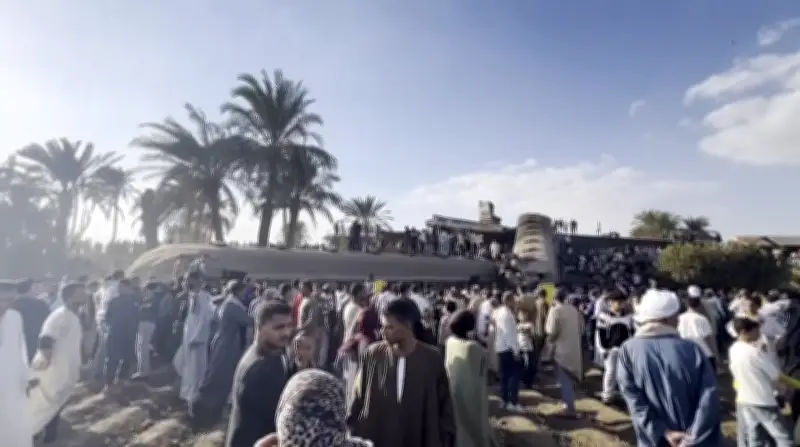
A train travelling from Giza to Fayoum, Egypt, slammed into the back of another train coming from Cairo, killing at least four people and injuring 88. Rescue teams are searching the wreckage for survivors and fear the death toll could climb.
The collision happened around 32 miles south of Cairo in Al-Ayyat, an area nicknamed the “Bermuda Triangle of train crashes”. Several carriages fell off the tracks and down a verge as the Giza train struck the rear of the Cairo-bound train.
Emergency response and casualties
Egypt’s health ministry said 52 ambulances were deployed to the scene. Fifty-four people were taken to Al Wasta Hospital in Beni Suef and 10 to Al Ayyat Hospital in Giza. Cranes have been brought in to help clear the wreckage.
President Abdel-Fattah el-Sissi has ordered an investigation into the crash. Witnesses said locals rushed to the scene to help passengers escape overturned carriages.
History of crashes in the area
The location has seen deadly incidents before. In 2002, Egypt’s worst-ever train disaster occurred there when an explosion burnt several carriages to the ground, claiming 383 lives. Last September, a train driver and his assistant were injured after two freight trains collided in the same district.
Separate crash in Spain
The Egypt crash follows a separate incident in Spain, where 68 people died after two high-speed passenger trains collided in the province of Toledo. That crash happened at Urda station, where two carriages fell down an embankment.
The Spanish collision involved a Renfe AVE that left Madrid at 8am bound for Seville and a train run by private operator Iryo, between the villages of Los Yebenes and Urda. The Iryo train carried 147 people and the AVE train carried 297. Spain’s Transport Minister Óscar Puente has resigned following the crash.
The October 28 crash was the second major smash on the Madrid-Seville line this year. In January, a train derailed and collided with another travelling in the opposite direction further south on the same route, claiming 46 lives. Spain’s high-speed rail network, the world’s second-largest after China’s, had not suffered a fatal crash in more than three decades before this year.