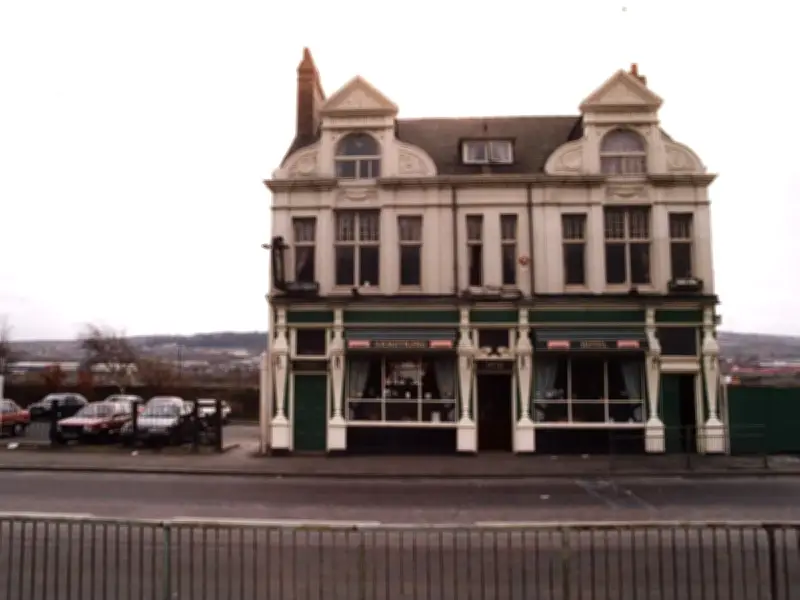
The Armstrong Hotel, the last pub on Newcastle's Scotswood Road, was destroyed by fire in November 1995, bringing to an end 150 years of tradition on the famous thoroughfare. The road had been immortalised in the unofficial Geordie anthem Blaydon Races, written in 1862 by Geordie Ridley.
A Road Steeped in Tyneside Folklore
Scotswood Road runs west, close to the north bank of the River Tyne, for around four-and-a-half miles, from the city centre through Cruddas Park, Elswick, Benwell, then on to Scotswood and beyond. The road once boasted a dense industrial corridor lined with factories, terraces, pubs, shops, and its own cinema. Since the mid-1980s, it has become a wide dual carriageway flanked by business parks, modern housing estates, and only a handful of surviving older buildings.
In November 1995, the Chronicle reported: “Gannin’ along the Scotswood Road will never be the same after the fire which destroyed the last pub. With the loss of the Armstrong Hotel, we have lost part of the heritage of the North East. Now Scotswood Road is just another traffic route.”
The Armstrong Hotel and Its Legacy
The pub was also known locally as the Hydraulic Crane, a device invented by Lord Armstrong, whose sprawling, world-famous engineering and armaments works had come to define the area, employing thousands of people over many decades. The Armstrong Hotel stood on the border between Elswick and Benwell and was the final old-fashioned boozer on a road which once boasted a watering hole seemingly every few yards. From the 1950s, an ongoing project of mass demolition of what was deemed “slum housing” saw numerous pubs disappear as the community declined.
A local historian told the Chronicle: “There were around 50 pubs altogether over 150 years from 1830 - but never more than 27 at one time. Some of the locals used to pride themselves on going from one end to the other and having half a pint in each one.”
A Definitive List of Lost Pubs
A definitive list of all the pubs that once lined Scotswood Road is impossible to produce with total accuracy, but the following traded at one time or another after 1830: Atlas, Armstrong Hotel, Bath, Blast Furnace, Blenheim, Boat House Inn, Bridge End, British Lion, Clasper Arms (formerly the Park Road), Crooked Billet, Delaval Arms, Dene, Duke of Cumberland, Durham Ox, Elswick Hotel, Elswick House, Falcon, Farmers' Rest, Flax Mill (formerly Caledonia), Foresters Arms, Forge Hammer, Fountain, Freemasons Arms, Gladstone Hotel, Golden Eagle, Golden Fleece, Grahams Arms, Grapes, Green Tree, Gun Hotel, King's Head (later Courtyard), Lincoln, Lord Wharncliffe, Maid of Derwent, Marlborough (later Rockies), Mechanics, Miners Arms, Moulders, Ord Arms (later Robin Adair), Ordnance, Plimsoll, Rifle, Robin Adair (original 19th century), Rokeby, Royal Oak, Shell, Shipwrights Arms (formerly New Burnt House), Somerset, Vulcan, and Whitworth.
Today, Scotswood Road is a symbol of the region’s heritage, a reminder of Tyneside’s vanished industrial past where only fragments of the old streetscape survive. While the Armstrong Hotel was the road’s last traditional, old-school pub, a handful of modern bars trade in 2026, mainly towards the eastern end.