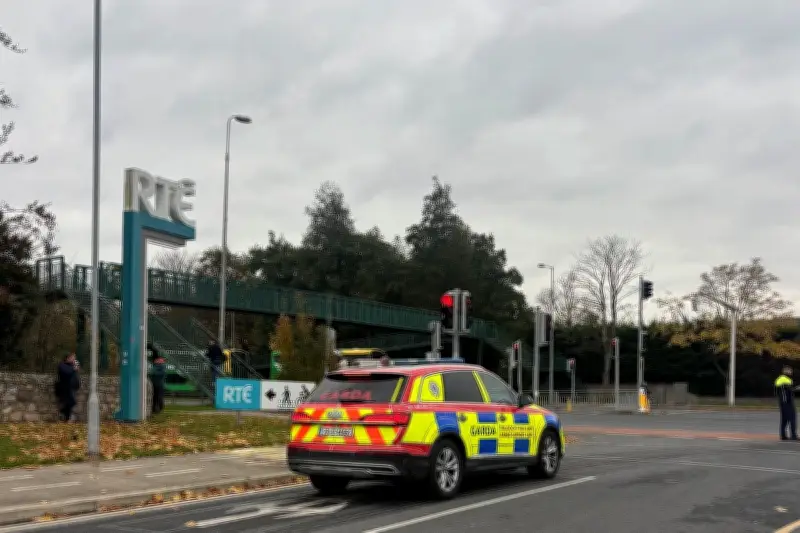
Staff at Ireland's national broadcaster may have to wait several more hours before returning to its Dublin headquarters after a bomb threat forced the evacuation of its television and radio buildings, the director-general has said.
The Irish Government confirmed that other media organisations in the country were also sent “very serious” threats on Friday morning, with authorities working to identify those responsible.
Broadcaster forced off air
RTÉ Radio One went off air around 9am on Friday, replacing its programme Today With David McCullagh with a pre-recorded programme of music. The show returned later in the morning, with McCullagh presenting from a mobile broadcasting truck as gardaí continued to search the RTÉ buildings.
Staff, including radio and television presenters at the Montrose campus, were told to leave the studio buildings after the email was received. Children being looked after in a creche on site were also evacuated.
Threat details emerge
McCullagh later told listeners the threat warned of a bomb which would explode within 45 minutes. Threats were also sent to Virgin Media, Newstalk and the Irish Independent.
RTÉ presenter Sarah McInerney said the sender of the email claimed to have been part of a group behind other recent threats against airlines, and had claimed an operative had planted an explosive device in the building. Irish police, including the armed response unit and sniffer dogs, attended the site.
Government response
Taoiseach Micheál Martin told RTÉ Radio One: “It is worrying and we take the threat seriously. Obviously, because the safety of the Irish public is our first priority, and indeed across Europe.”
“Yesterday, there appeared to be co-ordinated efforts to disrupt air travel and so forth. The gardaí, the Defence Forces, cyber and aviation authorities are working to establish who’s behind this, as are their European counterparts. It’s not determined yet whether it’s individuals or a co-ordinated attack. However, we will go after this to identify who’s responsible and to hold them accountable.”
Mr Martin said there would be a “very significant security operation” in place for the European Political Community meeting on Thursday next week and the informal meeting of EU heads of state on Friday.
“We’ve been alive to this risk since before our presidency and our agencies have worked extremely hard on this, and we have had meetings even in the last week in preparation for next week,” he said.
“It does highlight, and I would say this to all of our main representative bodies in society, the security stakes are much higher in this period of time than they have been for a long time in Europe.”
He added: “We have the largest number of prime ministers ever at the one time in our country (for the EU Council events) and that does call for a very significant security operation. The gardaí are to be commended on the extraordinary preparation that they’ve put into this, as have our Defence Forces, and both are working very closely together and working with like-minded agencies across Europe, so we’re confident in terms of our capacities and in terms of the preparation we’ve put into this.”
Tánaiste Simon Harris said the Government is “alive” to the risks associated with the types of threats received by Irish media outlets on Friday.
“There’s a very serious and evolving situation this morning, and obviously this comes on the back of a number of bomb scares yesterday and in recent days in relation to airlines as well,” he told Cork 96FM.
“So this is evolving in real time. I think it’s fair to say we don’t yet know who is responsible for what’s happening this morning. We don’t yet know whether it’s an individual behind this effort or some form of a co-ordinated effort.”
Return to buildings delayed
RTÉ director-general Kevin Bakhurst said around midday on Friday that it may be another “few hours” before staff can re-enter its buildings.
“On the basis of the information we had, we decided that we wanted to put the safety of the staff first and evacuate the buildings,” he said. “It’s a disgraceful attack on the media, on free media, and unfortunately, probably where it comes from, they don’t really appreciate the importance of free media.”
Seamus Dooley, the secretary of the National Union of Journalists in Ireland, said the threat was a “deeply disturbing” attack on press freedom.
A Garda spokesperson said: “An Garda Síochána is aware of a threat made against media organisations here and in Europe. An Garda Síochána has been liaising with the Irish media organisations and the threats will be investigated.”