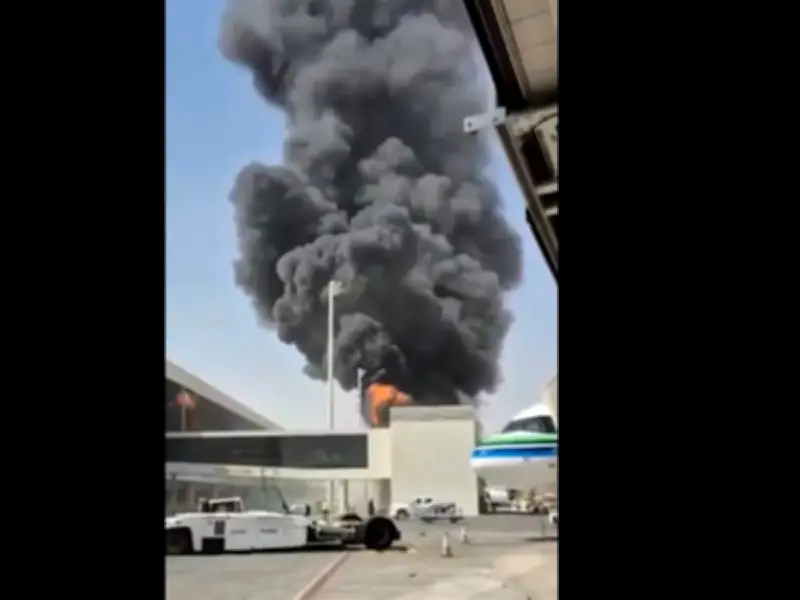
A missile strike on King Khalid International Airport in Riyadh has killed 12 people and injured more than 300 others, according to civil aviation authorities. Several victims are in critical condition. The attack is the deadliest in any Gulf Arab country since the start of the Iran war, with battlefronts now extending to include the recent escalation in clashes between Iran-backed Houthi militants in Yemen and Saudi-supported government troops.
Victims and nationalities
The statement, which did not attribute responsibility for the assault, revealed that the fatalities comprised four Saudi nationals, two Bangladeshi citizens, a Palestinian, a US citizen, an Egyptian, a Jordanian, a Syrian and a Sudanese national. It confirmed that the wounded are receiving treatment across multiple hospitals.
The strike – the most recent in a series targeting King Khalid International Airport over recent days – is anticipated to intensify Saudi demands on allies, including the United States, to furnish military backing for the kingdom. Following Saturday afternoon's attack, US President Donald Trump indicated he was considering whether America should participate in Saudi operations against the Houthis.
US response and previous attacks
The Houthis had previously claimed responsibility for earlier assaults this week on King Khalid International Airport that resulted in three Saudi deaths, including a pilot. On Saturday, a missile hit a facility containing terminals 3 and 4 for domestic services, according to a regional official.
Regarding potential intervention, Mr Trump stated: "We may. We're going to look at it. We just found out about the recent attack. So we'll make a decision. We move very quickly."
Airport operations and regional impact
The escalation in strikes, including those targeting other Saudi airports, military installations and oil infrastructure, has occurred during the week following a Saudi-led coalition's launch of a significant military campaign against the Houthis. There was no immediate response from the rebels, who earlier on Saturday claimed Saudi Arabia had hit Sanaa International Airport in the Houthi-controlled Yemeni capital.
Saudi civil aviation authorities previously stated that airport operations were halted and the scope of casualties and damage was under review. An official notice to pilots indicated the suspension would last until midnight. The airport maintained a substantial police presence, with all access points sealed off, and illumination throughout the facility was reduced.
Aircraft were redirected to alternative destinations, according to the Flightradar24 tracker. Nations including the United States, Britain, Germany, Australia and Canada advised their citizens to steer clear of the airport.
Wider conflict and diplomatic efforts
The strikes on Saudi Arabia, the globe's leading oil producer, have unsettled markets and the region. Nevertheless, the Saudi energy ministry hours after the most recent incident was still championing a major international energy conference scheduled to commence in Riyadh on Sunday.
Combat in Yemen between the Houthis and Saudi-supported Yemeni government troops has intensified, with the Saudi-led coalition delivering aerial backing for government forces trying to overturn recent Houthi advances along the Red Sea. Those advances provided the rebels with enhanced monitoring of shipping along a route that serves as a vital alternative to the Strait of Hormuz, where Iran has been launching attacks on vessels.
Although the Houthis have informed the AP and others that they are exclusively targeting Saudi shipping as part of a blockade in response to one imposed upon them, worries about broader assaults remain. The Houthis had previously struck other vessels after the Gaza conflict commenced, describing it as solidarity with Palestinians. A US bombing offensive severely curtailed that activity.
Saudi Arabia is running short of missile interceptors and has requested France, Britain, Pakistan and Egypt to deploy air defence assistance to the area, regional officials told the AP last month, with one highlighting that the US has witnessed its own supplies diminish during the conflict with Iran. Officials have stated US support has encompassed intelligence sharing, target identification and planning for the most recent offensive against the Houthis.
On Saturday, Saudi Arabia announced its foreign minister and Omani counterpart discussed by telephone the significance of "supporting diplomatic solutions to de-escalate tensions" in the region. Oman, which sits opposite the Strait of Hormuz from Iran, has occasionally served as a mediator in the area.
Meanwhile, Saudi authorities cautioned the public this week that "filming, publishing or sharing information related to countering missiles and drones and their impact sites exposes you to legal liability".