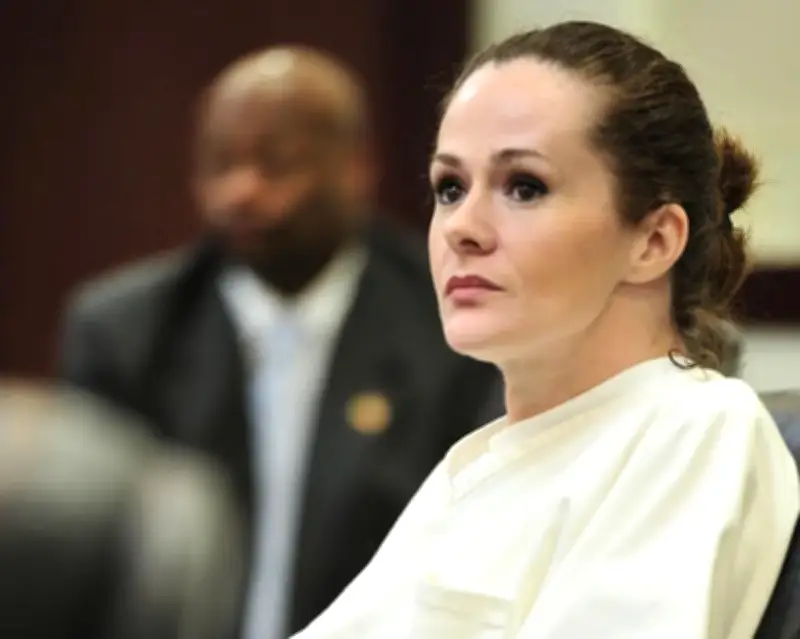
A former lawyer for Christa Pike says he was not surprised that Tennessee botched its attempt to execute her because attorneys had warned that problems accessing her veins could make the procedure dangerous and potentially cruel.
James Crowson, who represented Pike during part of her post-conviction appeals, said he had followed the case from afar before the failed execution at Riverbend Maximum Security Institution in Nashville on 30 September.
“Well, I can’t say I’m surprised,” said Crowson, who represented Pike while working for the Tennessee Post-Conviction Defender. “I knew that there were a number of defense filings saying that she had compromised veins, and that was going to be a difficult and perhaps cruel procedure for her because it was going to put her at risk for exactly what happened.”
Pike remains hospitalized on ventilator
Pike, 50, on Sunday remained hospitalized and on a machine helping her breathe after Tennessee administered two doses of pentobarbital that failed to kill her, as far as an attorney now representing her knew, the lawyer said on the CNN program State of the Union.
“She’s still in the hospital, on a ventilator, critically ill – we don’t really know the prognosis yet and may not know for several days,” Stephen Ferrell, an assistant federal defender, said to CNN host Jake Tapper.
Ferrell told Tapper that he had not been able to personally see Pike, but “this is the extent of what we know”.
Pike’s attorneys allege improperly placed intravenous lines allowed the drug with which she was injected to enter tissue rather than her bloodstream, leaving both arms severely injured.
State maintains protocol was followed
The Tennessee Department of Correction has maintained that it followed every step of the state’s lawful execution protocol. And the department said the protocol did not permit additional procedures after the steps carried out on Wednesday.
Crowson said the accounts that officials followed the written protocol and that the execution was badly mishandled are not necessarily contradictory.
“The state comes up with a protocol and, typically, states that are inclined to impose the death penalty don’t really include medicine or science in the discussions when they’re coming up with these protocols,” he said.
Crowson said the reported injuries appeared consistent with the concerns raised before the execution, citing the theory that the drug entered surrounding tissue instead of circulating properly through Pike’s bloodstream.
Case highlights age disparity in sentencing
Pike was sentenced to death for the 1995 torture and killing of 19-year-old Colleen Slemmer, a fellow student at the Knoxville Job Corps. Pike was 18 at the time. Her then boyfriend and co-defendant, Tadaryl Shipp, was 17 and was ineligible for the death penalty. He received a sentence of life imprisonment.
That gap in punishment based on a small age difference remains significant to Crowson. He said it illustrates what he views as the capricious nature of capital punishment.
“She’s a few months older than the young man that was engaged in the same conduct, and she’s been fighting for her life now for 32 years,” Crowson said. “He’s still in prison, but hasn’t been subjected to the death penalty.”
He said the age of 18 that was decisive for Pike “just seems like an arbitrary number”.
Crowson represented Pike during a stage of her post-conviction case about 16 years earlier and said he visited her “dozens of times” on death row. He said he last spoke with her in 2009.
He described Pike at the time as “very superficially charming” and attentive to people around her. But he said the person he knew bore little resemblance to the teenager whose crime sent her to death row.
“I never saw the Christa that committed those crimes that put her in prison,” Crowson said. “That person exists, obviously.”
The core of the post-conviction appeal, he said, was ineffective assistance of counsel. His team argued that Pike’s original attorneys failed to adequately present evidence about her mental illness, brain damage and history of severe childhood abuse during the sentencing phase.
Pike ultimately exhausted her appeals without ever getting relief, despite her attorneys’ offering evidence of being diagnosed with bipolar and post-traumatic stress disorders.
“It took me numerous years to even realize the gravity of what I’d done,” Pike had said in an earlier petition for clemency. “Even more to accept how many lives I affected. I took the life of someone’s child, sister, friend. It sickens me now to think I had the ability to commit such a crime.”
Crowson more recently said “there was a lot that was left out” at the time of Pike’s conviction.
“Would it have made a difference? I don’t know. There are a lot of people who feel very strongly, and her crime was grisly and horrifying.”
Fallout widens after failed execution
What happens next depends on whether Pike ultimately survives the botched execution – and, if she does, the extent of any lasting injuries.
Crowson said he expects intense pressure on Bill Lee, Tennessee’s governor, to commute Pike’s sentence to life imprisonment if she recovers. If she suffered serious neurological damage, he said, questions about her competency would become central to any attempt by Tennessee to execute her again.
The fallout of the botched execution widened on Saturday when Lee announced Frank Strada, the Tennessee Department of Correction commissioner, would resign later in October. Lee has ordered an independent review and halted executions in the state for the remainder of the year.
Strada’s resignation was a predictable consequence of a botched execution now under national scrutiny, according to Crowson, who said: “Whenever you have a disaster like this, there’s going to be some fallout.”
Furthermore, Pike’s was at least the fifth execution Strada had botched since 2022 in Tennessee as well as Arizona, where he previously worked, according to death penalty lawyers.
Crowson said he hopes that Pike’s case results in the government taking a closer look at the death penalty as a functional legal punishment. He said there is a clear pattern between people who are sentenced to death and their history of trauma and mental illness not being accounted for during trial and sentencing.
“I think we as a nation have a strange relationship with mental illness,” he said. “It’s just so often discounted and mocked. It’s unfortunate.”