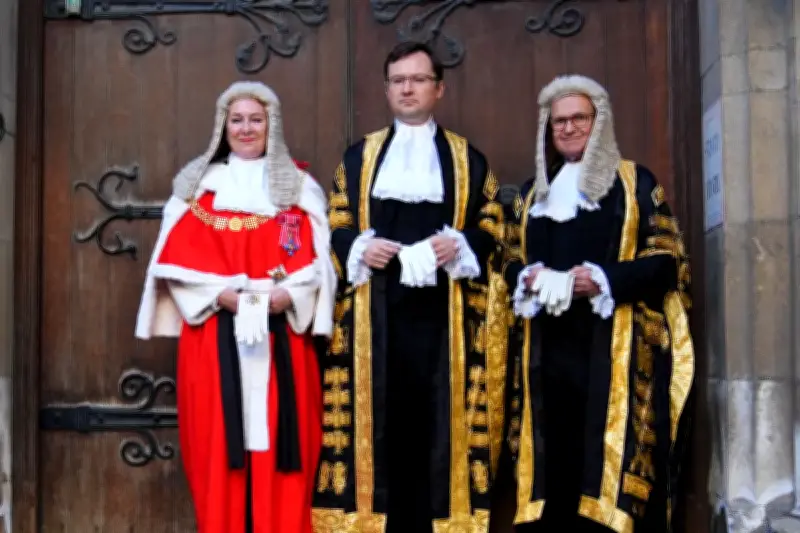
Justice Secretary Alex Norris was sworn in as Lord Chancellor on Thursday, pledging to defend the judiciary’s independence and be “ambitious” in efforts to reduce Crown Court backlogs. The MP for Nottingham North and Kimberley told England and Wales’ most senior judges that he would “bring with me a profound respect for the institutions that make our country great”.
Ellie Reeves and Andy Slaughter were also sworn in as Attorney General and Solicitor General respectively at the ceremony at the Royal Courts of Justice in central London on the first day of the new legal year. The ceremony coincided with around 700 prisoners being released from jail on Thursday as part of the Government’s move to free up prison spaces, with the Conservatives claiming that the public were being put at risk.
Pledge to defend judicial independence
In his speech, Mr Norris said he felt “greatly” the responsibility to “respect the rule of law (and) defend the independence of the judiciary”. “I reaffirm my commitment to these duties, and I take them extremely seriously,” he said. Mr Norris also said confidence in the criminal justice system was negatively affected by the backlog of Crown Court cases, with figures released last month showing the number of outstanding cases is continuing to rise.
Ministry of Justice figures showed there were 80,829 cases still to be dealt with at the end of June, with the backlog almost doubling since 2020. Mr Norris said: “We must change that, and I will be ambitious, because the status quo is not good enough. I am clear that justice delayed cannot be justice diminished.”
Institutions and judicial security
He continued that “I strongly believe in institutions”, citing his own constituents, who he said “need institutions more than anybody, whether that is effective policing, whether that is a national health service, an independent judiciary”, and “frankly, the BBC”. This also included a “commitment to an international rules-based order” and emphasised “this Government’s commitment to the European Convention on Human Rights”.
Mr Norris also raised concerns about threats to judges’ safety, and pledged to “ensure that arrangements for judicial security keep pace with this evolving threat”. He is the first non-lawyer appointed as Lord Chancellor under a Labour government, succeeding David Lammy. Ms Reeves previously served as Solicitor General but was elevated to Attorney General in July, replacing Lord Hermer.
Judicial and Bar responses
The Lady Chief Justice Baroness Carr welcomed Mr Norris, Ms Reeves and Mr Slaughter to their roles at the ceremony and reiterated Mr Norris’ “statutory duty to defend judicial independence”. “That duty has many facets to it, but it includes a duty to speak out publicly in defence of that independence whenever necessary,” she said.
Baroness Carr continued that “national wellbeing and economic growth depend” upon the rule of law, and highlighted the “importance of a properly functioning, accessible and fair justice system”. Kirsty Brimelow KC, the chairwoman of the Bar Council, also told Mr Norris that he had to “hit the ground running”, highlighting “prisons at capacity and unacceptable delays through decades of under-investment” in the justice system. She said: “The Bar is alongside you, but we will keep pointing out that we are in dire need of new running trainers.”
Prisoner release context
Mr Norris’ swearing-in comes ahead of the expected release of around 5,000 prisoners over the next year in a bid to ease pressure on the overcrowded male prison estate. Figures show the number of people behind bars has jumped by more than 1,700 in the past three months, with ministers claiming the expanded early release scheme is needed to prevent the justice system from collapsing.
But shadow justice secretary Nick Timothy said the public would “pay the price” for the decision and that the policy was an “insult to victims”, with Victims Commissioner Claire Waxman warning that the Government’s confidence “is not yet matched by the reality on the ground”. Under a separate process introduced by the previous Conservative government, 13,325 prisoners in England and Wales were freed early between October 17 2023 and September 9 2024.