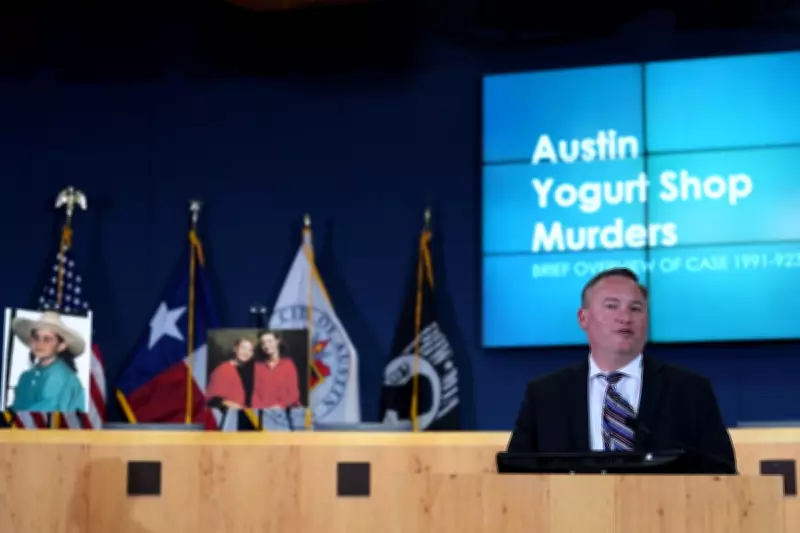
Texas Judge Formally Declares Four Men Innocent in 1991 Yogurt Shop Murders
A Texas judge has formally declared four men innocent of the brutal 1991 Austin yogurt shop murders, clearing their names more than three decades after the horrific killings that shocked the city. State District Judge Dayna Blazey affirmed the men's innocence during a poignant hearing in a packed Austin courtroom on Thursday, bringing a measure of closure to a dark chapter for the men, their families, and a community deeply shaken by the crime's brutality.
Judge's Declaration and Legal Significance
"You are innocent," Judge Blazey stated during the emotional proceedings. She described her order as "an obligation to the rule of law and the obligation to the dignity of the individual." This declaration of "actual innocence" could prove crucial for the men and their families should they seek financial compensation for years spent incarcerated or living under a cloud of suspicion.
Two of the four original suspects, Michael Scott and Forrest Welborn, were present in court with family members to hear prosecutors acknowledge their innocence. Robert Springsteen, who was initially convicted and spent several years on death row, did not attend. Maurice Pierce died in 2010 during a confrontation with police after a traffic stop.

Prosecutors Acknowledge Wrongful Prosecution
Travis County First Assistant District Attorney Trudy Strassburger opened the hearing by stating, "Over 25 years ago, the state prosecuted four innocent men ... (for) one of the worst crimes Austin has ever seen. We could not have been more wrong."
The announcement follows cold case detectives revealing last year that they had connected the killings to a suspect who died in a 1999 standoff with police in Missouri. This breakthrough came after an HBO documentary series in 2025 attracted new public attention to the unsolved crime, prompting investigators to re-examine evidence with advanced DNA science.
Background of the Case and Wrongful Accusations
The killings shocked Austin and confounded investigators for years. Amy Ayers, 13; Eliza Thomas, 17; and sisters Jennifer and Sarah Harbison, ages 17 and 15, were bound, gagged and shot in the head at the "I Can't Believe It's Yogurt" store where two of them worked. The building was subsequently set on fire.
Investigators pursued thousands of leads and several false confessions before the four men, who were teenagers at the time of the girls' deaths, were arrested in late 1999. The case against them unraveled over time:
- Springsteen and Scott were convicted largely based on confessions they insisted were coerced by police. Both convictions were overturned in the mid-2000s.
- Welborn was charged but never tried after two grand juries refused to indict him.
- Pierce spent three years in jail before charges were dismissed and he was released.
Prosecutors had intended to retry Springsteen and Scott, but a judge ordered the charges dismissed in 2009 when new DNA tests, unavailable in 1991, revealed another male suspect.
Emotional Testimonies and Personal Impact
During the hearing, family members spoke of lives ruined by incarceration and years of harassment by investigators. "My son's name has finally been cleared after more than 25 years of being called the monster, the murderer and everything else," said Phil Scott, Michael Scott's father. "Son, be proud."
In a statement read in court, Welborn recounted losing friends, struggling to maintain employment, and experiencing homelessness. Michael Scott testified that his arrest, conviction, and prison sentence ultimately fractured his family. "I lost my family. I lost my youth. My daughter was 3 years old when I was arrested. We had just celebrated our first wedding anniversary. I lost the chance to build a family," Scott said. "Every day I have carried the weight of a crime I did not commit."
Maurice Pierce's daughter, Marisa Pierce, directed her comments at former police investigators and prosecutors, whom she accused of harassing her father even after his release, tormenting him until the confrontation that led to his death. "Daddy, you have your name back," she declared. "The world knows what you were trying to say all along."

Breakthrough in the Case
After Scott and Springsteen were released, the case effectively went cold until 2025. Investigators then made a stunning announcement last September: new DNA science and reviews of old ballistics evidence pointed to Robert Eugene Brashers as the sole killer.
Since 2018, authorities had used advanced DNA evidence to link Brashers to multiple crimes:
- The strangulation death of a South Carolina woman in 1990
- The 1997 rape of a 14-year-old girl in Tennessee
- The shooting of a mother and daughter in Missouri in 1998
The crucial link to the Austin case emerged when a DNA sample taken from under Amy Ayers' fingernail matched Brashers from the 1990 killing. Austin investigators also discovered that Brashers had been arrested at a border checkpoint near El Paso two days after the yogurt shop killings. In his stolen car was a pistol matching the calibre used to kill one of the girls in Austin.
Police noted similarities between the yogurt shop case and Brashers' other crimes: victims were tied up with their own clothing, sexually assaulted, and some crime scenes were set on fire. Brashers died in 1999 when he shot himself during an hours-long standoff with police at a motel in Kennett, Missouri.
Springsteen's attorney Amber Farrelly reminded the court of the gravity of the wrongful convictions, stating, "Let us not forget that Robert Springsteen could be dead right now, executed at the hands of the state of Texas."