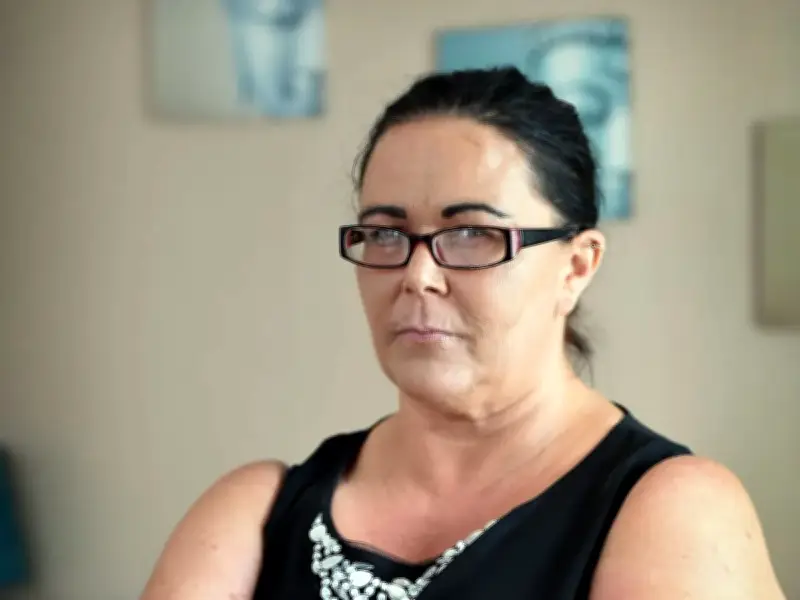
Sharon Cowan, whose husband Paul died while a prisoner at Low Moss, has called on the Scottish Government to end the country's growing prisoner death toll. She spoke before joining members of the United Families and Friends Campaign in a Saturday lunchtime vigil outside the official residence of the First Minister, John Swinney, at Bute House in Edinburgh.
The families, including relatives of Allan Marshall and Sheku Bayoh, are calling for urgent action to address what they say is an increasing number of deaths in the 'care and custody of the state', particularly in jails. They also want the abolition of the Fatal Accident Inquiry system and more support for prisoner families who lose a loved one, including immediate legal representation and funding.
A letter will be delivered to Bute House urging John Swinney to meet with relatives to discuss their concerns in person.
Paul Cowan's death in custody
Sharon's husband Paul Cowan, 41, died in Glasgow Royal Infirmary from liver cancer in January 2018, while serving time at Low Moss prison, near Glasgow, for car theft. She has previously accused prison authorities of denying him the chance to die with dignity.
He was under 24-hour guard in hospital by a private security company used by the Scottish Prison Service for five months, which was only relaxed hours before his death. At one point he was constantly handcuffed, but that stopped as his condition deteriorated.
Sharon, 55, said: "We want to change how the prison service deals with death in prison custody and a more humane approach towards families. We need more information when a prisoner and loved one has died and more transparency. Deaths are still happening and they are happening regularly."
Rising death numbers
In March, the Daily Record reported how 54 deaths were recorded in prison custody in 2023-24 - an increase of 15 on the previous year, and the highest since 2012. Separate research by the University of Glasgow found that 261 people died in custody or state care last year, including prisons, police custody, and immigration detention, up 6.4 percent on 2024.
Sharon, from Bonhill, Dunbartonshire, added: "If your loved one is in the care of the state you expect them to be looked after. When I think back to Paul his biggest fear was actually dying in the prison. You expect people to be treated on the inside as they would on the outside. They shouldn't have to worry that if they are not well they won't get any help. I only saw Paul alone in the last three hours of his life because the doctor refused to let the guards in the room with me. The man couldn't walk, he couldn't even get out the bed."
Sharon, who married Paul at Glasgow Royal Infirmary five days before his death, said her husband had no history of violence and was due for parole in July that year. She was also unaware her husband, who was originally from Castlemilk in Glasgow, could have applied for compassionate release after he was diagnosed with cancer.
Families demand answers
Also taking part in the vigil is the family of 39-year-old Christopher Masson, who died following a seizure in his cell at HMP Barlinnie in Glasgow in March 2024. His younger sister Skye Masson said: "Almost three years have passed since Christopher's death, and we are still searching and fighting for answers. These deaths have a profound and long-lasting effect on families. Every day, we struggle to raise awareness, yet we receive so little in return. We lost my brother Christopher to a system that families have spent years fighting to change - so much hurt, so many voices, and a lifetime of unanswered questions."
At the time of his death, Christopher, a former gardener, was serving a term for breach of the peace and was due for release in ten days' time. His niece, 12-year-old Harper Masson, has written a poem about her uncle which will be read out at the vigil.
High-profile cases and institutional responses
The Scottish Prison Service (SPS) and Police Scotland have been rocked by several high-profile deaths in custody in the last decade which have raised serious questions about prisoner safety. Allan Marshall, 30, who ran his own recycling business in Castlemilk, Glasgow, died in hospital four days after being restrained by up to 17 prison officers at HMP Edinburgh in March 2015. A Fatal Accident Inquiry later ruled Allan's death had been "entirely preventable" and the prison officers involved in his restraint were "mutually dishonest".
The case provoked fury after the Sunday Mail revealed CCTV footage showing the dad of two being dragged naked down a segregation unit corridor with a towel over his face, having suffered multiple injuries. Allan was an untried remand prisoner and due to be freed when the restraint took place. In March 2023, the Lord Advocate ordered Police Scotland to investigate the SPS for corporate liability in Allan's death, including corporate homicide. The following year, the Marshall family launched a £200,000 compensation claim against the prison service, Police Scotland and the Crown Office.
At the Court of Session in Edinburgh last year, the SPS admitted a breach of human rights law by unlawfully causing Allan's death. His family also received an apology from the prison service, Crown Office and Police Scotland. There will also be a tribute at the Bute House vigil to Allan Marshall's aunt Sharon MacFadyen, who died in August having campaigned on his behalf since his death more than ten years ago.
Trainee gas engineer Sheku Bayoh, 31, died in hospital after being restrained by police in a Kirkcaldy street in May 2015. His death is now the subject of a public inquiry which began in May 2022.
A Scottish Prison Service spokesperson said: "Every death, whether in prison custody or in our communities, is a tragedy for all those who knew and supported the individual. Following the death of someone in our care, Police Scotland are advised, and the matter reported to the Procurator Fiscal. Fatal Accident Inquiries are held in due course. We recognise the additional impact on families of waiting for Fatal Accident Inquiries into the deaths of their loved ones, and support calls for this process to be accelerated."
A Scottish Government spokesperson said: "Every death in custody is a tragedy, and our thoughts remain with the families, friends and staff who are affected. Keeping people safe in our prisons continues to be a top priority. We are committed to learning from every death to drive meaningful, lasting improvement across the system. That includes strengthening oversight, improving transparency and accountability, and ensuring that the voices and experiences of bereaved families help shape that work, alongside wider reforms to how deaths in custody are examined and learned from. Unfortunately the First Minister is not available to attend the vigil on Saturday but he will be pleased to meet the families at an appropriate opportunity."
It is understood that the overall numbers of prison deaths so far this calendar year have fallen.