
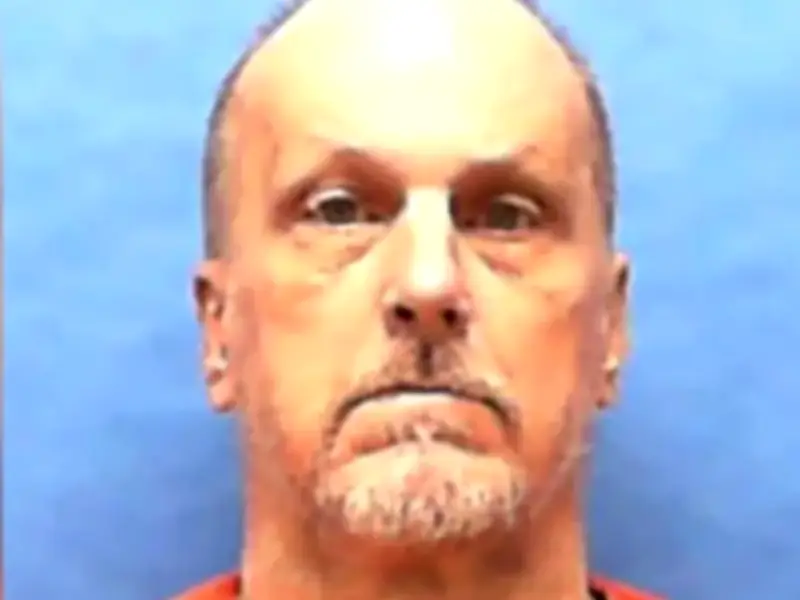
James Robertson, 63, was pronounced dead at 12.32pm on Tuesday after receiving a three-drug lethal injection at Florida State Prison near Starke. The execution took place nearly 18 years after he strangled his cellmate in a bid to be sentenced to death.
Robertson pleaded guilty to the first-degree murder of fellow inmate Frank Hart in 2008 and waived all appeals. He had previously told investigators he killed his cellmate because he wanted to be sentenced to death rather than spend the rest of his life behind bars.
Execution amid scrutiny of capital punishment
His execution comes amid renewed scrutiny of capital punishment in the US, following a botched execution attempt in Tennessee and an announcement that the planned execution of Fort Hood shooter Nidal Malik Hasan by firing squad would be livestreamed.
At a press conference on Tuesday, Florida Department of Corrections spokesperson Jordan Kirkland was asked how the state would prevent a repeat of what happened to Christa Pike in Tennessee, who reportedly survived an execution attempt despite receiving two lethal doses of pentobarbital.
"Florida has a sound lethal injection process and protocol," Kirkland said, adding that he could not comment on Tennessee's procedures. "We are very committed to carrying that out in a humane and dignified manner."
Florida's lethal injection procedure involves administering a sedative, a paralytic and a drug that stops the heart, according to the state's Department of Corrections.
Second execution warrant withdrawn
Robertson was originally due to be one of two prisoners executed in Florida on Tuesday. However, Republican Governor Ron DeSantis withdrew the death warrant for William Lee Thompson last week, without giving a reason.
Thompson's execution had been temporarily halted the previous month pending a psychiatric evaluation. Although the withdrawal does not change his death sentence, he remains on death row and could face a new execution warrant in the future.
Court records show Robertson was being held at Charlotte Correctional Institution, north of Fort Myers, in December 2008 when he strangled Hart as he slept, using several socks tied together.
Robertson told investigators the killing was unprovoked and that he had deliberately murdered his cellmate to secure a death sentence. He was first imprisoned in 1980, aged 17, for burglary and assault. Subsequent convictions for escape, battery and possessing weapons in prison repeatedly extended his sentence. Hart had been jailed in 2003 following a sexual battery conviction.
Appeals waived and questions raised
Robertson pleaded guilty and waived the penalty phase of his trial, during which a jury would have recommended either execution or life imprisonment. A judge subsequently sentenced him to death.
He later abandoned all post-conviction proceedings. At a hearing earlier this month, Robertson confirmed he understood his execution had been scheduled and did not wish to pursue further appeals to either the Florida Supreme Court or the US Supreme Court.
Campaigners against capital punishment said the case raised questions about claims that the death penalty deters murder. Maria DeLiberato, legal and policy director for Floridians for Alternatives to the Death Penalty, said Hart deserved to be safe while serving his sentence. She argued that "the existence of the death penalty may have caused the very violence it purportedly prevents".
Meanwhile, Thompson, 74, has become the third Florida governor to sign a death warrant for his execution. Former governors Bob Graham and Bob Martinez also scheduled his execution in the 1980s, but appeals and stays prevented him from being put to death by electric chair, the state's method at the time.
Thompson was convicted of first-degree murder, kidnapping and sexual battery in connection with the 1976 killing of 23-year-old Sally Ivester. His lawyers have argued that he has dementia and is in failing health, and have called for him to be transferred to an appropriate medical facility for treatment.
Only one other Florida inmate remains alive after receiving a death warrant under DeSantis. James Dailey, 80, was scheduled to be executed in late 2019 for the murder of a 14-year-old girl, but a federal judge halted the execution.




