
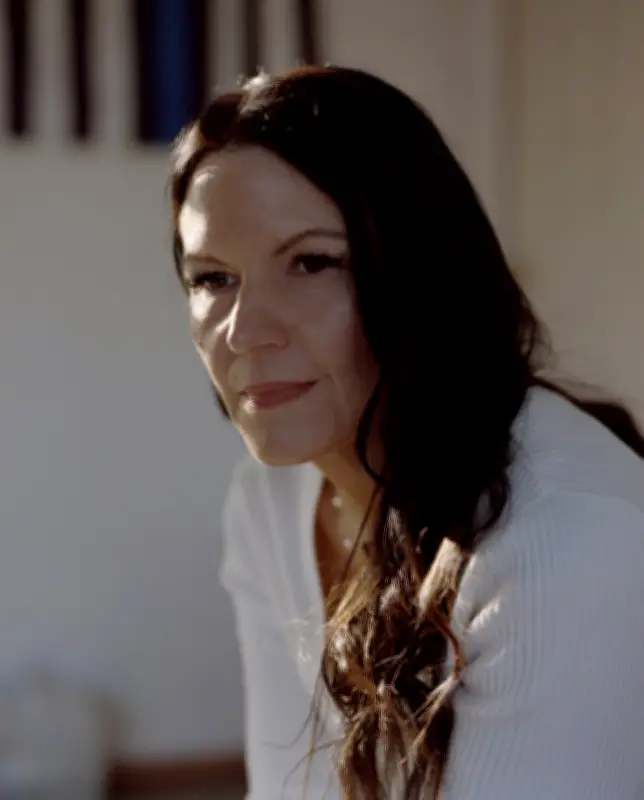
Traci Carr sits in her garage, where she keeps a box containing items left behind by her foster brother, Steven Judy, in Plainfield, Indiana. 'People treated us like we had raised a murderer,' she says.
A Foster Brother's Double Life
Childhood returns to Traci Carr in fragments. Night-time, she is five, waking to shadows on the wall. She pads downstairs and climbs into bed next to her foster brother, Steven Judy. He scoots over, and the monsters recede. Morning, they share Froot Loops, their favorite cereal, the milk turning pink. He teases her, tells funny stories, acts extra goofy to make her laugh. Later, they play hide and seek.
Then one day, Steve disappears. No one explains where he went. Her parents are away for long stretches. Conversations drop into whispers. Doors click shut. The television is switched off when she enters the room.
The year Traci turns seven, her parents take her to Conkle funeral home just outside Indianapolis. The room smells of carnations and furniture polish. She is led to the coffin at the end of the room. It's Steve. His eyes are closed, his face composed. His hair isn't right – a wig, she'll learn later. Her mother, Mary, leans close. 'Touch him,' she urges. 'Don't be afraid. Just touch him.' Traci extends a single finger. It leaves a dent in his cold skin.
Three days earlier, on 9 March 1981, the state of Indiana had executed Steven Judy. Traci would not fully grasp this for years.
The Crime That Shocked a Community
On the morning of 28 April 1979, around 6.30am, Judy, 22, raped and murdered Terry Lee Chasteen, 21, along the banks of White Lick Creek outside Indianapolis. When her three children – ages two, four and five – cried, he threw them into the creek to drown. It wasn't his first violent crime, but it was the one for which he would be executed.
The four bodies were discovered later that morning by mushroom hunters. Residents called it the worst crime Morgan county had ever seen. A distinctive red and silver truck seen near the site of the killings was traced back to Bob Carr. He told police his foster son had borrowed it the night before. Judy was arrested the next day.
Public outrage hardened quickly. Even before all the evidence was presented, a grassroots group called Protect the Innocent demanded the death penalty. At first, Judy said he couldn't remember what happened. Later, he confessed. Attorney Steve Harris initially pursued an insanity defense, but two court-appointed psychiatrists concluded Judy was legally sane.
After the guilty verdict, Judy made his preference clear: death over life in prison. Determined to eliminate any possibility of leniency, he proposed leaping across the table to attack the prosecutor before sentencing. 'You can't do that,' Harris told him. 'There are 50 officers in that courtroom.' Instead, Judy asked to address the jury. He told them he knew their names, where they lived, where they worked, and would kill anyone who failed to vote for the electric chair. Then he turned toward the bench. 'That goes for you too, bud,' he said to the judge. The jury deliberated 20 minutes before recommending the death penalty.
A Brother Remembered
Steve saved Randy Carr's life when Randy was two years old. Randy was playing in a mud puddle in the alley behind their house when a family friend known as Stinky climbed into Bob Carr's truck and began backing it up, running over Randy's legs. Steve saw the scene unfold and began yelling and waving his arms. 'He stopped him,' Randy says. 'Another minute and Stinky would have run over my head.'
After that, Steve became Randy's person. 'The only one who paid me any attention,' Randy recalls. Saturdays were their day. Together, they cleaned the basement, mowed the grass. When the chores were done, Steve took him for ice-cream. 'Never failed,' Randy remembers.
Steve entered the Carr family through a friendship with Randy's Uncle Tony. On the day of the Chasteen murders, Randy, who was nine, and his brother Bobby, who was 11, helped Steve clean out the garage. They drove trash to the dump. They swept out their father's pickup truck, the one Steve had been driving earlier that morning. Then they went for ice-cream.
The next day, the police came. Steve was out with a friend, but they questioned the boys. They drove them back to the dump and asked where the trash had been thrown. 'I wasn't going to tell them,' Randy says. 'I pointed everywhere except where we dumped.'
After Steve's arrest, children at school avoided Randy. He began fighting. 'I would get mad if anybody told me Steve was guilty of this. I couldn't see it in my mind. Steve couldn't do this.' Eventually, Steve told Randy himself. 'You've gotta let it go,' Steve said. 'I'm guilty of this. It's something I can't control.' He joked about the electric chair. 'Man, I'm gonna ride that lightning.' Randy thought he meant an amusement park ride. 'I still didn't understand,' he says.
Years later, Randy came to believe Steve deserved to die. He says that plainly now. But then he adds, quietly, tearing up: 'To this day, I hate that he did that. Because he was everything I had in life.'
The Execution and Aftermath
In the months before the execution, Randy started spiraling. He skipped school for the first time. He stole diet pills to get high. 'I just felt like I needed to do something.' When his mother told Steve during a prison visit that Randy was acting out, Steve wrote Randy a seven-page letter about his own childhood, about how he had started screwing up. In a letter to Mary, Steve mentioned that he had written to Randy, and offered her some parenting advice: 'Listen, Mary, I just wrote Randy that letter we talked about. It was hard, too. I don't know if it was exactly what you wanted but I think it will help if he listens. But you have to understand if you keep telling someone not to do this or that, it sometimes pushes them to do it anyway for spite.'
Randy read the letter 'a thousand times' when he was a kid. He never skipped school again. 'I loved Steve to death. I defended him for a long time. I broke a lot of jaws of people who didn't really deserve it.' Randy begged Steve to appeal against the death penalty. 'I cried with him for a long time. Finally Steve said: "Look at me. Don't bring this up again. It's over with. Don't be sad, because this is what I need."'
Randy visited Steve the afternoon before his execution. 'I was so upset. But Steve was laughing and carrying on like nothing was happening. It just blows my mind how he knows he's going to his death, and he was just worried about how I was.'
A few months after the funeral, Traci noticed the spine of a book jutting from a stack of papers on the kitchen countertop. 'Burn Judy Burn.' Published between Judy's conviction and his execution, the book was written by Bette Nunn, managing editor of the Reporter-Times in Martinsville, Indiana. Traci pulled it free and turned immediately to the photographs. One showed a small body just beneath the water's surface. Another showed a little boy lying on a metal table, his shirt half pulled up from his torso. They were children, very small. She could tell they were close to her age. 'I was starting to piece it together,' she told me. 'I think I knew Steve had killed somebody. But I still didn't understand what had happened to him.'
She asked Randy what happened to Steve. He told her what he could, as much as he understood. She couldn't reconcile the brother she knew with the killer described in the book. Yet she kept returning to the photographs. 'I had a morbid interest,' she says. The more she grasped, the more terrified she became. The house itself seemed altered. When she returned from school and found no one there, she wouldn't go inside, pacing the sidewalk instead.
The Family's Burden
After the execution, threatening and abusive calls flooded the Carr home. They took the phone off the hook for days, but the noise did not stop. Inside the house, Mary and Bob fought constantly, often about Steve, and Bob moved out. Traci found her mom's house chaotic and undisciplined so she went with her father; Randy and his brother stayed with Mary, who seemed unreachable, crying often, sunk in a sorrow with no clear edges.
Isolation hardened around them. Parents forbade their children from playing with the Carr kids. On the playground, though, the question surfaced anyway: 'Hey, what was he like, your brother?' Traci refused to answer. 'I wouldn't talk about it. I just wouldn't,' she recalls. 'I thought we did something wrong. I was really ashamed of it.'
Randy kept getting into fights. Strong, athletic and ready to use his fists, he swung at anyone who tried to force him to accept what Steve had done. The stain of being Steven Judy's foster siblings followed Traci and Randy through high school and beyond. It entered rooms before they did.
When Traci moved into her first apartment, eager for the ordinary independence of adulthood, she slept with the lights on. 'The dark terrified me,' she said. Later, motherhood gave the fear somewhere new to live. She found herself watching her children obsessively, imagining dangers before they arrived. 'The worst thoughts still pop in my head,' she says. 'I have to mentally block them out.'
For a long time, Traci carried anger toward her parents for bringing Steve into their home, for not knowing more, for not protecting them better. She has forgiven them now, at least mostly. 'They grew later in life,' she said. They were young. They didn't know the full extent of Steve's crimes. 'Mom had the best intentions. She was always trying to rescue people. Steve was charming so she really thought she could turn it around for him and make something good out of something terrible. She was trusting to the end of her life. And it's a good quality.'
Bob died in 2005; Mary died in 2023. The bin containing Steve's belongings went to Traci. After we spent a day going through the bin together, Traci carried Steve's belongings back to a corner of her garage. She doesn't love having his stuff. 'Was he wearing that belt when he did that? And that watch. Was he wearing that?' she asked. 'I know Mom loved him, but I would never have kept this if it were up to me.' But even now, the final act of throwing it away still feels impossible.
Asked what she would say to Steve today, knowing all she knows now, Traci hesitated. 'I'm sorry for what he had to go through as a child. It makes me sick to think about the things he had to witness.' She paused. 'Some people can pull through,' she said, 'and other people can't.'
Mary's attachment to Steve did not end with his execution. For 20 years, on the anniversary of his death, Mary would check into a hotel room alone and try to connect. She said she could feel him. She said he came to her. The kids sometimes teased her about this, but she just laughed good-naturedly. She was not religious, but recalled her grandmother communicating with spirits. She believed she came from a psychic family.
Though she kept a connection with Steve, Mary cut herself off from her parents for a time after the execution. 'If anyone ever needed support and love from their family, I needed it this month,' she wrote to her mother. 'We buried Steve yesterday and not one member of my family was there. I think I know how Steve must have hurt when his family turned their back on him. My family did the same to me. And all I did was give a very lost kid some love.' Traci says when she discovered that letter, 'it broke my heart. She never told me about any of that.' It took Traci years to understand that her mother's grief carried its own kind of exile.
For Randy, the spiral that began after Judy's arrest never fully stopped. A star high school athlete, he later went to prison on drug-related charges. 'Everybody always told me I was going to turn out like Steve, and I'm thinking I didn't mind that because I loved Steve to death,' he said. 'But I felt like everybody expected me to screw up, so it wasn't no big deal to meet their expectations.'
Traci is married to a police officer. She works as a patient advocate at a hospital now. She sits with families in crisis, helping them navigate what they don't understand. In the evenings, she knits thick blankets, the yarn moving through her hands row by row. Her mother has begun appearing again in her sleep: Mary holding her, comforting. Almost as if speaking aloud what had been buried for decades had called her mother back.
'Everyone hated Steve, and we were told we should too,' Traci says. 'For a long time, I thought we did something wrong, and I was ashamed. People treated us like we had raised a murderer. It's still how people remember us. I don't think Mom ever got to grieve properly. I don't think any of us did.'




