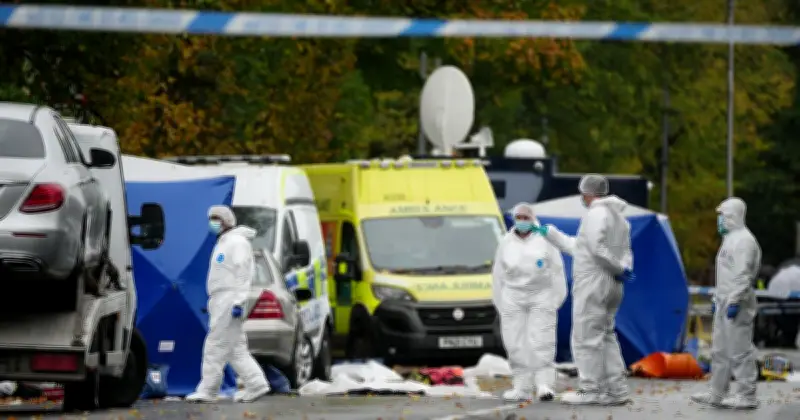
A year on from the deadly attack on Heaton Park synagogue, British Jews are "sick and tired" of being forced to live behind ever higher walls, the chair of the Jewish Leadership Council has said.
Keith Black, writing in an opinion piece, said he still struggles to fully comprehend what took place at the Manchester synagogue on Yom Kippur last year, when two Jews, Melvin Cravitz and Adrian Daulby, were killed on the holiest day of the Jewish calendar because they were Jewish.
He described the image of Rabbi Daniel Walker standing outside his synagogue in a blood-stained kittel, the white robe worn on Yom Kippur to symbolise purity, as "seared into my memory".
Attack 'was never if, but when'
Black said that, despite the shock and horror, he was not surprised by the attack. In the post-October 7 world of rampant antisemitism, he said it was "never if an attack of this nature would happen, but when".
Jewish communal organisations had planned for this very scenario for years, and security around synagogues had always been increased for the High Holy Days, he added.
What he found most disturbing, Black wrote, was that the terrorist attack triggered a wave of antisemitic incidents which justified or celebrated the atrocity. He said he was especially horrified to learn that Sherelle Dresner, Melvin Cravitz's step-daughter, had received abusive antisemitic messages justifying his murder. Yoni Finlay, who was wounded during the attack, has also said his son has received death threats.
Too many words, not enough action
Black said this is what British Jews have continued to contend with in the year since Heaton Park, and that Rabbi Walker is right to say British Jews are now in an even harder position than immediately after the attack.
He noted some movement from government in the last year, mostly focused on increasing security and policing, as well as reviews into antisemitism in various sectors of society and policy proposals on social cohesion and counter-extremism. Legislation on public order and hostile state threats had also been passed.
Yet, a year after two Jews were killed in the new Prime Minister's home city, there remains a feeling that there have been too many words and not enough action, and that those in power still don't get it.
Black wrote that Britain is a country where hatred of Israel has intensified and is routinely used as cover for hatred of and violence against Jews. This is most clearly demonstrated by the regular anti-Israel protests since October 7, which are almost always accompanied by chants, placards and conduct that cross the line from criticism of the Israeli government into racial or religious hatred.
As the attacker tried to barge through the doors of Heaton Park Synagogue, he was allegedly heard shouting: "This is what you're going to get for killing our children." But he did not ask Melvin Cravitz for his thoughts on Israeli settlements or the war in Gaza before attacking him. Indeed, Sherelle told ITV News that Melvin had never expressed any political views. He was simply a Jew who was proud of his faith.
Living in fear
Since Heaton Park, Black said, there has been another terror attack on the streets of Golders Green, and a spate of arson attacks against Jewish charities and synagogues. The only solution offered, he said, seems to be the quiet indignity of living our lives behind ever higher walls with an ever-heightened sense of anxiety about when the next attack might come.
"We are sick and tired of living like this," he wrote. "British Jews should not have to plan our lives around security threats. We deserve to be able to live our lives openly and practise our faith without fear."
That requires a concerted national effort to eradicate extremism and antisemitism wherever it is found, he said, requiring political leadership but also allyship from across society.
A year on from Heaton Park, Black said we owe it to Melvin Cravitz and Adrian Daulby to remember why this matters. They were two human beings with families, friends, and full, rich lives. "Two proud British Jews killed simply because they went to synagogue to pray on Yom Kippur. May their memories forever be a blessing."