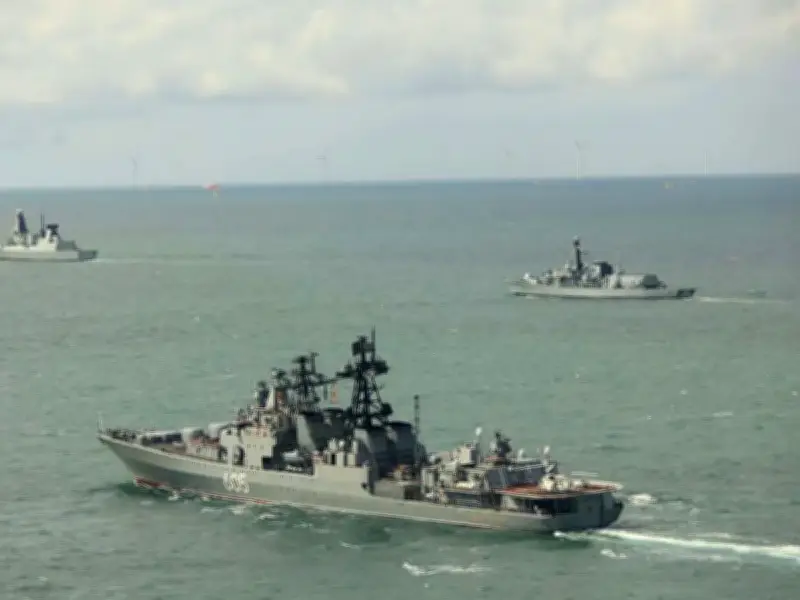
The Royal Navy tracked a Russian destroyer and a group of sanctioned cargo vessels through British waters in an intensive 72-hour operation last week. The task group, including the destroyer Admiral Levchenko and sanctioned vessels General Skobelev and Sparta, was monitored as it travelled from the North Sea through the English Channel.
Vessels deployed for tracking mission
The Navy deployed the Type 45 destroyer HMS Duncan, the Type 23 frigate HMS St Albans and the patrol vessel HMS Severn to track the Russian ships. Officials said the tracking began when the vessels approached the Strait of Dover, prompting Russia to respond by deploying the Neustrashimy frigate to guard the shipment.
Over the following 72 hours, the British vessels closely observed the task group before handing over duties to a Nato ally near the French island of Ushant.

First Sea Lord warns of shadow fleet risks
First Sea Lord General Sir Gwyn Jenkins said there was “no room for complacency” as shadow fleet vessels continue to pose “an unacceptable risk” to maritime security and the environment. He added: “Alongside our allies, this approach is forcing Moscow to divert Russian warships away from their core purpose. That is because Russia knows we stand ready to act again, should it be required.”
The operation follows warnings of increasing Russian activity around UK waters earlier this month. Naval operations to monitor Russian activity increased 25 percent in July compared to the previous year, with warships making repeated voyages through the Dover Strait and North Sea.
Context of rising Russian naval activity
Moscow uses its shadow fleet of ageing vessels to evade international sanctions on its oil and fund the war in Ukraine. The increase in Russian naval activity follows the seizure of the tanker Smyrtos by Royal Marines in June, the first time British troops have directly boarded a shadow fleet vessel.
The events come after a week of repeated threats from the Kremlin to the UK following Andy Burnham’s visit to Kyiv, during which he announced Britain would provide Ukraine with blueprints for long-range Scalp missiles. Western officials have sought to play down the prospect of a conflict between Russia and Nato, despite senior figures in Moscow accusing Ukraine’s allies, including the UK, of “playing with fire”.
Ex-Russian foreign minister Andrei Fedorov said he could not “100% exclude” the possibility of “semi-military” action against Britain in retaliation, raising the prospect of an attack on British drone factories from “unknown sources.” On Friday, Western officials said the threats were “not a new phenomenon” but part of “long-standing Russian military doctrine” that seeks to use “hostile rhetoric” to “exploit fears” and influence decisions.
“We do need to be careful to distinguish what is real from what is rhetoric designed to scare and deter us. Replaying Russian threats and heightening a sense of crisis is exactly what the Kremlin wants,” they said. “Our assessment remains that Russia isn’t seeking direct confrontation with Nato.”