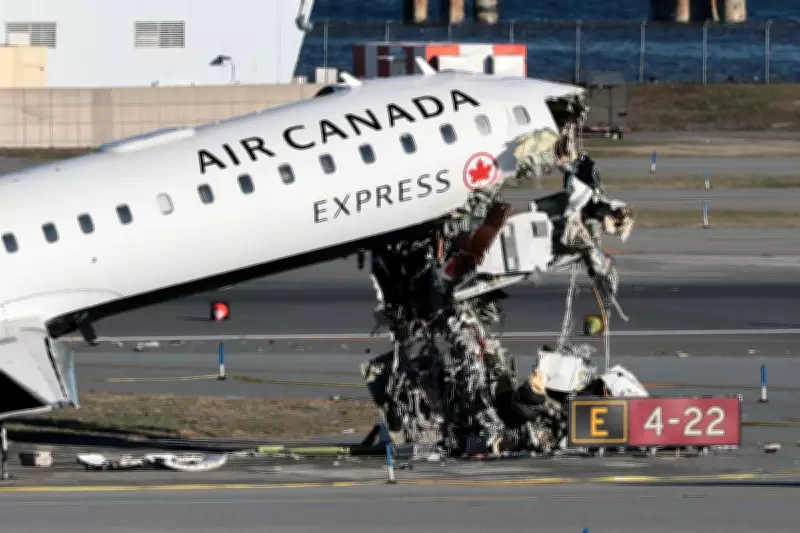
A recent spate of deadly accidents and close calls at US airports, already strained by an air traffic controller shortage and federal layoffs, has heightened public anxiety. While aviation experts stress that flying remains statistically the safest mode of transport, they point to a critical flaw in high-tech safety systems that may have contributed to a devastating runway collision at New York’s LaGuardia Airport in March, which killed two pilots.
The LaGuardia Collision and Broader Incidents
Retired airline captain John Cox, a safety consultant who has testified before Congress, described the issue as an "existing gap" that needs urgent attention. The problem involves inexpensive electronic transponders that enable air traffic controllers to track ground vehicles. The Federal Aviation Administration has urged airports to adopt these devices since 2011 but has never made them mandatory.
The LaGuardia crash is part of a broader pattern. On May 3, a Boeing 767 carrying 231 people clipped a light pole and a bread truck on the New Jersey Turnpike while approaching Newark Airport. The truck driver, Donald Boardly Jr., survived with minor injuries. His father recounted his son’s terror, saying he feared decapitation. Retired United Airlines captain Steve Arroyo noted the plane was "below the glide path" with "narrow margins" for safety, calling it a near catastrophe.

The following day, a regional flight from Rochester came within 500 feet of a single-engine plane while landing at Kennedy Airport. This near miss followed an April 20 incident at Kennedy where cockpit alarms sounded as one plane veered into another’s path, forcing an aborted landing. Similar events occurred at Nashville Airport on April 18 and at John Wayne Airport in California on March 24, where a military Black Hawk helicopter and a Boeing 737 had a close call, echoing the deadly Potomac River collision last year that killed 67 people.
On May 8, a suicidal man climbed a fence at Denver Airport and was fatally sucked into a plane’s engine during takeoff, causing a fire and minor injuries to 12 people.
Statistical Perspective on Safety
Despite these incidents, National Transportation Safety Board data shows commercial aviation accidents in the US ranged from 91 in 2008 to 59 in 2020, with 75 in 2024, none fatal for major airlines. The Flight Safety Foundation recorded 61 accidents last year, up from 54 in 2024. Cox emphasized that the trend line over five to ten years continues downward, stating, "The most dangerous part of any flight is the drive to and from the airport." Arroyo echoed this, noting passengers would need to fly 20 million flights to be involved in an accident.
Transponder Gap and FAA Response
The LaGuardia crash involved a fire truck lacking a transponder. A preliminary NTSB report revealed the control tower screen displayed only two of seven emergency vehicles. The Port Authority of New York and New Jersey subsequently announced it would install transponders in all its airport emergency vehicles. Cox noted that FAA rule-making is complicated and takes years, with pushback from airports. Hassan Shahidi of the Flight Safety Foundation urged the FAA to take a more active, risk-based approach.
On Wednesday, the FAA announced $16.5 million to equip all its vehicles at 264 airports with transponders, accelerating plans after the LaGuardia collision. Cox called it a positive step but noted many other vehicles on airport grounds remain unequipped. Arroyo expressed surprise that FAA vehicles were not already fitted but is cautiously optimistic.
Air Traffic Controller Shortage
The FAA also faces a shortage of controllers. A December Government Accountability Office report found a 6% decrease in controllers to 13,164 between fiscal 2015 and 2024, despite a 10% increase in flights. The GAO blamed reduced hiring and attrition due to funding lapses and the pandemic. Shahidi called the shortage a real concern, with many controllers working 12-hour shifts, six days a week. He noted that while the FAA is hiring aggressively, training takes two to three years.

Last month, the Transportation Department launched an online ad campaign targeting video gamers, featuring a video titled "It's not a Game. It's a Career." Transportation Secretary Sean Duffy said the FAA aims to reach young adults with skills aligned with air traffic control. Shahidi called it a smart approach, and Cox agreed, noting the military has done the same.
Additionally, about 400 FAA personnel were laid off last year as part of government efficiency efforts, though Duffy said no air traffic controllers or critical safety workers were affected.