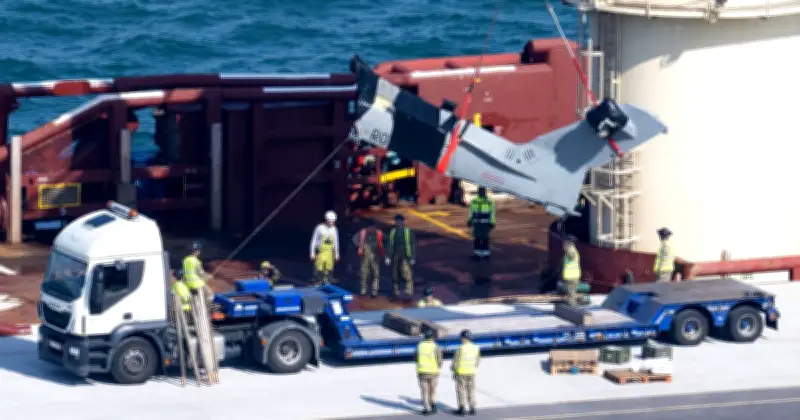
A service inquiry into a fatal Royal Navy helicopter crash has exposed “sustained penny pinching” in military budgets, a retired commander has warned, after rescue efforts were hampered by a lack of specialist equipment.
Retired commander Tom Sharpe said defence cuts are placing a “corrosive burden” on under-resourced Royal Navy leaders. The report noted the rescue mission after the Merlin aircraft ditched into the English Channel was hampered by a lack of specialist equipment.
Mr Sharpe said commanders are being forced to make difficult decisions over “limited stockpiles” due to inadequate funding.
Rescue hampered by missing hoist
Senior Navy officers have been urged to review the availability of rescue hoists following the incident during a night-flying training exercise with the aircraft carrier HMS Queen Elizabeth on September 4, 2024.
Handling pilot Lt Rhodri Leyshon died in the crash, while two other crew members on board suffered injuries. The report said rescue efforts were disrupted after another Merlin was not fitted with a hoist.
A senior commander, who ordered the helicopter to prepare for search and rescue activity, was “unaware” it lacked the kit, the investigation found. This meant the helicopter was unable to pull survivors out of the water.
Report findings and recommendations
The report said: “While rescue hoists were part of the standard role fit for Merlin Mk 4/4A, they were only fitted for specific roles or when specifically requested by 846 NAS [Naval Air Squadron] crews.
“The lack of hoisting capability increased the surviving crew's time in the water, thus increasing the likelihood of hypothermia.” This was listed as an aggravating factor by the investigation panel.
In a recommendation, senior military leaders were urged to “review the provision and use of rescue hoists when conducting over-water operations to optimise rescue capability”.
Responding to the finding, Mr Sharpe said the kit surplus was a result of underinvestment. He told the Express: “As with any accident, there will be a chain, but there is no doubt that one of the aggravating factors here was the eternal curse of ‘fitted for but not with’ where sustained penny pinching means there is not enough kit to go around.
“This makes our forces less capable but also adds a corrosive burden to commanders who are forever having to prioritise what of their limited stockpile they should fit to what system.
“Most of the time, they get this right. Occasionally, tragically, they do not. As long as we continue to try and do defence-on-the-cheap, these things will happen.”
Crash details and aftermath
The report also found HMS Queen Elizabeth’s duty sea boat crew were initially unable to rush to the scene due to a sensor fault on a crane. Another sea boat was instead launched at approximately 21:05.
The aircraft commander and aircrewman, who were on a partially submerged single-seat liferaft, were rescued by the boat crew at 21:09. Both were treated for minor injuries.
Lt Leyshon was not found until around two hours after the crash and was pronounced dead in the hospital. The 31-year-old suffered a serious injury, which prevented him from escaping from the Merlin, the service inquiry said.
While the impact was deemed survivable, the report detailed a reduction in the effectiveness of his seat to absorb the force of the crash. It noted this was likely caused by a combination of Lt Leyshon’s body position, a weight below his own being set on the seat's system and “other unquantifiable factors”.
The crash happened after an engine fault was misdiagnosed by the crew, leading to two working engines being switched off, the Defence Safety Authority (DSA) found. The helicopter, which had been flying at 125 feet, ditched approximately 25 nautical miles south of Lyme Regis, Dorset.
Investigators said it was very likely that “collective skill fade” affected the crew’s ability to react. The service inquiry panel made a total of 44 recommendations. The Royal Navy said all had been accepted.
Lt Leyshon’s father, Tim, said he believed his son was “let down by people and systems beyond his control”.
A Navy spokesperson said: “Our thoughts remain with Lt Rhodri Leyshon's family, friends, and colleagues at this very difficult time. He served with great professionalism and is much missed by those who knew and worked alongside him.
“We have accepted the inquiry’s recommendations in full. A number have been implemented to date, and we are working to deliver the rest to improve safety for serving personnel.”