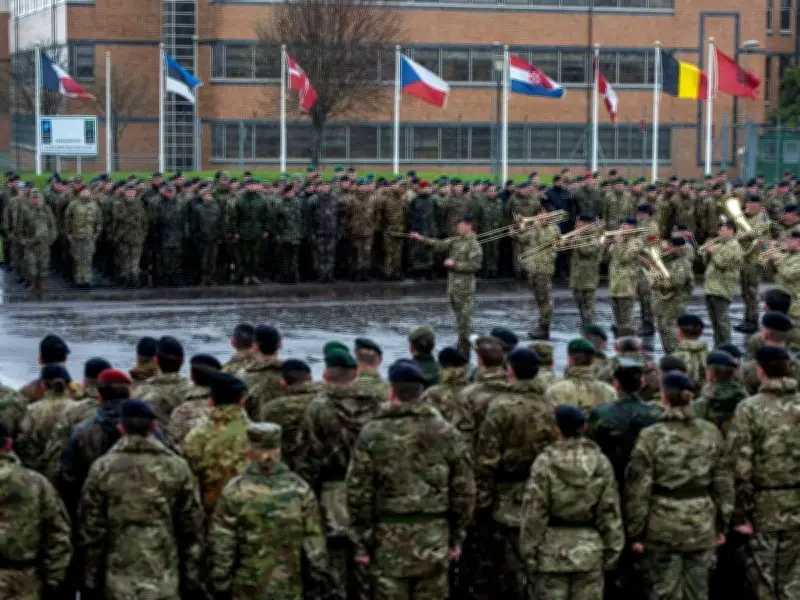
NATO has confirmed that a US service member assigned to the Allied Rapid Reaction Corps has been arrested by counter-terrorism police in the UK on suspicion of espionage, with reports suggesting links to Russia.
London counter-terrorism officers revealed that a 41-year-old man was detained as part of a joint investigation working closely alongside US authorities, according to The Guardian. The US Army counterintelligence command confirmed the allegations were linked to a "senior soldier."
Official NATO statement
In an official statement released on Tuesday, November 10, a senior NATO military official declared: "We can confirm that the American service member arrested by British police was assigned to NATO's Allied Rapid Reaction Corps (ARRC)."
The soldier was stationed at Imjin Barracks in Innsworth, Gloucestershire — the headquarters of NATO's Allied Rapid Reaction Corps. He was seized in Gloucester on Tuesday on suspicion of offences under section one and section three of the National Security Act, and remains in custody at a London police station.
FBI response
FBI director Kash Patel issued a statement confirming the arrest "involves allegations of espionage, which is of the utmost concern to the United States and our allies."
He stated: "While this investigation is continuing, I want to send a clear message - this FBI has no tolerance for anyone who breaks their oath to the United States and whose actions endanger our national security and that of our partners."
Patel added: "This includes 167 counterintelligence and espionage arrests from this FBI over the last 21 months - a 53% increase. This matter shows that partnerships are essential to protect our countries and I want to express my thanks to UK Counter Terrorism Policing, MI5, UK Defence Counter Intelligence and the U.S. Army Counterintelligence Command for their outstanding work."
NATO context
NATO, a 32-member alliance established in 1949 to counter the threat of Soviet aggression, now centres its efforts on safeguarding member nations under the principle that an attack on one is an attack on all.