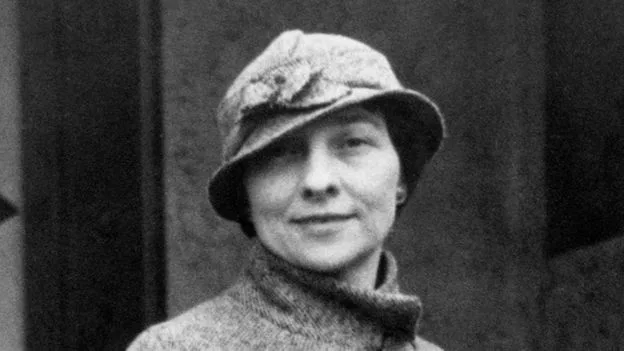
Over the last 100 years, women have played significant, high-level roles in breaking secret codes—from Nazi ciphers to the secret messages of Al Capone's gang—but their contributions are only now emerging. In 1917, as the United States entered World War One, its military code-breaking efforts were centred at a mansion estate in Illinois, owned by eccentric millionaire George Fabyan. At the heart of this operation were Elizebeth Smith and William Friedman, a code-breaking team who later married. Neither had formal training in cryptanalysis; Elizebeth had studied Shakespeare and Tennyson, while William held a PhD in genetics. Both were adept at recognising patterns, a skill crucial to their work.
Fabyan had originally employed Elizebeth to prove that Shakespeare's plays were written by Francis Bacon, but his estate, Riverbank, became a hub for code-breaking during the war. Jason Fagone, author of The Woman Who Smashed Codes, describes Fabyan as 'insane' and 'a lunatic', but his whims facilitated the centre of US code-breaking. Elizebeth and William cracked enemy codes sent from Washington, with Elizebeth later becoming one of the greatest code-breakers in history. However, while William's achievements were well-documented, Elizebeth's were marginalised for decades.
Elizebeth's talent lay in mentally rearranging cryptograms and using statistical measures of letter frequencies to decipher codes. For example, in the simple cipher 'UIF GPY KVNQFE PWFS UIF GFODF', she would recognise that 'F' stands for 'E', the most common English letter, and 'UIF' for 'THE', revealing the message 'THE FOX JUMPED OVER THE FENCE'. She cracked far more complex ciphers, where letters were shifted in intricate ways, requiring reverse engineering with only the encrypted output.

After World War One, Elizebeth's skills remained in high demand. Her contributions, along with those of other women in code-breaking, are now being recognised thanks to newly discovered papers and interviews with surviving members of once-secret enclaves. On Ada Lovelace Day, 10 October 2017, it is fitting to remember these women who applied code-cracking techniques by hand, long before cryptography became the preserve of computer scientists.