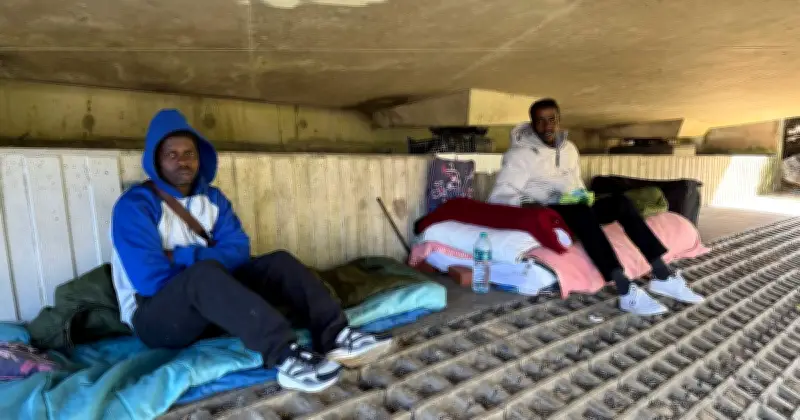
Migrants are camping under bridges and in tents near the ferry port in Dover, prompting fears of “Calais Jungle-style” camps, according to a new report by the Global Initiative Against Transnational Organised Crime (GIATOC). The report says a growing people-smuggling trade inside Britain is exploiting lax visa rules, with migrants contacting smugglers “within days” of arriving on visitor or study visas to reach other European countries.
Dover as a temporary accumulation point
Giulia D'Amico, from GIATOC, said in the report: “Dover has become a temporary accumulation point, with people sheltering under bridges and near freight parking, in scenes reminiscent of the Calais Jungle.” Sleeping bags were left under a bridge on Monday, with clothes and rubbish littering the floor.
A Senegalese national camping in the port town revealed “people are sleeping everywhere”, including in parks and along the waterfront. The report notes that entry requirements for many European countries are more restrictive, and Home Secretary Shabana Mahmood has been informed of this.
Political criticism and local concerns
Shadow Home Secretary Chris Philp criticised the government, saying: “Under Shabana Mahmood, our borders are in chaos. She can’t keep illegal immigrants out, and now it turns out she can’t stop them using the UK as a transit hub either. These people can’t get a visa to directly enter a Schengen area country like France or Spain – but apparently they can get a visa to enter the UK. This just shows how slack Shabana Mahmood’s visa regime is – letting in people that France and Spain wouldn’t allow into their countries. The visa system needs to be urgently tightened up a lot so these migrants can’t enter the UK in the first place. Dover now stands where Calais stood a decade ago, when a relatively open market began to consolidate around a smaller number of dominant networks.”
Reform’s Kent County Council leader Linden Kemkaran said: “Organised criminals are using our county as some sort of arrival and departure lounge: taxis dropping people in Kent lay-bys, trucks loading up in our freight parking, people randomly sleeping under bridges in Dover waiting for a gang to move them on. Here in Kent, we have an illegal migration emergency, and we have had enough. We urgently need action, but instead we have a new PM more interested in sending texts about barbecues than anything else.”
Smuggling networks and enforcement
Gangs are seizing on Britain’s lax borders to offer routes into France, Germany, Spain and other European destinations, with many routes advertised on TikTok. However, a single network has yet to seize control of the UK-to-France route. Kurdish gangs control the vast majority of small boat departure points, but Ms D'Amico said: “These groups arbitrate who departs and from where, and they have defined zones and engage in violent competition over launch sites. There has been no such consolidation in Dover. Instead, the UK market resembles the early stages of a smuggling economy, before enforcement pressure selects the actors best equipped to survive. Here, individuals from Algeria, Romania, Poland, Lithuania and South Asia handle recruitment, transport and concealment, with no single group controlling the entire chain.”
In January, 23 Bangladeshi men were discovered in a lorry approaching the ferry port in Dover. Five suspected people smugglers were charged with plotting to move migrants out of the UK. Three taxi drivers, men aged between 43 and 55, were separately arrested on suspicion of facilitating illegal immigration, as was a 32-year-old Romanian lorry driver. A 43-year-old man, the suspected ringleader, was arrested in the New Cross area of London, and about £30,000 cash was seized from a property. The group allegedly focused on smuggling Pakistani and Bangladeshi nationals out of the UK.
Impact and response
Senegalese national Arms Jawo, 20, who arrived in the UK 18 months ago, spoke to the Daily Express near his tent in Dover. The failed asylum seeker said: “People do go over to France, but it's risky in the lorries. People are leaving because they're being rejected. If you're rejected, you have no right to stay, you have no help. Before that, people are sleeping everywhere. They're here, they're in parks at night, they're on the waterfront. The people who, unlike me, are fleeing from warzones are the ones who need it most. Maybe those people need help more than me, and they should be getting it.”
Ms D'Amico added: “The way in which the authorities respond will influence how the situation develops. Exercising sustained pressure on a fragmented smuggling environment will not necessarily eliminate it; instead, it will favour the groups best able to absorb risk and evade detection. These actors are often better financed, more organised and more willing to use coercion. Dover now stands where Calais stood a decade ago, when a relatively open market began to consolidate around a smaller number of dominant networks. Channel smuggling is no longer primarily a one-way phenomenon. It moves in both directions, using shared infrastructure, driven by discrepancies in two legal systems that no longer align. Recognising this is the first step towards a more coherent UK-EU response.”
A National Crime Agency spokesman said: “The same gangs involved in smuggling people out of the UK illegally are often involved in bringing people in too, which is why targeting them is important, and the NCA has a number of investigations into this kind of criminality. These gangs not only threaten the border security of both the UK and France, but also risk the lives of those they transport. We have seen people utilising the services of these groups to circumvent French visa restrictions or evade law enforcement attention.”