The bodies of four Italian scuba divers who died last week while exploring underwater caves in the Maldives have been located, the Maldives government confirmed. A group of five Italian divers perished on Thursday while attempting to explore caves at a depth of 50 meters (164 feet) in the Vaavu Atoll, Italy's foreign ministry reported. The body of one diver was recovered from the cave opening on the same day.
On Monday, a team of three Finnish divers arrived to coordinate a fresh search for the remaining bodies, according to Divers Alert Network Europe. Earlier, a high-risk recovery operation was suspended following the death of a Maldivian diver from decompression sickness. Mohamed Mahudhee, a member of the Maldivian National Defence Force, died of underwater decompression sickness after being transferred to a hospital in the capital on Saturday, said Mohamed Hussain Shareef, the Maldives presidential spokesperson.
Shareef stated that three Finnish divers, experts in deep and cave diving, arrived in the archipelago nation and joined the Maldives coastguard in a meeting to map a new search strategy. Mahudhee was buried with military honors in a funeral attended by President Mohamed Muizzu on Saturday night. The diver was part of the group that briefed Muizzu on the rescue plan when he visited the search site on Friday.

Decompression sickness occurs when depressurized gas, usually nitrogen, exits the solution phase in tissues and obstructs circulation by forming bubbles. This can happen after a quick ascent from deep-sea diving, according to the National Library of Medicine.
Victims Identified
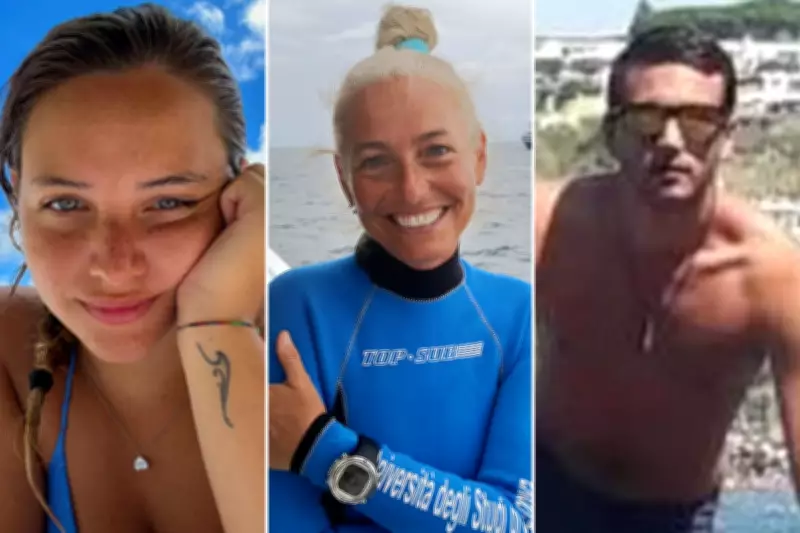
Italian Foreign Minister Antonio Tajani said they would do everything possible to bring the bodies home and offered condolences for Mahudhee's death. The victims have been identified as Monica Montefalcone, an associate professor of ecology at the University of Genoa; her daughter, Giorgia Sommacal; marine biologist Federico Gualtieri; researcher Muriel Oddenino; and diving instructor Gianluca Benedetti, according to the Maldivian government. Benedetti's body was recovered on Thursday from near the mouth of the cave.
What Happened Inside?
While no one knows exactly what happened inside the caves, as there were no survivors, the recovery of four bodies and the cave's layout have led to common theories. The group entered a complex underwater cave in Vaavu Atoll at around 50 meters depth on Thursday morning, a depth well beyond the permitted recreational diving limit of 30 meters. The cave system consists of three large chambers connected by narrow passages, overhangs, swim-throughs, and tunnels in a coral reef structure, with potential strong currents, low visibility in rough weather, silt, and tight spaces. It stretches up to about 60 meters.
The divers gave a distress call at around 1:45 p.m. and were reported missing after they failed to resurface. Dive master Maurizio Uras suggested oxygen toxicity inside the cave might have contributed. "It's a phenomenon that can happen when you dive very deep," he told Italian news agency Agi. "If the oxygen mix is inadequate, oxygen can become toxic at certain depths. Weather conditions are also an important factor, and we have to consider that the Indian Ocean is not the Mediterranean, which is relatively calm. There, there are strong currents which I imagine can pull from one side to the other. A real danger."
Weather conditions were rough in the area, with a yellow warning issued for passenger boats and fishermen on that day. Conditions included rough weather and currents, which can disorient divers, stir up silt, reduce visibility to near zero, and complicate navigation or exit. Speaking to Italian outlet Adnkronos on Thursday, pulmonologist Claudio Micheletto said it was likely that "something went wrong with the tanks" during the dive. Micheletto, director of pulmonology at the University Hospital of Verona, said oxygen toxicity, also known as hyperoxia, can be among the deadliest complications during deep dives.

"Death from oxygen toxicity, or hyperoxia, is one of the most dramatic deaths that can occur during a dive – a horrible end," he told Adnkronos. When diving, scuba divers breathe compressed air, which is 21% oxygen and 79% nitrogen. But some divers use a specialized gas mixture known as nitrox, or enriched air nitrox, which contains more oxygen and less nitrogen than regular compressed air. "When you breathe in too high a concentration of oxygen, the gas becomes toxic to the body. During the dive, dizziness, pain, altered consciousness, and disorientation occur, making it impossible to surface."
Alfonso Bolognini, president of the Italian Society of Underwater and Hyperbaric Medicine, said panic may have also contributed. "Inside a cave at a depth of 50 meters, all it takes is a problem for a diver or a panic attack for a diver. The agitation will cause the water to become cloudy and can impair visibility, which can lead to fatal errors." But he added that it is not easy to conclude what exactly happened at the bottom of the sea.
The Italian ministry said it is coordinating with Divers Alert Network, a specialist diving organization, to support recovery operations and repatriation of the bodies. It said recovery teams have so far explored two of the three chambers, but the search was limited due to considerations over oxygen and decompression. Divers are now drawing up a plan to explore the third chamber.