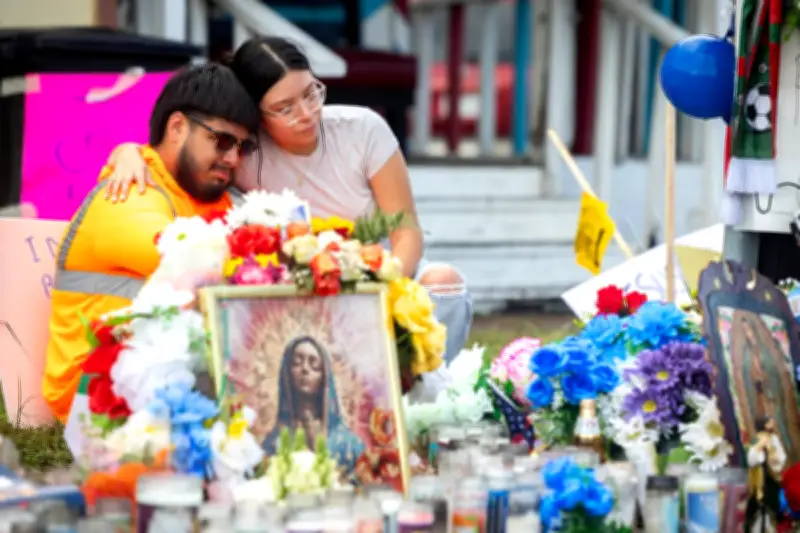
A vigil on Canal Street has grown every night since July 7, when Lorenzo Salgado Araujo, a 52-year-old husband and father, was shot and killed by an ICE officer on a corner of Houston’s Magnolia Park neighborhood. The killing has shaken a community defined by a century of arrival and endurance, but also strengthened bonds among residents facing gentrification and a legacy of police violence.
Community Response and Vigil
The vigil began when two neighbors nailed white roses to a utility pole. Within hours, streams of people brought candles and carnations. By the seventh night, the sidewalk was enveloped by votive candles painted with the Virgin of Guadalupe, Mexican flags flapping alongside Texas ones, and a wooden cross ringed with photographs of Salgado Araujo.
“Magnolia Park is a tight-knit community. Neighbors know each other and they help each other,” said JoAnna Rodriguez, co-founder of the non-profit Magnolia Park Arts and Community, located two blocks from the shooting site. “So when we heard what had happened, our first reaction was, ‘Who was it?’”

The Shooting and Its Aftermath
Salgado Araujo, who employed more than a dozen workers building homes across the region, was driving to work with three others when he was killed by federal immigration agents on July 7. He was not the man immigration officers said they were looking for. “It could have been anybody,” said Jesse E Rodriguez, JoAnna’s husband and an artist who has lived in the neighborhood his whole life. “It could have been me or a sibling. My little brother buys breakfast right there before he goes to work,” he said, pointing to a shop across the street.
The killing has landed in a neighborhood once called Houston’s “Little Mexico.” Magnolia Park took shape in the early 1900s as Mexican families settled along the channel to build docks and refineries, followed by thousands fleeing the Mexican Revolution. In recent years, century-old homes have been increasingly sold off to developers, rents climbing without matching investment, and longtime families watch their blocks grow less familiar.
Gentrification and Demographic Shifts
Jose Aranda, who teaches Mexican American literature at Rice University and grew up in Magnolia Park, traces the area’s identity to Houston’s economic geography. The city’s rise as a shipping and oil hub created enormous demand for labor along the Houston ship channel. “This is why people continue to immigrate to these neighborhoods,” Aranda said. “They’re low-cost neighborhoods, but they’re also situated economically in the places that Houston is most strong economically.”
Adela Cedillo, a historian at the University of Houston who has lived in East End for 15 years, said the community’s Mexican and Mexican American character solidified as earlier waves of German and Chinese immigrants moved out. Salvadorans arrived after their country’s civil war; more recently, Guatemalans and Hondurans have added to the mix. But the Tejano core has anchored the area, which residents call a barrio as a point of pride.
Between 2018 and 2023, Magnolia Park’s Hispanic population shrank by 15%, despite an increase in new housing. “Many of us whose families have been here for generations are still here, but some of us have left,” said Jesse E Rodriguez.
History of Police Violence
Racial tensions between authorities and Magnolia Park are not new. In 1977, Joe Campos Torres, a 23-year-old Vietnam war veteran, was beaten by Houston police officers and drowned in Buffalo Bayou. The officers involved received only probation, sparking the Moody Park riot the following year. “Whether it’s Joe Campos Torres at 23 or Araujo at 52, it’s just senseless and so damaging to everybody,” Aranda said.
Aranda said growing up in Magnolia Park meant absorbing a wariness toward law enforcement passed down through generations. “You needed to be always strait-laced,” he said. “You cannot really mess around with them because there was a way that barrios were intensely patrolled, and we just didn’t have any faith that law enforcement would follow the rules.”

Cedillo said the community’s collective memory of Campos Torres’ killing shaped how quickly residents responded to Salgado Araujo’s. “These stories are marked by segregation, racial profiling, police harassment,” she said.
Ongoing Activism and Community Solidarity
Activists are vowing to get justice for Salgado Araujo by calling for accountability and an independent investigation. They’re rallying at city hall and holding “know your rights” trainings. They’re also bringing the broader Houston community together with protests featuring art for healing.
“If an unmarked vehicle is trying to pull me over off the road, and especially if there are men with masks, I’m not gonna stop,” said JoAnna Rodriguez, referring to how the ICE agents tailed Salgado Araujo’s vehicle. “I would think they’re trying to rob me, or that I’m probably the next victim that’s gonna be thrown into the bayou.”
Throughout the day, neighbors continue to gather where Salgado Araujo died, lighting candles, playing music, trading phone numbers so they can check on one another. It is the same impulse, Cedillo said, that has always defined the neighborhood. “We’re not asking for much,” she said. “We just want to be treated like humans, with due process and within the framework of the rule of law.”