Thousands walk through Exchange Flags in Liverpool every week, but most fail to notice that its buildings bear the scars of one of the deadliest periods in the city's history.
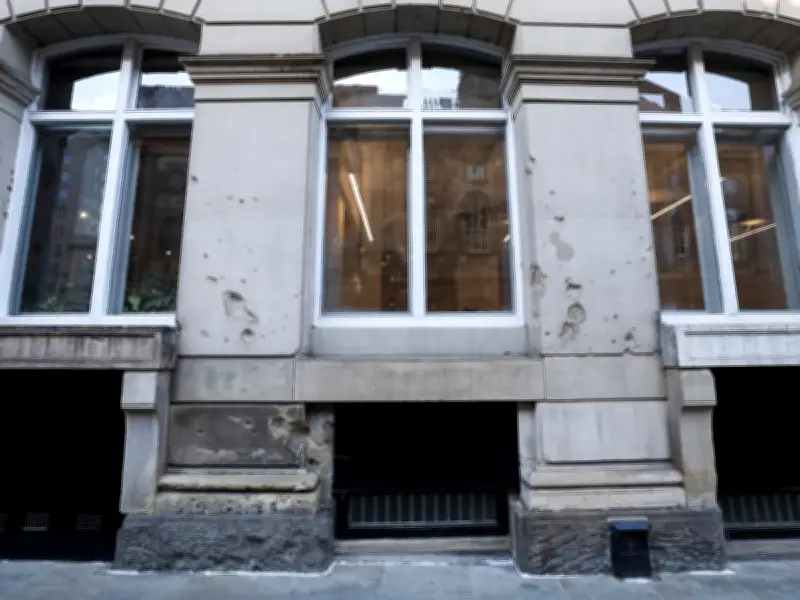
Today, the mid-19th century Grade-II Exchange Court is home to flexible working spaces and a restaurant, Dishoom Permit Room. From a distance, it has much in common with the other buildings that are dotted around it in the city centre. However, upon closer inspection people walking past will be able to see significant chunks missing from the building's brickwork.
Bombing Campaign
Between 1940 and 1942 Merseyside became one of the main targets for Hitler's air force as bombs rained down over the city. In a bid to destroy Liverpool's docklands, many of the surrounding buildings were destroyed completely while many of those that remain still bear shrapnel scars.

Alongside the destruction caused to landmarks, 2,700 people died during the Blitz in Liverpool, 442 died in Birkenhead, 409 died in Bootle, 332 died in the Blitz in Wallasey.
Historian's Account
Local historian Ken Pye said: "Exchange Court is associated with the Second World War because of all the scars that it carries from shrapnel that came from the bombs that were dropped on Liverpool, particularly during the May Blitz of 1941.
"It wasn't deliberately targeted. In fact, the Liver Buildings and the Cunard Building were deliberately avoided by the Germans because they were landmarks. And as they flew over for their bombing raids, they would take bearings on those buildings and then drop bombs on other targeted sites."
Repairs Too Costly
Despite the significant damage and markings left from the shrapnel on Exchange Court, Ken said fixing it was simply not an option after the war.
He said: "They would only have been repaired if they were a threat to the structural integrity of the building. So if the bombing had weakened the building, cracked the building, or left gaping holes in it, then it would be repaired then.
"But otherwise, these marks were left; too expensive to actually go around trying to fill in each one. We had no money immediately after the war, of course, in Liverpool. We wouldn't get any money from the government."
Memorial for Generations
Now over 80 years since the end of WWII, many would have expected repair works to correct the damage on Exchange Court, but Ken feels that the building's blemishes serve as a poignant reminder for younger generations.
He said: "It is a memorial in a way, because so many people did die during the bombing of Liverpool, civilians, never mind the people in the forces. In a way, it is a remembrance, for all those people."