The Mirror witnessed police arrest four people in under three hours during a Live Facial Recognition (LFR) camera deployment in Oxford Circus, as the Met Police plans to roll out the technology across the capital.
The force parked mobile camera vans in the busy shopping district, with officers ready to swoop on anyone whose face matched a watchlist. Legal restrictions prevent identifying those arrested, but police linked them to a "range of offences", including theft and breach of conditions.
How the technology works
LFR converts the facial features of passersby into biometric codes and compares them in real-time against a database containing photos of tens of thousands of wanted people. The watchlist is updated every morning, and data of anyone who doesn't trigger a match is deleted immediately.
An operator remained inside the van monitoring the live camera feed, while around eight officers were stationed on the street outside. When a match is identified, a 'ping' is sent to all officers' handsets, showing a photo on the watchlist, the snap just taken, and a biometric similarity rating out of 10. The officer in charge then decides whether to stop the suspect.
Testing the system
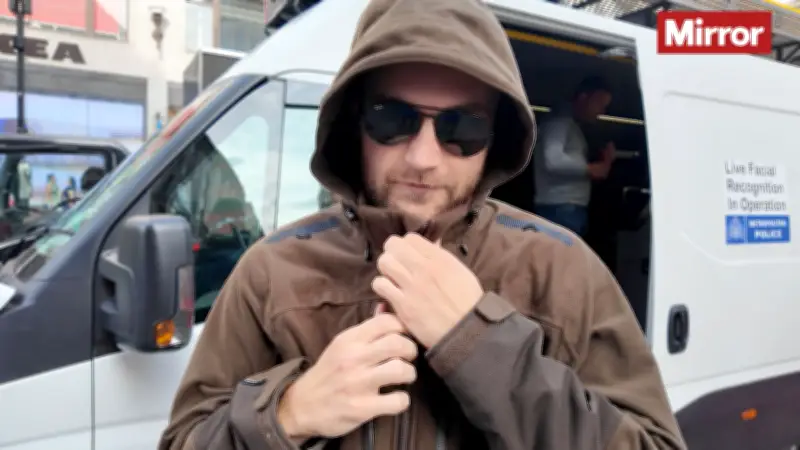
Mirror reporter Benedict Tetzlaff-Deas asked police to temporarily put his face on the list to test the technology. As he wandered out of Oxford Circus station, a chorus of alerts sounded from officers' pockets. On a second attempt, he covered his face with a hooded coat and wore sunglasses, but was flagged immediately.
Inside the van, the software identified him in a split second by measuring distances between key features like his eyes, nose, and mouth. The commanding sergeant was explaining how officers decide whether to make a stop when a potential positive ID was identified across the road, springing the team into action.
Success and expansion plans
Officers lauded the cameras' success, hailing a six-month trial in Croydon, south London that saw crime drop by 10.5%, and violence against women and girls fall by over 20%. In the past year, LFR has led to over 1,600 arrests in London for serious offences, including kidnap, rape and assault.
The Met now wants to put permanent LFR technology in busy spots across the capital, such as the West End and Soho. Static cameras would avoid resourcing issues that saw this van depart Oxford Circus early after multiple arrests, as officers had to leave the scene to take suspects into custody. The Home Office has pledged £11.6million into static and mobile LFR technology across England and Wales.
Not everyone is enthusiastic. Patrick Brink, 57, visiting from Sweden, approached the van to say it reminded him of his recent trip to China, where face-scanning technology is routinely used. He said: "I'm kind of used to the surveillance of the people. But I have a 50/50 feeling about those cameras because they are good for people in general when it comes to safety - we can feel safer and like that. But then again, I'm against a society where people are identified everywhere and monitored in what they are doing online, and now in reality too. We have to remember that the future is ahead and the technology will be developing."
Campaigners have highlighted international studies suggesting LFR software may be prone to misidentifying people from ethnic minority backgrounds. Police said the algorithm has been independently tested by experts at the National Physical Laboratory, showing "no statistical racial or gender bias within the system".
Sergeant Kevin Brown said: "In the last 12 months of the data, we're looking at over 1 in every 350,000 people. We've never arrested anyone or taken anyone into custody as a result of a false alert. We're not harvesting data. That's really, really important. As an organisation, we do understand that people have got some concerns around this. When you look at the number of arrests, we're looking at over 3,000 arrests since the start of 2024. You're looking at the efficiencies that this is delivering in putting people in front of the courts. It's not going to replace policing, and general policing tactics - but it's an additional tool."