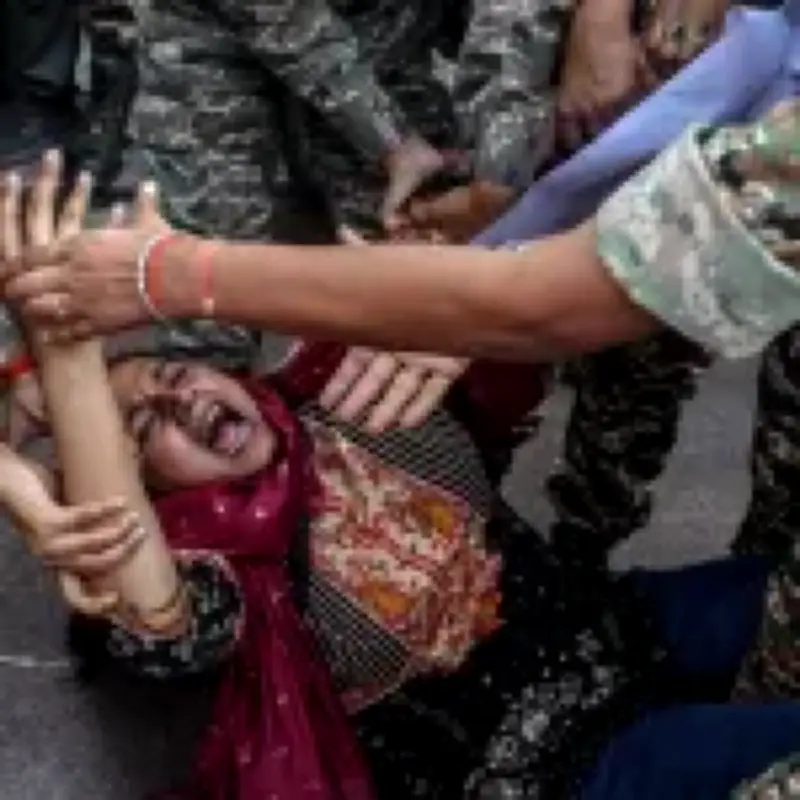
Police detained more than 2,000 protesters and the founder of the 'Cockroach' youth movement as they sealed off part of Delhi in a massive security crackdown. Thousands of police and paramilitary personnel were deployed across the capital, the internet was shut off and transport hubs were closed in a bid to stop a rally in the Jantar Mantar area of the city demanding the resignation of India's election chief.
As well as detaining the youth movement's leaders, opposition politicians and journalists were also held. Some 400 protesters were also detained at a rally in Mumbai, local media reported.
Leaders detained at airport
Police detained Cockroach Janta Party founder Abhijeet Dipke and senior leaders Saurav Das and Ashutosh Ranka when their flight from Mumbai landed in Delhi, the group said in a statement. Footage showed Dipke challenging officers who approached him on board the aircraft, while he and colleagues chanted 'long live the revolution'.
CJP also said authorities refused to provide updates on the leaders' whereabouts or health, even after news arrived of the death of Dipke's grandmother. Police said Dipke was informed of her death and was offered help to return home for the funeral.
Politicians and journalists held
Some opposition lawmakers and former chief ministers Mamata Banerjee of West Bengal, Arvind Kejriwal of Delhi, and Pinarayi Vijayan of Kerala were also detained, TV reports said. Representatives of two news outlets said police briefly detained four of their reporters while they were covering the demonstrations. A Reuters journalist was also detained briefly before being released.
Aditi Sharma, a protester, told Metro the restrictions raise concerns about the right to protest. 'The government should not treat peaceful demonstrations as a security threat,' she said. 'When citizens are prevented from reaching a protest site, it raises serious questions about their freedom to express concerns and demand accountability. The purpose of a peaceful protest is to make the public's concerns heard, not to create disorder. Authorities should ensure that security arrangements protect citizens while also respecting their constitutional rights and allowing democratic dissent.'
Civilian detentions questioned
A research scholar who says they were detained near Jantar Mantar has also alleged that police intervened while demonstrators were holding posters and speaking to journalists. They were not given a clear explanation for their detention before having their posters destroyed and being taken away in a bus.
'We were peacefully holding posters and speaking to journalists when the police intervened,' the scholar says. 'We were not given a clear explanation for our detention before being taken away in a bus. Our posters were torn, and even after we were detained, we were not allowed to speak freely to the media.'
Meanwhile, the All India Students' Association (AISA) has alleged that Delhi Police illegally took away the phones of its president, Neha Bora, and activist Nirma at the Maidan Garhi detention centre. Activist Sonam Wangchuk said he will be 'compelled' to consider further protests if detained demonstrators are not released soon.
Delhi Police said it had denied permission for the CJP's planned demonstration at Jantar Mantar, citing the late submission of the application, alleged non-compliance with conditions imposed during an earlier protest, and concerns about public safety, law and order and traffic management.
Protest background
Metro also spoke to civilians who were targeted by police after being in the area where the demonstration was due to take place. Shahid, 30, who had travelled to Delhi from Bhagalpur in Bihar, said: 'I had come to the area to look for food, not to take part in any protest. I did not understand why I was being treated as someone connected to the demonstration.'
Saurabh, 22, from Karol Bagh in Delhi, also questioned whether officers were distinguishing between demonstrators and other people in the area. 'Some people seemed to be looking for food, while others were trying to arrange transport or get on with their daily work,' he said. 'Security may be necessary during a major protest, but it should be implemented carefully.'
The protest was aimed at Chief Election Commissioner Gyanesh Kumar over a revision of voter lists that critics say disproportionately benefits Prime Minister Narendra Modi's ruling Bharatiya Janata Party (BJP). The Indian Express newspaper reported last week that two election commissioners had questioned Kumar's voter-list revisions that removed roughly 130 million names from voter lists.
Opposition parties say the deletions affected the outcome of recent state elections won by the BJP and have cast a shadow over voting in the world's largest democracy. Kumar has not commented but the Election Commission and the BJP have denied allegations of wrongdoing.
The near daily protests come just months after demonstrations over exam paper leaks forced Modi's education minister to quit. The CJP movement began in May following a remark by India's Chief Justice Surya Kant likening unemployed young people to 'cockroaches'.
The movement's rise reflects a wider frustration among young people struggling to find work and among students concerned about the fairness and reliability of competitive examinations. Allegations of paper leaks have repeatedly raised questions about recruitment processes, the security of examinations and the prospects of candidates who spend years preparing for government jobs.
It has now become a wider anti-government protest amid allegations of corruption, tampering with voter lists and heavy-handed policing of protests.