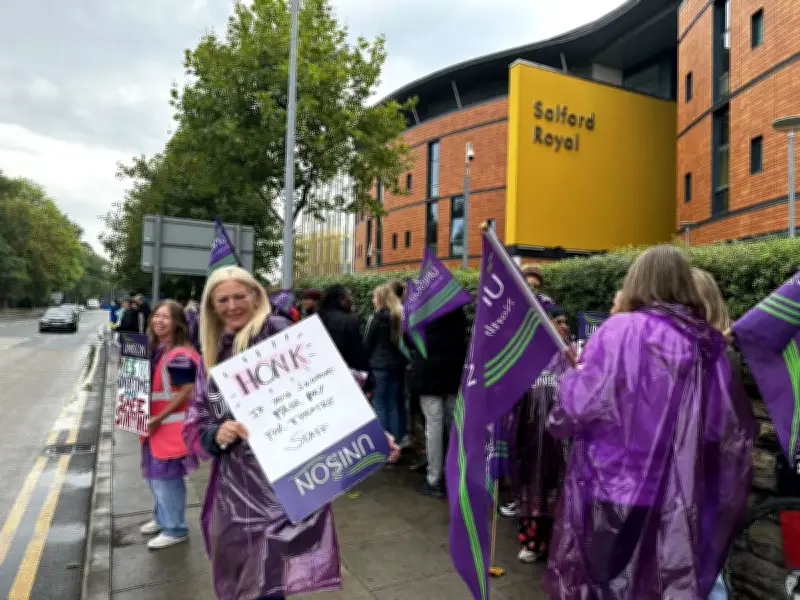
More than 350 workers at four Greater Manchester hospitals run by Northern Care Alliance Foundation Trust (NCA) will stage further strike action on Friday (October 2) and Monday (October 5) in an ongoing dispute over overtime pay. Nurses, clinical support workers and housekeepers are among those walking out, taking the total number of strike days to 11.
Negotiations at a standstill
Trade union Unison says the strikes come as negotiations with the trust, which runs Salford Royal, Royal Oldham Hospital, Fairfield General Hospital and Rochdale Infirmary, have reached a standstill. The union claims trust bosses had agreed to return to the negotiating table following strikes in August and September, but have yet to produce an offer the union can put to its members.
UNISON North West regional organiser Kevin Dolan said: "There was hope the trust was serious about ending the dispute, but that doesn’t appear to be the case at this moment. We’re still waiting to see what any offer will look like once approved by NCA. Staff want to end these strikes and get back to doing what they do best, serving the people of Greater Manchester. The trust has the ability to make that happen whenever it wants."
Overtime pay changes
The dispute centres on the use of outside agency NHS Professionals (NHSP) to manage additional shifts. Unison claims changes to how overtime is managed mean some staff can now earn less for an additional shift than previously, with some missing out on as much as £80 a shift.
One staff member on the picket line in August told the Manchester Evening News some colleagues have been working five or six shifts a week, two or three more than usual, to earn the same amount they previously made from taking one extra shift.
Impact on patients
Picket lines will be at Salford Royal Hospital, Royal Oldham Hospital, Rochdale Infirmary and Fairfield Hospital in Bury. During August industrial action, trust bosses declared a critical incident as it prepared for more than 350 workers to strike, with 'several hundred' patients' operations cancelled. Figures released by NCA this week state between 120 and 130 treatments are cancelled for each day of industrial action, including cancer treatment. Care is cancelled because staff walkouts reduce theatre capacity to Christmas Day levels, meaning only trauma care and emergency operations can be delivered.
Responding to the figures, Unison said the "last thing" its members want is to see treatment cancelled. Kevin Dolan added the figures "do not highlight a failure by workers" but the trust’s "failure to resolve a dispute entirely of its own making".
In a social media post on Wednesday (September 30), NCA wrote: "Some theatre colleagues are expected to take industrial action. Action is currently expected during these periods: 7.30am on Friday 2 October until 8am on Saturday 3 October 2026. 7.30am on Monday 5 October until 8am on Tuesday 6 October 2026. If you have an appointment, please attend as planned unless we contact you directly. You do not need to call us to check. Patient safety remains our absolute priority. We are working hard to minimise disruption and ensure essential services continue safely. We respect our colleagues’ right to take lawful industrial action and remain committed to reaching a fair and sustainable resolution."
Patient safety concerns
The strikes follow criticism of NCA over patient safety concerns, with public records showing dozens of patients have died or come to harm due to treatment delays and serious errors. A total of 28 deaths were linked to lengthy delays last year, with 56 issues of 'severe harm' and 10 deaths linked to problems diagnosing illness, according to the trust's own board papers.
NCA Chief People and Strategy Officer Gertie Nic Philib said: "We have made a fair and strong offer to UNISON which we believe addresses many of the issues raised in this dispute. UNISON has agreed to put the offer to members, although it is not recommending acceptance. We had asked UNISON to stand down industrial action while members considered the offer, but it was not prepared to do so. We therefore took the time needed to prepare the proposal carefully and make sure we got it right before sharing it. UNISON can still choose to call off the planned industrial action while members consider the offer. Doing so would avoid further disruption to patients and services while giving colleagues the opportunity to consider the proposal. We remain firmly committed to resolving the dispute through negotiation with UNISON. However, our focus is on maintaining safe services and minimising the impact of industrial action on patients. Industrial action will continue to do further harm on the patients we serve."