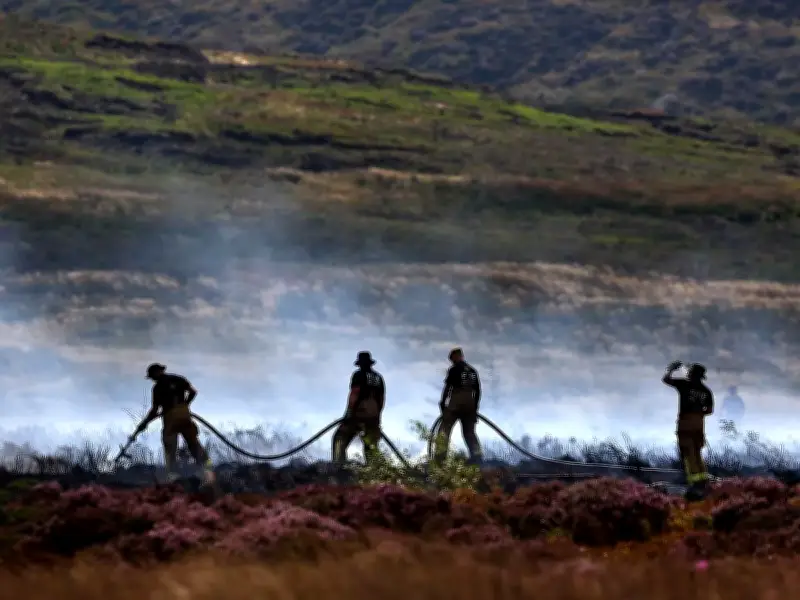
Firefighters who have spent more than five weeks battling moor fires in Greater Manchester say those responsible for starting them should face "harsher consequences" to prevent future incidents.
Crews from Greater Manchester Fire and Rescue Service have been fighting fires at Dovestone, Swineshaw, and now Saddleworth, working in "very, very difficult" conditions to stop the blazes from spreading.
Challenging conditions at Saddleworth
Firefighters remain at the scene of a moorland fire near Holmfirth Road (A635) in Saddleworth, where crews continue to work in challenging conditions to contain the incident and dampen down affected areas. Since the fire was first reported on Wednesday evening, around 50 firefighters have been working alongside landowners and the Royal Society for the Protection of Birds (RSPB) to bring the fire under control in extremely high temperatures.

Andy Steele, a Crew Manager at Stalybridge, said he hopes there's a consequence for the person who started the Dovestone fire. He said: "It's the vastness and the volume of time that we're out here dealing with this that makes it difficult. You're just open. We do get periods of rest and areas of shelter that have been set up but as soon as you're out there it's just hot from the bottom up."
"I think unless there's a large amount of education around moorland fires it won't stop. Hopefully there's a bit of consequence to the person that did the Dovestone fire, that might stop it a little bit. But unless there's a large amount of education around moorland fires, I can't see it stopping. I just don't think that we should be selling disposable BBQs at all. There's plenty of dead animals out there because of people starting a BBQ or dropping litter."
Call for deterrents
Zoe Politis, a firefighter from Altrincham fire station, also thinks that without a proper deterrent the fires will continue. She said: "Yeah it's a bit of graft but you're in it together at the end of the day so it's not that bad. It's one of the things we have to deal with. We have to deal with it as it comes."
"It might be long and hard graft but we enjoy working together and it makes it a lot easier when everyone's helping out together. When it's hot like this it can take it out of you but luckily we've got the Salvation Army here and they've been a great help, they've provide food and water to keep us going. We're getting there with it, it seems like we're getting more control of the situation."
"I just think at the end of the day it's taken a lot of resources from the brigade and I just think making little, silly decisions can have such a big impact and I don't think people realise that. It affects the wildlife massively as well and the money that goes into it and the graft - people don't realise these sorts of things."
"They just think 'oh, this won't happen to me' and get a set up with a BBQ but the next minute, because the grass is so dry, it's caught alight and then people panic. There should be harsher consequences when it comes to things like this because with the weather being so dry at the moment we're not use to it being so dry and I just think people need to be a lot more conscious of these decisions."
Impact on resources and wildlife
The current moor fire follows major wildfires that have ravaged Greater Manchester this summer, with previous fires at Dovestone and Tintwistle damaging nearly 1,000 acres of land.
Martin Cail, the Station Manager, said: "The first two were more significant than this one currently is. The first fire was at Dovestone and that's been very, very difficult because of the terrain, the weather conditions and also the fact that we had other incidents ongoing when that one began."
"With the second fire, that incident alone was ten pumps most days for at least two weeks. After a week we were fairly confident we'd put the fire out but because of the peat, the conditions and the remote location, we found it difficult to get equipment and people up there."

"It's really, really challenging. Just the fact that it's so remote. We're asking crews sometimes to walk two to three kilometres out along lines that need continually wetting because we don't know if it's still burning underground. It's the peat underground that is still burning now and there's no way of knowing that until we see smoke and that could come up anywhere. A fire could start in one location and then travel because of the peat and pop up somewhere else."
"The unknown nature of where it could go next makes it difficult. You can try to predict it to a degree but we're in Great Britain so it can be very unpredictable. Because this has been ongoing for so long, we're stretching resources. It makes it really difficult and we've been using neighbouring services to come and help us when we've got incidents that are on borders because we're so stretched at these times."
"The vast majority of these incidents are caused by the human factor, whether it's BBQs or fireworks or smoking or dropping litter like glass bottles up here, it's all those things that are starting these. We don't just get fires popping up in the middle of nowhere for no reason."
"So please do not bring portable BBQs, please don't bring fireworks and please don't smoke up here and take your litter home with you. If you are out an about and you see smoke please ring us because the earlier we know about it, the earlier we can respond to it and have a higher chance of putting it out. What people don't see is all the times we've driven up here and put out a small fire and prevented a bigger fire from starting."