In the late summer of 1989, a routine callout in rural Flintshire led Tony Davies, then a North Wales police sergeant, to arrest a man who weeks later would commit a cold-blooded murder. The man, Anthony Hughes, shot and killed Inspector Raymond Codling at Birch Services on the M62 on September 14, 1989.
Tony, now 72 and long-retired, had joined the force in the early 1970s after an unhappy two-year stint in the Merchant Navy. Working the thin blue line suited him – or, as he puts it, he was a "round peg" who found a "round hole."
The Woodland Arrest
Tony told the M.E.N. that his station in Flintshire received a call about a stolen firearm. "I got called to somebody that nicked a shotgun from the back of a car, and some cartridges, and ran off into the woods," he said. Following witnesses' directions, he tracked the thief through the woodland until he spotted a figure.

"There's this guy sitting on a stile, and he's got the gun over his knee and a box of cartridges next to him. I thought, 'There's no way.' I walked up to him and said, 'You're under arrest for stealing that, come with me.' And this guy's about 6ft 2in, I mean I'm 5ft 8in, so he's a big lad. And he just gave me the gun."
Tony drove the man back to the station, where he was interviewed. A search of the man's house in Manchester uncovered "a few strange things." Eventually, he was bailed.
The Murder at Birch Services
About a month later, Tony received a call from police in Manchester. "What had happened was this guy was walking around Birch Services on the M62 there. Two bobbies turned up, an inspector and a sergeant, and started to question him, and he shot them both," he said. "He kills the inspector, wounds the sergeant and runs off. And that has played on me for quite a while, because I'm wondering why he had a shotgun in his hand, no one about, and I was in the middle of the woods and he didn't shoot me. And yet in the middle of a motorway services, he shoots two police officers."
Inspector Codling, 49, and Sergeant James Bowden, 47, had gone to the westbound area of the service station to make inquiries about a van. There they saw a man in a motorcycle leather jacket wearing a crash helmet. He asked for directions to the café and gave false ID. When the officers went to check his motorcycle, Hughes pulled a firearm from inside his jacket, firing at Sergeant Bowden's chest, but the bullet deflected off his notebook. He then shot Inspector Codling in the left side of his chest into his heart. As Codling lay helpless, Hughes fired a second bullet into his head before fleeing on a dark blue Yamaha motorbike. Sergeant Bowden, hit below his left knee, gave chase for 300 yards before Hughes escaped.
The killing sparked a nationwide hunt. A week later, Hughes, cornered in a garage, turned his gun on himself.
A Lifelong Haunting
The case still haunts Tony. "That's one of the things that gets me. What did I do differently to those other officers? He could have just blown me away, gone off into the woods, and probably we'd have never found him. Somebody on my shoulder that day was looking out for me."
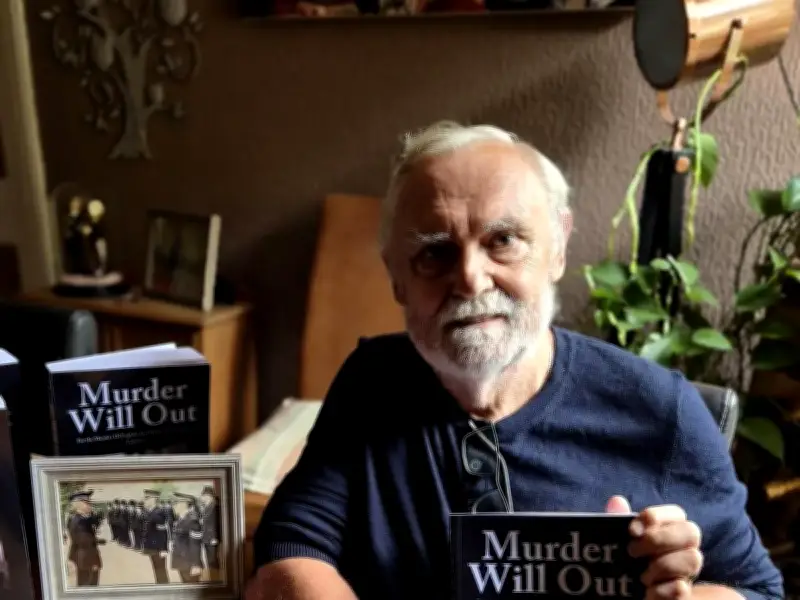
Tony retired from the police in 1998 and, a few years later, settled in Tabley, just outside Knutsford, with his partner, Jane. Since then, he has written both fiction and non-fiction, including crime novels and historical accounts of World War One.
His latest book, Murder Will Out: For The Murders Of English And Welsh Police Officers, went on sale this week. Tony researched the deaths of 450 police officers in England and Wales who have been murdered, going back to the mid-Sixteenth century up to the present day. The first murder he traced back to around 1445, documenting killings right up until 2024. All proceeds will be donated to the police benevolent fund.
Tony believes the book is timely, noting recent calls to stop PC Harper's killers from serving only half their sentence as part of the Government's early release scheme has brought police officers being killed in the line of duty back into the public consciousness.

"When you walk out the door of that police station, you don't know what you're going to be facing for that 8 to 10 or 12 hours that you work," he says. Despite the dangers, being a "bobby" was for him a calling – one he would never change. "I loved it. I miss it every day, and I've been out 20 years," he said. "And I still miss it every day."