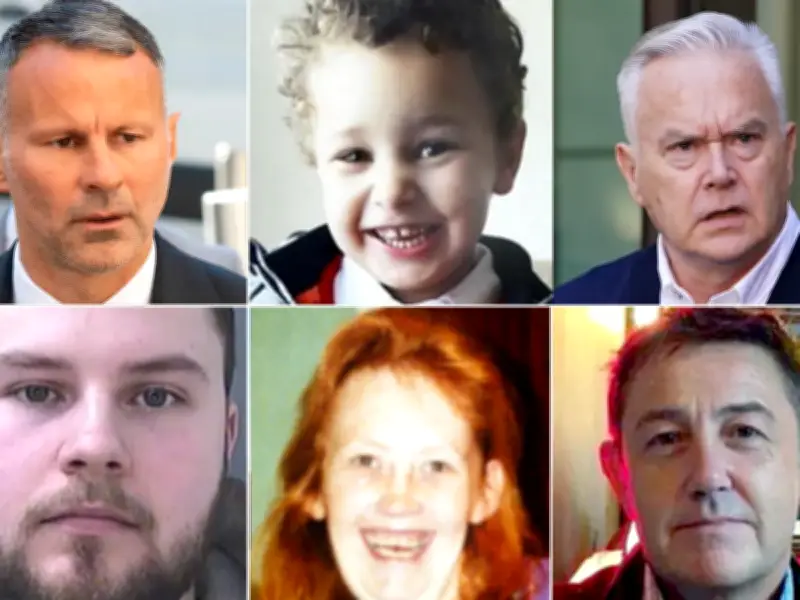
Wales Online court correspondent Philip Dewey has selected the cases that have stayed with him throughout his six-year career covering courts across south Wales and beyond. From the murder of a five-year-old boy to the trial of a former Manchester United footballer, these are the cases that have left a lasting impression.
Logan Mwangi murder
The death of Logan Mwangi and the subsequent conviction of his mother, stepfather and stepbrother for his murder is perhaps the case which most frequently plays on Dewey's mind, having covered every single day of the trial over a number of months. Logan was just five years old when he was killed and his body dumped in the River Ogmore. Photographs depict him as a smiling schoolboy with a cheeky grin, brown curly hair and kind eyes posing for the camera, but the facts of what he was put through before his death still haunt those who attended the trial.
Throughout his short life, Logan was cruelly beaten by his mother Angharad Williamson, stepfather John Cole and stepbrother Craig Mulligan. He was isolated from the family unit, punished severely, called names and ultimately murdered in his own home before being dumped in a river like fly-tipped rubbish by those who were meant to protect him. The lies, deception and stomach-churning performances carried out by his family in a bid to avoid justice saw police officers make the traumatic discovery of Logan lying pale, cold and alone in the water of the River Ogmore dressed in mismatched pyjamas.
Dewey saw the body-worn footage of the moment Logan's body was discovered in the river, scooped up by a police officer who immediately began performing CPR on his tiny frame. But it was all for nothing. Logan was already dead when he entered the river, having been carried by Cole from Williamson's house in the dead of night with the assistance of 13-year-old Mulligan. They returned minutes later, left again to discard his pyjama top and went back to the flat before ringing the emergency services hours later. Remembering the footage of Cole carrying Logan's body over his shoulder and making the short walk to the river is something that still sends shivers down Dewey's spine.
Logan suffered catastrophic injuries at the family home in Lower Llansantffraid, Sarn, Bridgend, in July 2021. In court, his injuries were compared to those usually found in people involved in high-speed car crashes or falls from great height. The trial heard the injuries and the suffering of the child "would have been obvious to those who inflicted the injuries". It was difficult sitting through the evidence, especially when Logan's injuries were read out, but one of the most disturbing aspects was Williamson's behaviour in court. In stark contrast to the co-defendant, who appeared emotionless throughout the trial, Williamson could at one moment appear like a doting mother before theatrically in the witness box as she was cross-examined about her role in Logan's death. When the guilty verdicts were read out, Dewey remembers Williamson collapsing to the floor and pleading with Cole to "tell the truth".
Williamson was jailed for life with a minimum term of 28 years, Cole for life with a minimum term of 29 years and Mulligan detained for a minimum of 15 years during a sentencing hearing in June 2022. After the trial, Dewey stood outside the court steps as Logan's father Ben Mwangi read out a tribute to his young son, saying: "Logan was the sweetest and most beautiful boy whose life has been tragically cut short. The world is a colder and darker place without this warm smile and the happy energy with which he lived his life. The hole that has been left in the hearts of all who knew him will never be filled."
Tracey Woodford murder
Tracey Woodford was murdered and dismembered by former butcher Christopher May on the night she met him in a Pontypridd pub. This was the first major trial Dewey covered for Wales Online after joining in 2015. The gruesome aspect of this case has stayed with him more than a decade later, with the trial hearing how May killed Tracey at his flat before he brutally cut her body to pieces using a saw and other tools before placing her head in a storm drain near Pontypridd RFC. The attack was sexually motivated, with May having sex with Tracey, but it is not known whether this took place before or after her death.
Dewey will always remember the evidence of two police officers who attended May's flat after Tracey was reported missing. They broke down in tears in the witness box as they recounted the smell of "gone-off meat or food" coming from the bathroom and the discovery of Tracey's limbs in the bath. One of them stated: "I thought my eyes were deceiving me and I was watching some sort of horror movie." Dewey also recalls the words of Tracey's mother Linda, who spoke about the moment she viewed her daughter's body which had been assembled back together on a mortuary table. She said: "I started to get distressed when they started to tell me what happened to Tracey's body. It was like I was living in a nightmare. I didn't want to believe what they were saying. I thought 'What person would do something like this? What did he do to her?' I stood over her crying. I didn't know what to do or say. I kissed her on the forehead and then I had to leave the room."
May was sentenced to life imprisonment with a minimum of 28 years and will spend the rest of his life on licence if he is ever released. Viewing the CCTV footage of Tracey's last moments as she walked with May to his flat, not knowing the horror that awaited her, still colours Dewey's memories of this horrendous case.
Huw Edwards incident images
As the main newsreader on BBC's News at Ten and one of the most recognisable faces on television, the revelation that Huw Edwards had admitted making indecent images of children was a shock. Cases involving people accessing images of children are not uncommon and are something Dewey covers on almost a daily basis, but what made this case so memorable was the profile of the defendant and his behaviour in the courtroom on the day of his sentencing at Westminster Magistrates' Court.
The court heard Edwards had been involved in online chat with the paedophile Alex Williams on WhatsApp between December 2020 and August 2021, who sent him 377 sexual images, of which 41 were indecent images of children. The bulk of these, 36, were sent during a two-month period. The relevant images range from the most serious category, known as category A, to the least serious, known as category C. They include seven category A images, 12 category B images and 22 category C images. The court heard Edwards told Williams "go on" when asked if he wanted "naughty pics and vids" of somebody described as "yng (sic)". He wrote "yes xxx" when he was asked by Williams if he wanted sexual images of a person whose "age could be discerned as being between 14 and 16".
Apart from the media circus outside the court and Edwards' demeanour as he walked to the court entrance wearing sunglasses, what struck Dewey most was Edwards' behaviour in the courtroom. As the details of his crimes were read to the court, he appeared unphased and even arrogant as he sat cross-legged in the dock and nodded as the district judge referred to Edwards' childhood and "puritanical" father. Edwards was sentenced to six months in prison, suspended for two years. He was also ordered to carry out a sex offender treatment requirement of 40 days and a rehabilitation activity requirement of 25 days.
Lewis Edwards blackmail
As a serving police officer, Lewis Edwards was meant to protect the most vulnerable people in our society, but he led a secret life in which he psychologically manipulated children into sexually abusing themselves on Snapchat. He had been in contact with more than 200 children on the social media platform, who he bullied, threatened and exploited in order to feed his depraved sexual urges by forcing them to send him indecent videos of themselves naked and abusing themselves as they sobbed and begged him to stop. The 24-year-old, who had 4,500 indecent images of children, later admitted 160 counts of child sexual abuse and blackmail, but still refused to show up for his sentencing hearing in an act of ultimate cowardice.
What struck Dewey most about this case was the sheer scale of Edwards' offending, with a three-day sentencing hearing witnessing countless statements from victims and their families about the devastation brought upon their lives, with many attempting or contemplating suicide. The children, as young as ten years old, described feeling "dirty and ashamed", losing confidence in relationships, trust in the police and suffering ongoing mental health problems. One 12-year-old girl slept with a hammer under her pillow as she didn't feel safe. Their parents describe seeing their children become withdrawn, unhappy and even seeing evidence of self-harm.
The court heard how Edwards would add children, aged between 10 and 16 years old, on Snapchat while pretending to be a boy of a similar age. Once he had received one indecent image from his victim, he would use it to blackmail them into sending more, while threatening to send the images to friends, family or post them online. Many of the victims would beg the paedophile to delete the images, with heartbreaking audio and video footage played in court of the victims' pleas for empathy. In one video, a girl of 13 is exposing her breasts while crying and wiping her face and types "Pls Stop… 'I'm litro 13 pls jus del everything (sic)." Another victim, who was just 12 years old, said: "Just delete them please, I am sick of them now", "Just delete them and I'll do more", "Leave me the f*** alone dude, I am serious."
Dewey spoke to detective superintendent Tracey Rankine of South Wales Police about the shock her colleagues experienced when they realised the person they were investigating was a serving police officer, and in some cases a workmate. The defendant was later sentenced to a life sentence with a minimum term of 12 years. Edwards' role as a police officer and the sheer destruction he caused to so many young lives makes this case all the more horrific, and one that continues to stay with Dewey long afterwards.
Dr Gary Jenkins murder
The homophobic murder of Dr Gary Jenkins is sadly another case which brings back strong memories for Dewey. The doctor was beaten, tortured and kicked to death by a gang of unmerciful and remorseless murderers who left him unconscious and covered in blood with his trousers pulled down. The fact the murder took place in Bute Park, a picturesque landmark in Cardiff city centre where thousands of people walk every day, makes it all the more disturbing, and when walking through the park Dewey still thinks of Dr Jenkins' cries, which were played to the court during the trial.
"Leave me alone (Repeated)... For God's sake, get off me… No… Can you help me… Get off me." It's hard to comprehend what the doctor must have been feeling in his last moments as he was callously and viciously punched and kicked by Jason Edwards, Lee Strickland and 16-year-old Dionne Timms-Williams. The tortuous attack was estimated to last nearly 15 minutes or longer, and afterwards their victim was unable to get up and could be heard moaning in pain and distress. Dr Jenkins was taken to the University Hospital of Wales in Cardiff and spent two weeks in intensive care but never regained consciousness. He suffered injuries including multiple fractures, bleeding to the brain and bruising.
Jason Edwards was sentenced to life imprisonment with a minimum of 33 years. Lee Strickland was sentenced to life imprisonment with a minimum of 33 years. Dionne Timms-Williams was sentenced to life detention with a minimum of 18 years. The fact Dr Jenkins was targeted due to his sexuality, the age of the youngest murderer Timms-Williams, and the public nature of the murder makes this one of the most shocking cases Dewey has covered. Dewey and his colleagues in the press managed to overturn a reporting restriction in respect of Timms-Williams, who had anonymity during the trial due to her young age. Achieving this allowed them to report the full facts on those responsible for Dr Jenkins' murder.
Ryan Giggs trial
It's not every day that you see Sir Alex Ferguson taking the witness box in defence of one of the most decorated football players of all time. This happened during the trial of Ryan Giggs at Manchester Crown Court when he was accused by his former partner Katie Greville that he had assaulted her and her sister Emma at Giggs' home in 2020. The Champions League winner was also accused by Ms Greville of subjecting her to controlling and coercive behaviour between August 2017 and November 2020. Giggs denied all the charges against him and faced a trial in respect of the allegations in 2022, but the jury were unable to reach verdicts. The prosecution formally offered no evidence in respect of the three charges Giggs faced, and he was formally found not guilty.
Of course, watching a player Dewey witnessed playing international football at the then Millennium Stadium in court was quite the experience. To see him crying in the witness stand as he recounted his arrest was in stark contrast to seeing him dribbling past defenders on the pitch. Perhaps the most surreal moment was seeing former Manchester United manager Sir Alex Ferguson giving evidence, describing his relationship with Giggs and his impact on the success of the team. Sir Alex said: "He was a player who had a number of girlfriends and lady friends as his life progressed." Sir Alex said Giggs played under him from the age of 17 until 41. He added: "Fantastic record."
The former manager said: "When he got over the issue of the dressing room I used Ryan a lot in the sense of when I lost my temper about performance I would use Ryan as an example. Sometimes he got the sharp end of my tongue but he was strong enough and could take it. Everyone else would think 'If Ryan Giggs can take it I can take it'." Mr Daw asked Sir Alex about Giggs' temperament. Sir Alex said: "Fantastic temperament, wonderful temperament…… Best example I had in the club, everyone looked up at Ryan as the number one." Mr Daw said: "Did you ever see him lose his temper?" Sir Alex said: "No." This was another new experience for Dewey, covering the trial of a world famous athlete in a situation no one ever thought he'd be in.