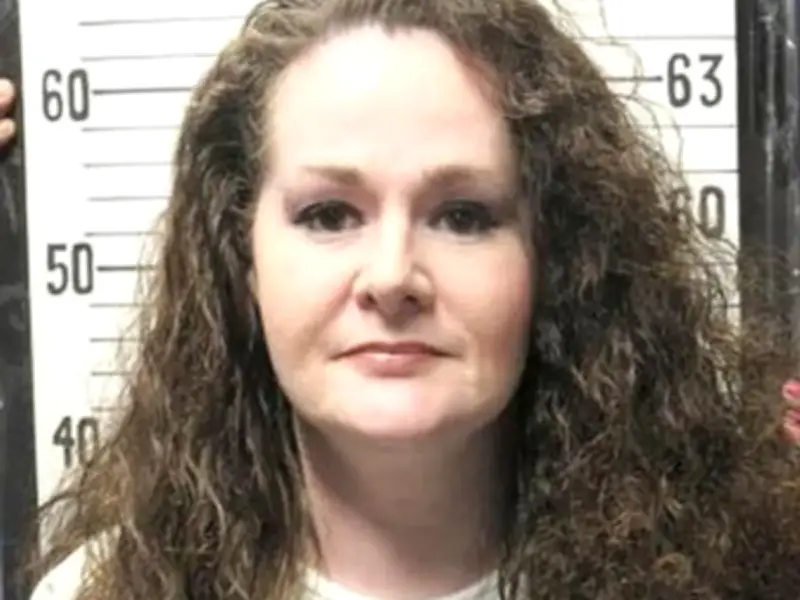
Christa Pike, a Tennessee inmate, was rushed to hospital after surviving two rounds of lethal injection, prompting an emergency motion from her legal team. The case has again thrust America's capital punishment laws into the spotlight.
There are currently around 2,000 people waiting to be executed on America's death row. Last year, 47 people - all men - were put to death in the US, the highest annual total since 2009. Florida led with 19 executions, followed by Texas, Alabama and South Carolina, using lethal injection, nitrogen hypoxia and the firing squad.
Pike's botched execution
The US is one of 53 countries that still practices capital punishment, and 27 of the 50 states have the death penalty. Lethal injection is the most common method, intended to be quick and painless. But for Pike, the opposite proved true. She was alive and audibly snoring despite having been given two doses of the lethal injection, forcing officials to rush her to hospital, her lawyer said.
Her legal team filed an emergency motion to halt the execution on Wednesday, arguing she was in "unnecessary agony" and it was violating her right to be free of cruel and unusual punishment. One of her attorneys told the media that Pike, 50, was being given "life-saving measures" after being given two doses of pentobarbital.
Witnesses described Pike gasping and moaning as she kicked her bedsheet. One said: "Her mouth fell open a few times, and she began to loudly snore. She gasped a few times." Catherine Sweeney, a reporter for local outlet WPLN, said at a conference: "They went through two rounds and she was still breathing at the end, it was very ragged. She lifted her head up and was looking around at one point. She said that there was a spot that was burning and hurting and asked if it was normal. None of it was normal."
Clayton Lockett's 45-minute ordeal
Clayton Lockett, 38, was sentenced to die in April 2018 at the Oklahoma State Penitentiary after being convicted of murder, rape and kidnapping. He shot 19-year-old Stephanie Neiman and watched as two accomplices buried her alive in 1999. But he took almost 45 minutes to die in a horrifying botched execution that left the chamber covered in his blood.
On the day of the execution, teams spent more than 50 minutes trying to find usable veins before locating one on Lockett's groin. Court filings described dozens of needle punctures across his arms, legs and neck. A doctor attempting the groin line reportedly struck an artery, spraying blood that hit staff and left the chamber in a 'bloody mess'. After the injection, Lockett thrashed, lifted his head and shoulders, and made groaning sounds. Prison staff drew blinds over the witness chamber about 16 minutes into the process.
A paramedic at the scene told The Guardian: "I said (redacted) you've hit the artery. Well, it'll be alright [sic]. We'll go ahead and get the drugs. No. We can't do that. It doesn't work that way, and then I wasn't telling him that." Courtney Francisco, a local journalist, told the BBC that Lockett was mumbling "as if he was trying to talk". Lockett's lawyer, David Autry, said: "It was a horrible thing to witness. This was totally botched."
Governor Mary Fallin ordered an independent investigation and imposed a temporary ban on other scheduled executions. A nationwide debate ensued regarding the substances states were using and whether midazolam - the sedative given in this case - provided adequate unconsciousness.
Alan Eugene Miller and nitrogen gas
Alan Eugene Miller was found guilty of murdering three men in a workplace shooting in 1999 and survived a lethal injection attempt in 2022, with prison officials calling off that execution just 30 minutes before the state's death warrant expired. After a two-hour struggle, staff could not get an IV line into Miller's veins in time. The former delivery truck driver was also left hanging vertically as he lay strapped to a gurney at one point.
Miller was convicted of capital murder for the deaths of Terry Jarvis, Lee Holdbrooks and Scott Yancy in Birmingham, Alabama. He was finally executed in September 2024 as the second person to be killed using nitrogen gas, just months after the state became the first to use this previously untested method. According to an Associated Press reporter, "he shook and trembled on the gurney for about two minutes with his body at times pulling against the restraints. That was followed by about six minutes of periodic gulping breaths before he became still."
In January 2024, Kenneth Eugene Smith, 58, became the first inmate to be killed using the nitrogen gas method. He was pronounced dead at an Alabama prison after breathing pure nitrogen gas through a face mask. This marked the first time a new execution method has been used in the US since lethal injection was introduced in 1982.
The American Veterinary Medical Association stated in their 2020 euthanasia guidelines that nitrogen hypoxia is not an acceptable euthanasia method for most mammals because it causes distress. Smith's spiritual adviser, Reverend Jeff Hood, said the execution did not match the state attorney general's prediction that Smith would lose consciousness in seconds. "We didn't see somebody go unconscious in 30 seconds. What we saw was minutes of someone struggling for their life," said Hood.
Hood told The Mirror: "When the execution started, based on what the state said, I was expecting him to go unconscious in seconds. Well, as soon as the nitrogen hit, he began to convulse, and he didn't stop convulsing for minutes. I know that by some accounts, it was two or three minutes. It looked like a fish out of water. He kept heaving back and forth, back and forth. And the mask was tied to the gurney, and so every time he heaved forward, his face was hitting the front of the mask and pressing into the mask."
"His eyes started to bulge. He began to turn colours. He was spitting, and mucus was coming out of his mouth and his face. He kept almost hitting his face on the front of the mask. The mucus and saliva was hitting the front of the mask, and it was drizzling down the front of the mask. His whole body was seizing. It was absolutely, positively a horror show."
However, State Attorney General Steve Marshall said that nitrogen gas "was intended to be - and has now proved to be - an effective and humane method of execution." Alabama corrections Commissioner John Q. Hamm said Smith's shaking and convulsing appeared to be involuntary movements. "That was all expected and was in the side effects that we've seen or researched on nitrogen hypoxia," Hamm said. "Nothing was out of the ordinary from what we were expecting."
Other botched executions
Murray Hooper, 76, a killer executed by lethal injection in Florence, Arizona, had to have his arteries cut into, as state officials reportedly struggled to administer his fatal dose. Officials are believed to have struggled to insert an IV for 25 minutes before cutting into his femoral artery. Hooper - who killed William 'Pat' Redmond and his mother-in-law, Helen Phelps, during a home robbery in Phoenix on New Year's Eve in 1980 - is said to have looked to witnesses through the glass and exclaimed: "Can you believe this?"
Joe Nathan James, executed on July 28 2022, had his arm cut open and his hands and wrists "burst by needles" so he could be executed by lethal injection, an investigation found. Experts believe James may have undergone several painful attempts to find a vein and were unable to confirm if local anaesthetic was used as his arm was cut into by a blade. Atlantic staff writer Elizabeth Bruenig said: "My initial impression of James was of someone whose hands and wrists had been burst by needles." She added: "The state seems to have attempted to insert IV catheters into each of his hands just above the knuckles, resulting in broad smears of violet bruising."
Despite the grim reports, authorities said it was "nothing out of the ordinary". A spokesperson for the Alabama Department of Corrections (ADOC) Kelly Betts, said: "ADOC's execution team strictly followed the established protocol. The protocol states that if the veins are such that intravenous access cannot be provided, the team will perform a central line procedure. Fortunately, this was not necessary and with adequate time, intravenous access was established." James was convicted for the murder of former girlfriend Faith Hall in 1994 and sentenced to death five years later.
Angel Nieves Diaz, 55, grimaced in pain and jutted his head as a lethal cocktail of drugs was pumped into his body on December 13, 2006. Needles were mistakenly inserted into soft tissue in his arm instead of veins, resulting in horrific chemical burns. He remained conscious and at one point asked: "What's going on?" By the time he was pronounced dead, two full doses were administered and the execution lasted 34 minutes. Chemical burns turned the skin on his arms black and caused the outer layer to tear away. The gruesome death forced then-governor Jeb Bush to temporarily suspend executions so Florida's lethal injection protocol could be reviewed.
Doyle Lee Hamm, 61, was convicted of killing a man during a robbery in 1987. His execution attempt in 2018 at the Holman Correctional Facility saw staff and medics fail to find suitable veins in his groin, feet and legs for over two and a half hours. A medical report found 11 puncture wounds on Hamm's body, with as many as six wounds overlapping in his right groin. The report read: "Mr Hamm felt the needle penetrating deep into his groin and pelvis. He stated that this probing was extremely painful. During this time Mr Hamm began to hope that the doctor would succeed in obtaining IV access so that Mr Hamm could 'get it over with' because he preferred to die rather than to continue to experience the ongoing severe pain." Hamm, who had lymphatic cancer, was left "bruised, punctured and limping" with a suspected perforated bladder. Hamm and the state of Alabama reached a confidential settlement, halting plans for a second execution. He died from cancer-related complications in November 2021.
Former journalist Ron Word watched more than 60 Death Row inmates die. Twice, he looked on as flames shot out of a prisoner's head - filling the chamber with smoke - when a hooded executioner switched on an electric chair called "Old Sparky". Another time, blood suddenly appeared on a convicted murderer's white shirt as electricity surged through his body. Mr Word was present for the execution of Jesse Tafero on May 4, 1990. He told The Mirror: "Flames several feet high occurred from the top of his head during the electric chair execution." It turned out "Old Sparky" had malfunctioned - with three jolts needed to execute the condemned man.
A similar scene played out seven years later, when Mr Word was present for the execution of Pedro Medina, 39. On March 25, 1997, Medina uttered his last words - "I am still innocent" - moments before flames shot from the top of his head due to another malfunction. Mr Word said: "In both cases, officials had substituted an artificial sponge in the headpiece. When power was applied, the sponges caught fire. They determined that it was necessary to use natural sponges."
Mr Word was also present when Florida executed its last death row prisoner by electric chair on July 8, 1999. Triple murderer Allen Davis, 54, was sentenced to death over the killings of a pregnant woman and her two young daughters. Blood unexpectedly started appearing on his white shirt as about 2,000 volts of electricity coursed through his body. The stain had reportedly grown to about 8ins across by the time the execution was finished, and Davis had also suffered burns to his head, leg and groin area. He was still alive after the power to "Old Sparky" was turned off, according to witnesses, who reported seeing his chest rise and fall multiple times before he was pronounced dead.