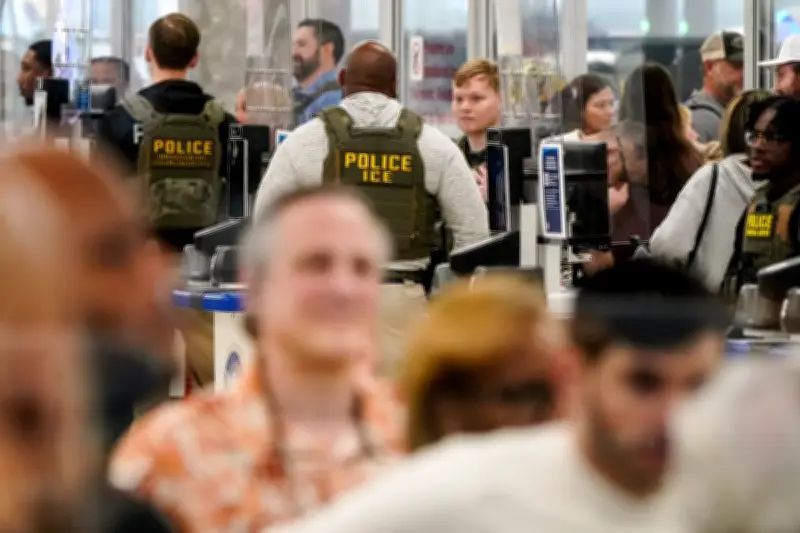
Airline employees are reportedly refusing to help federal agents arrest immigrants at US airports, as the Trump administration's crackdown accelerates. The expansion of immigration enforcement has put the airline industry at odds with authorities seeking up to 2,000 daily arrests.
Scope of the crackdown
Immigration and Customs Enforcement (ICE) and the Transportation Security Administration (TSA), both part of the Department of Homeland Security (DHS), have expanded their collaboration to make as many as three dozen daily arrests at US airports last month, according to the Wall Street Journal.
Some of those taken into federal custody include a former au pair, an asylum seeker with sickle cell anemia who uses a wheelchair, and women married to US citizens who are in the process of applying for lawful permanent residency, according to the New York Times.

Legal concerns
“It’s not people with criminal records,” said Ghassan Shamieh, a San Francisco-based immigration lawyer who had four clients detained at airports over 10 days. “You are talking about people with legitimate pending applications.”
The crackdown marks a policy shift for the DHS, which has generally avoided immigration enforcement at airports to avoid disrupting domestic travel. But with a goal of 2,000 daily arrests, ICE has started detaining people in public places far from security checkpoints, such as ticket counters and near gates.
Industry pushback
At one point in Dallas, a federal agent tried to board a plane in search of a target, but a Southwest Airlines gate agent reportedly refused to allow the officer to board without a judge-signed warrant. Airline employees also blocked ICE from seeing a computer screen while passengers were boarding.
Southwest told the Wall Street Journal that it follows the law and has protocols “to ensure appropriate legal documentation is presented by law enforcement personnel before any information about customers is shared”.
Hundreds of immigration arrests have already occurred at airports since TSA and ICE began cooperating last year. Airline industry members met with DHS in July to express discomfort with the policy change.
Safety concerns
Experts warn that tense encounters could escalate, creating unsafe conditions for bystanders or airline employees. “The actions that federal enforcement authorities have taken in our workplaces have raised glaring workplace, safety and legal concerns for flight attendants,” wrote Sara Nelson, international president of the Association of Flight Attendants, in a letter to carriers in March.