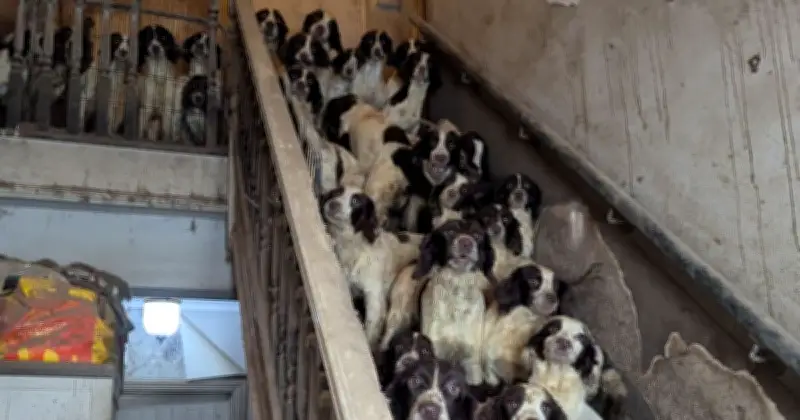
A police officer who found 84 dogs and two cats in "appalling conditions" at a family home was so shocked he had to rush outside to be sick, a court heard. Nine RSPCA officers, along with police and council staff, removed the mainly Springer Spaniel-type dogs from the house in Tickhill, near Doncaster, South Yorkshire, on April 18th 2025.
Barnsley Magistrates Court heard that the day earlier - after repeated attempted visits by the RSPCA - a raid on the house uncovered a disgusting "stench," with dozens of mainly unneutered Springer Spaniel dogs in vile conditions. Many rooms were covered from floor to ceiling in faeces and dirt several inches thick.
Raid on the Property
One image taken by the charity shows over 30 spaniels sitting on the stairs and landing as rescuers entered the home. Now children's social worker David Parkes, 61, who was convicted of three animal welfare offences - and his wife Delphine Parkes, 60, and son Sam Parkes, 28, who both admitted three animal welfare offences - face possible jail when sentenced on 9th December.
The court heard the RSPCA successfully rehomed all but one of the animals; the majority found homes through the charity's network of branch-run centres across the north of England. The family had tried unsuccessfully to give some of the dogs away and there was no evidence they were large-scale breeders but pets were left unneutered and bred out of control.
Conditions Inside the Home
The court was told RSPCA officers had first visited on 5th April 2025 after welfare concerns had been reported about a dog seen at the property with an injured leg. A notice was left offering assistance from the RSPCA and asking the owners to get in touch, but no-one responded. A further visit followed on April 15th with no response and another notice was left.
South Yorkshire Police officers then executed a warrant with the animal welfare charity on 17th April. Although the family were inside at the time, entry had to be forced via a back door. Prosecutor Philip Brown said conditions were so bad one police officer had to leave the house to be sick due to the overwhelming stench.
In her written evidence, RSPCA Inspector Kristy Ludlam said: "The door into the kitchen was opened and we were met with twenty to twenty five Springer Spaniels, some huddled in the corners, others running around. The kitchen was covered in dirt and faeces from floor to ceiling. The floor had at least 20 piles of faeces on it, which the dogs had distributed around the floor and over themselves."
"The dogs were cowering and huddling in a corner, or jumping on the kitchen sides near the window at the back of the room. They were very dirty, their fur covered in faeces, and many of their ears had lumps of dirt stuck to them, almost like dreadlocks. I walked around the corner to the bottom of the stairs, and was met by dogs on every step. There were approximately 33 Springer Spaniels crowding the stairs barking and staring at me."
"The stairs were caked in dirt, approximately six to seven inches sat on top of each step from the bottom almost all the way to the top. By the top step the dirt had almost reached ten inches and the landing was an undulating mass of dirt, faeces and fur which made it incredibly difficult and unsafe to walk on."
Rescue and Rehabilitation
Animal Rescue Officer Liz Braidley told the court: "On entry into the property at the rear the conditions were appalling. The first room was a small area to the rear of the garage. Every surface from the floor and up the walls was brown in colour, the smell of urine and faeces was overpowering; it made my eyes sting."
"We then went through a door to the left which led into the kitchen. There were numerous Spaniel type dogs, all filthy with stained yellow coats. Every part of the floor, walls, and surfaces was caked in a brown residue. The dogs all ran to the other side of the room appearing very scared and timid. The smell in this room was unbearable, it was difficult to talk or breathe properly and I was unable to stay in there for extended periods of time."
Two adult Springer Spaniels, two 12-week-old Springer Spaniel Puppies, two adult female Patterdale Terriers and two Patterdale Terrier pups were living in Mr and Mrs Parkes' bedroom. The room was piled high with various items and was nearly impossible to access, the court heard. Two cats were also found in their son's bedroom, which was also dirty and cluttered. Mrs Parkes told the inspector the situation had got out of control since Covid and she knew they now had too many dogs.
The couple were told neither themselves or the animals could carry on living in these conditions and Mr Parkes agreed for all of them to be removed and he signed them over into the care of the RSPCA - although he disputed ownership during the two-day hearing and claimed they were owned by his wife and son. He said his heavy workload meant he was unable to take responsibility for the animals.
But the court was told veterinary records showed all the animals were registered in his name, he knew the names and ages of most of the animals and their feeding plans, he purchased the dog food and transported pets to the vets when needed. Many of the dogs did not appear to have ever been walked on a lead and had to be carried to waiting vehicles.
The animals were assessed and those needing treatment were taken to four veterinary practices before being transported to private boarding facilities. A vet who examined 46 of the dogs said 14 of them were emaciated and had been suffering for at least a month. Five had infected cuts on their ears which are believed to have been caused by attempts to cut off matted fur with scissors.
Several had bilateral ear infections and one Spaniel had been found with an 'excruciatingly painful' broken front leg which was later successfully treated. The animals, including the cats called Jess and Flower, were vaccinated and received preventative treatment for fleas and worms. Some of the dogs needed antibiotics.
One vet said: "A very large number of animals were being kept in an inadequate space. They were living in filth and squalor. They were not provided with sufficient resources for their basic needs such as water, adequate food, beds or toys. Many of the dogs were underweight, probably due to their lack of ability to compete with the other dogs for resources. Many of them had untreated injuries. Any reasonable and humane person would have recognised these problems and addressed them."
They were then rehabilitated and rehomed, mainly in the north of England at RSPCA branch-run animal centres in Sheffield, Southport, Chesterfield, Doncaster, Halifax, Hull, York, Preston and Accrington, as well as the charity's national centre near Chester-le-Street. The spaniel with the broken leg was successfully treated at the RSPCA's Greater Manchester Animal Hospital and then rehomed.
Other dogs travelled to RSPCA branches and centres in Colwyn Bay, Coventry, Radcliffe-on-Trent, Woking, Lincoln, Birmingham, Taunton and Potters Bar. The cats were also rehomed by the team at the RSPCA's branch-run animal centre in Chesterfield. Despite ongoing care, one Spaniel was sadly put to sleep to prevent further suffering due to health issues.
Lynne Fairbridge, chairman of magistrates, who concluded it was clear Mr Parkes "had responsibility for the animals," praised the RSPCA for their work on the case at the end of the hearing.