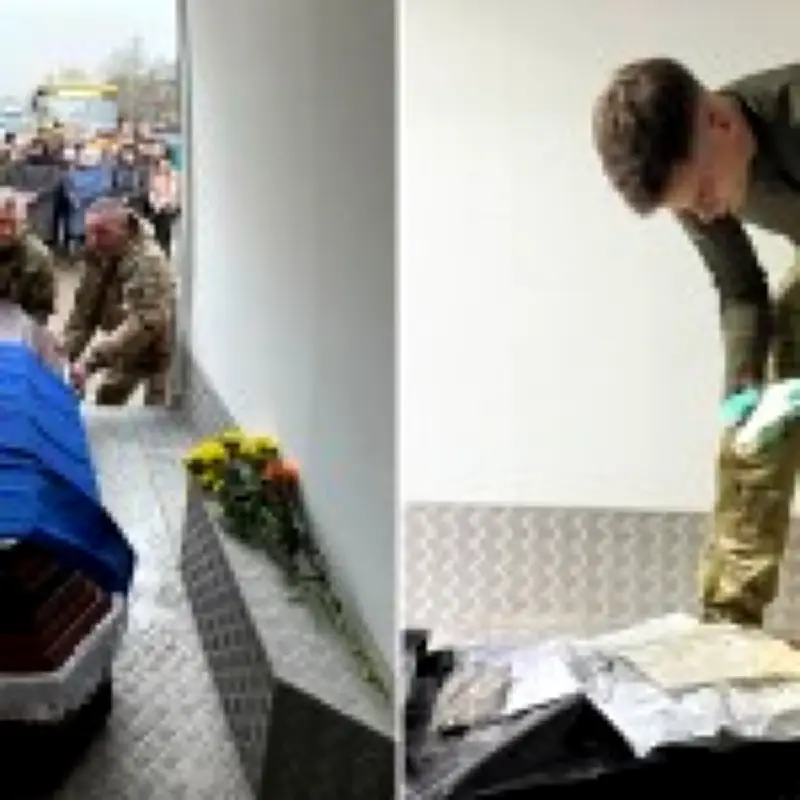
A 27-year-old volunteer in Ukraine has spoken for the first time about the harrowing work of collecting dead soldiers from the front line and bringing them home to their families. Mark Zydga, who runs a small business by day, leads a team called On The Shield that has handled over 1,000 bodies since the Russian invasion began more than four years ago.
Driving a refrigerator van purchased by his local Baptist church, Mark and his crew make countless 1,900-mile round trips across Ukraine to retrieve the fallen. The work is dangerous, with Russian drones posing a constant threat, and psychologically taxing, as Mark often has to open body bags to record how each person died.
From evacuation to body collection
Initially, Mark and his friends from the church in western Ukraine, near the Polish border, focused on evacuating civilians from the east as Russian troops advanced. But as the war turned into trench warfare and casualties mounted, families began asking them to bring their dead relatives home.
“One of my classmates died during the battle. His mum will not calm down before she buries his son,” Mark told Metro. “Lots of soldiers were dying and the process for bringing bodies back home was not established yet. Other bodies were being transported in a very horrible way. They didn’t have special cars or refrigerators.”
The church pooled resources to buy a van, and the team, now known as On The Shield, set out to give fallen soldiers a dignified return. They now serve three western regions: Luts’k, Rivne, and Zhytomyr.
The hardest part: light packages
Mark describes the most difficult aspect of the job as handling “light packages,” which often contain only parts of bodies or the remains of very young soldiers. “Because when the package is light, it is just a part of the body, like someone’s hand. Or it is a young guy who is just 18 years old,” he said.
He also recounted a particularly haunting delivery: a woman killed by a missile in a trench, whose husband carried her body for 8 kilometers before driving alongside Mark’s van for 600 kilometers, weeping.
Psychological toll and moments of humanity
The constant exposure to death and grief has left Mark reserved and closed off, but he also finds that it has made him softer. “People often say that these experiences can make you aggressive or uncaring. But I would say that it makes you softer because you start to appreciate the time that you have,” he said.
Despite the dangers, including Russian drones and the risk of fuel stations being targeted, Mark continues his mission, driven by the gratitude of the families he serves. “Those families we bring the bodies to are extremely thankful. We become quite close friends after,” he added.