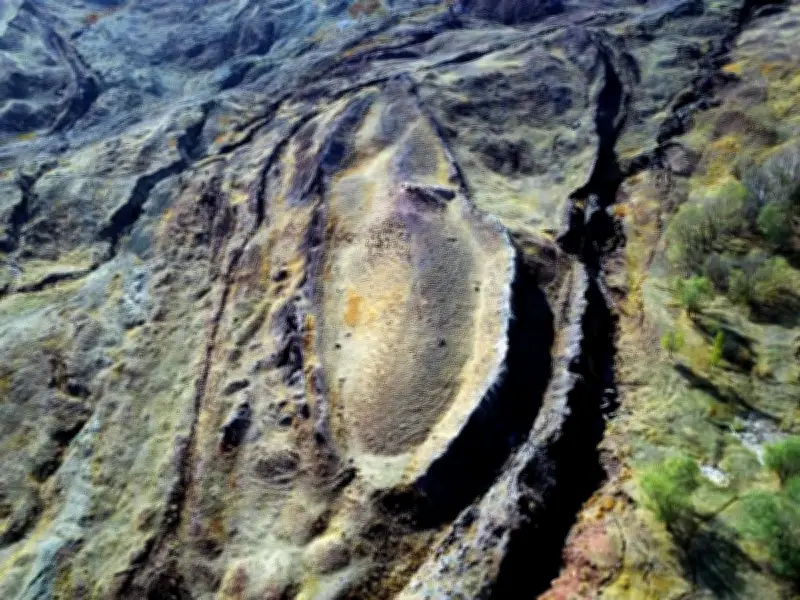
A scientist who spent decades working on US defence projects claims to have discovered mysterious "underground corridors" at a site believed by some to be the resting place of Noah's Ark in eastern Turkey.
Dr Khosrow Bakhtar, a veteran engineer who previously worked for the Department of Defense, brought his high-tech subsurface scanner to the famous Durupınar formation. Using his "BakhtarRadar" technology, which filters out geological noise such as rocks and dirt, he says he detected organised patterns buried deep below the surface.
Strong radar signatures
Among the reported findings are what Dr Bakhtar describes as massive underground corridors and chambers running through the 515-foot boat-shaped mound near the Mountains of Ararat. Speaking after analysing the scans, he said: "This is the most significant finding for 40 years of my career. I have never seen this kind of anomaly before."
Mainstream scientists have long dismissed the Durupınar formation as a natural geological quirk, but Dr Bakhtar insists his equipment proves otherwise. "If the anomalies were not important, we would not have seen them at all," he said. "But the fact that they showed so clearly indicates that they come from something. I am a hundred per cent sure that they come from the same original object."
Consistent readings at depth
The rock-mechanics engineer explained that the radar signatures remained consistent no matter how deep the team scanned. "As we enter the boat, we identified a very strong interface, which is a very dark line going all the way down," he said. "If you look at the strength of the signature, it doesn't matter what depth you're looking at, they all have the same strength."
He added: "We can quantify the repeated anomalies that when you connect them, they form corridors. Because of that, I think all the anomalies are related to one particular object."
The results were released by research group Noah's Ark Scans, which declared the site is "100% not geological."
Open-minded on origin
While believers are convinced the subterranean labyrinth is the biblical vessel, Dr Bakhtar admitted he remains open-minded about what made the outline. "What that original object was - a ship or spacecraft or what - I do not know," he said. Despite his caution, he insisted it could not be natural rock: "They all came from the same original object. It's not geologic related because we mask the geologic features."
The announcement comes as an international expedition, jointly authorised by the Turkish government, steps up physical work at the site. Led by Prof Dr Cenker Atila of Sivas Cumhuriyet University alongside Noah's Ark Scans founder Andrew Jones, researchers have begun core drilling into the formation to pull up soil and rock samples for laboratory testing.
The group hopes analysing the layered material will reveal exactly when and how the mound was formed. Sceptical mainstream geologists insist that extraordinary claims require extraordinary evidence, leaving the world waiting on the lab results to see if Dr Bakhtar's "corridors" really are the remains of Noah's Ark.