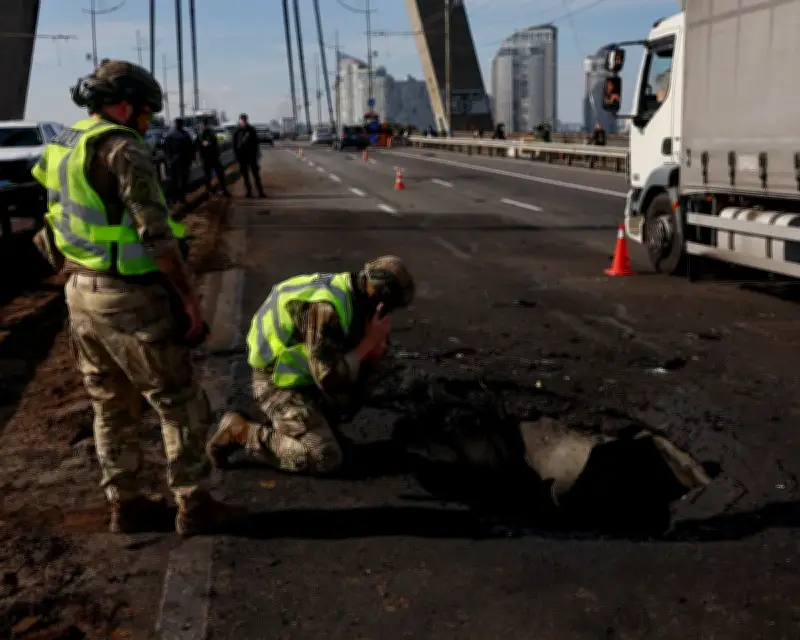
A Russian drone struck Kyiv's key Northern Bridge over the Dnipro River, injuring two people, on the fourth consecutive day that Russia has targeted bridges used by thousands of residents commuting between the city's two banks. The attack came shortly after German Chancellor Friedrich Merz arrived in the capital on an unannounced visit intended to underline Germany's backing of Ukraine.
Video footage showed cars driving across the bridge as the drone plunged into the roadway and exploded in a burst of fire. Kyiv's mayor, Vitali Klitschko, said two people were injured in the strike.
Germany's support for Ukraine
Germany has become Ukraine's biggest provider of military aid since Merz entered office in May 2025, surpassing the US as American support has declined. The visit is Merz's second to Ukraine since becoming chancellor, and he has been among Kyiv's most outspoken supporters in Europe and a leading voice warning about Russia's hybrid campaign against other nations.
The Ukrainian president, Volodymyr Zelenskyy, told Merz that people in Kyiv were suffering "terrible nights and days" from the relentless attacks, and called Ukraine's Russian adversaries "absolute barbarians". "We can see the entire pointlessness of this war at this place," said Merz, adding as he arrived that Ukraine "needs all our support in the coming weeks". "If Russia is not stopped, its war machine will sooner or later turn against us," he said.
Impact on Kyiv's bridges and infrastructure
Russia had already damaged Kyiv's Northern Bridge and repeatedly struck its Southern Bridge. Although the crossings remain standing, repeated attacks and the threat of further strikes have prompted the city's authorities to restrict or suspend traffic on five of the city's six road bridges over the Dnipro, causing temporary closures and large traffic jams.
The attacks form part of a broader Russian campaign against civilian and industrial infrastructure inside Ukraine. In recent weeks, strikes have hit logistics hubs, railway lines, datacentres, medical storage facilities and steel plants, alongside a sustained assault on the country's energy system that is expected to intensify over the winter.
Warnings and political reactions
Russia's foreign ministry on Saturday warned foreign nationals and diplomatic staff against remaining in or travelling to Ukraine. "Responsibility for any possible adverse consequences lies entirely with those who choose to disregard this warning," the ministry said. A number of foreign ambassadors, including Germany's, responded on social media that they intended to remain in Kyiv.
In Moscow, some pro-war commentators noted with glee that the Russian strikes had continued despite Merz's arrival. "Russia used to pause strikes on Kyiv during visits by European politicians. Not any more," wrote Sergei Markov, a prominent pro-war commentator.
Last month, Germany formally accused Moscow of being behind a suspected plot targeting Leipzig/Halle airport, a key logistics hub for western military aid to Ukraine. But Merz is also facing growing discontent at home over his support for Ukraine, as his approval ratings fall. Germany's far left and far right are sceptical of support for Ukraine and want Berlin to scale back aid, with pressure intensifying as the far-right Alternative for Germany (AfD) has made big electoral gains.
Alice Weidel, the AfD's co-leader, wrote in a social media post: "Merz is travelling to Ukraine on Germany's national holiday and promising further billions in German taxpayer money that is missing from the pension and health insurance funds, while Germany is mired in its worst energy crisis."