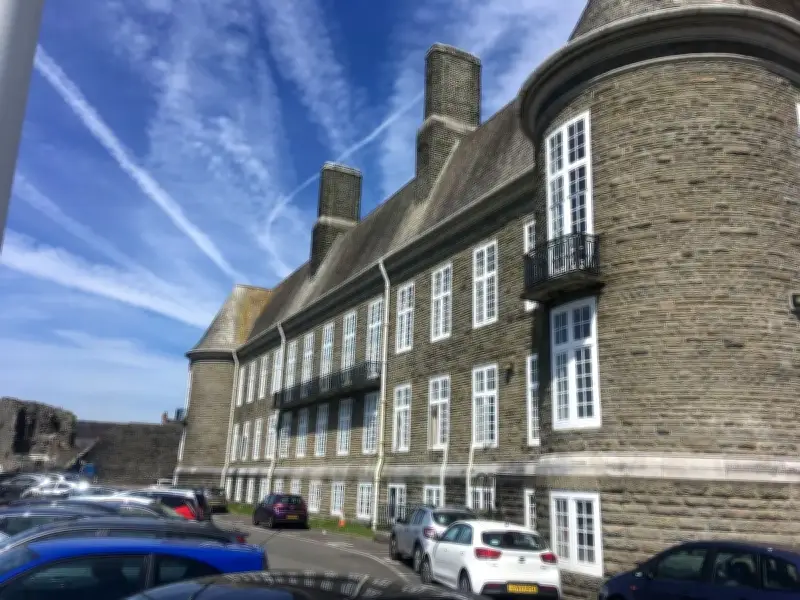
A deep-ground scan has been carried out in Carmarthen in an attempt to locate the remains of five criminals executed two centuries ago at a former prison, now a town centre car park.
The scan took place in February at Carmarthenshire County Hall, where the remains of the five men are believed to lie beneath a car park used by council staff and members of the public.
Men hanged at former Carmarthen Gaol
The men were all hanged between 1818 and 1894 on the grounds of the former Carmarthen Gaol, a prison once situated at the site of Carmarthen Castle. It is thought that the bodies of the five criminals lie beneath the car park, at a location that would previously have been the garden of the old gaol.
Leica Geosystems carried out the scans using a digital radar scanner in a bid to confirm whether the remains of the men - four convicted murderers and a convicted forger - are indeed interred at the location.
Survey areas and findings
The survey areas investigated comprised the entrance to the castle and the council car park area adjacent to the castle wall, with the findings sent to Italy for analysis.
A report has been compiled and details how “six discrete areas were identified” that contain notable subsurface reflection anomalies.
According to the report, prepared by Shane Gwilt and Fabio Giannino: “Area 1 is considered less likely to represent a burial location due to its spatial position within the survey area.
“However, the anomaly detected at this location still represents a subsurface feature of unknown origin and cannot be definitively interpreted on the basis of the geophysical data alone.”
Further investigations possible
Regarding the other locations in the car park, the report continues: ”Areas 2, 3, 4, 5 and 6 also display distinct anomalies within the GPR dataset.
“These areas exhibit radar responses that differ from the surrounding background signal and may indicate zones of ground disturbance or discrete subsurface features.
“While such responses can in some cases be consistent with historic ground disturbance associated with grave cuts, similar signatures may also be produced by a range of natural or anthropogenic subsurface features.
“It should therefore be emphasised that GPR survey results alone cannot conclusively identify the presence or absence of human burials.
“Areas 2–6 represent the locations where the most notable subsurface responses were detected within the surveyed area and may therefore warrant further consideration in relation to the objectives of the survey.”
Carmarthenshire Council has been asked if it intends to carry out further investigations in order to confirm the presence of the remains of the five criminals. The authority confirmed in February that if the remains are discovered to lie underneath the car park, it does not intend to disturb or remove them.