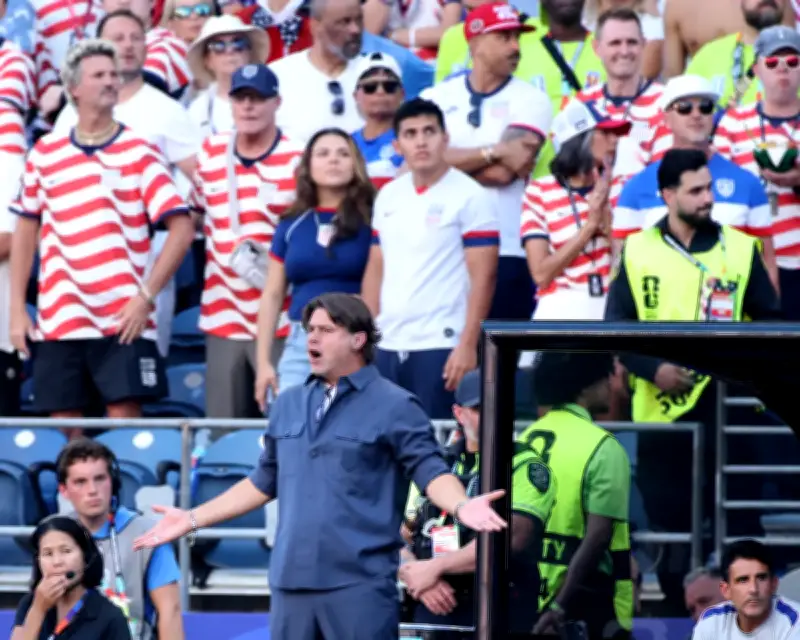
US men's national team head coach Mauricio Pochettino has said he regrets not being “more involved” in the situation surrounding US forward Folarin Balogun at this summer's World Cup.
Balogun was given a red card after a challenge against Bosnia and Herzegovina defender Tarik Muharemovic, which by rule is accompanied with a one-game suspension. Balogun's ban for the next game against Belgium was suspended after the US Soccer Federation and Donald Trump lobbied Fifa, with Trump saying that he personally placed a call to Fifa president Gianni Infantino to ask the ruling be reviewed. Infantino maintains that the decision to reinstate Balogun was made independently by Fifa's disciplinary committee.
Pochettino's Regret Over Balogun Decision
The entire affair cast a pall over what had been an otherwise positive tournament for the US to that point. Belgium's players and coaches said in the wake of the decision that it provided extra motivation ahead of the match. Balogun himself later spoke of having felt uncomfortable with the attention the situation placed upon him.
Speaking with broadcaster Andrés Cantor on Thursday, Pochettino said he was not involved in the decision – though in retrospect, he may have preferred to be.
“Maybe I regret not having been more involved,” Pochettino said in the Spanish-language interview for Fútbol de Primera. “In the situation that later generated all of the negativity afterwards. Maybe I regret not having been more inside of that decision making process. I wasn't involved in that decision, to overturn the red card. As a football person, I understand everything … Beyond whether we were right or not [about the call on the field], I think nobody understood how it happened.”
Impact on the Belgium Loss
The US were thoroughly outclassed by Belgium in the 4-1 loss, beaten badly in every phase of play. In his remarks to Cantor, Pochettino suggested that the backlash surrounding the Balogun situation actively contributed to the loss.
“As a football person,” said Pochettino, “where many times we have that emotional intelligence – [we know] that energy can change things. I think that energy changed the minute that happened. And by then, the game is played under different parameters, and that match was never a match where I believe the tactics, strategy, or selection of players would have changed the course of what happened during the game.”
Pochettino also suggested that the group who participated in US Soccer's efforts to get Balogun on the field against Belgium may have been too large for his liking.
“That's something we've talked about internally,” said Pochettino. “I think that these types of things have to be managed under a much more limited structure, a structure where decisions have to be made by very few people, where very few people manage these types of things. [Those decisions] should be strictly sporting and common sense, beyond whether a rule or a committee can say one thing or another.”
Further Comments and Schedule Concerns
Pochettino echoed those sentiments on Friday in comments to reporters in Orlando, where the USMNT will face Peru on Saturday.
“In the moment I didn't understand the criticisms well, but now with time, I can see that you have to learn from mistakes and I think at times the things that happen in a tournament have to stay there,” he said. “It's good that laws and rules can allow you to change decisions, but because I'm coming from South American soccer and elsewhere, and we have such a tremendous respect for referees – if a ref is confused for a moment, he's confused, and he the player pays for it. I also understand that you have to have the humility to understand that once in a while, you can be in the wrong. I think my error was to not be more involved in that moment. Things happen and in reality the energy of everything changed. That match is hard to analyze because it was created in an environment that wasn't the best one as far as competing in a World Cup.”
The coach also said he was unhappy with the decision for the US to play four games during this international window, calling it a “big risk”. The Americans face Chile on Tuesday in St Louis before traveling again to play Mexico outside Phoenix on 3 October and then Canada in St Paul on 6 October.
“Plenty of other countries play only three this window. I think it's a big risk, because from tomorrow there isn't any time to rest, lots of travel too. We weren't involved in that planning. We understand it's a big risk, lots of players bring from preseason or early season in Europe and lots of MLS players are in a crucial moment at MLS,” he said. “I'd have preferred to have much more space between games to help the guys grow in the way we want for the future.”