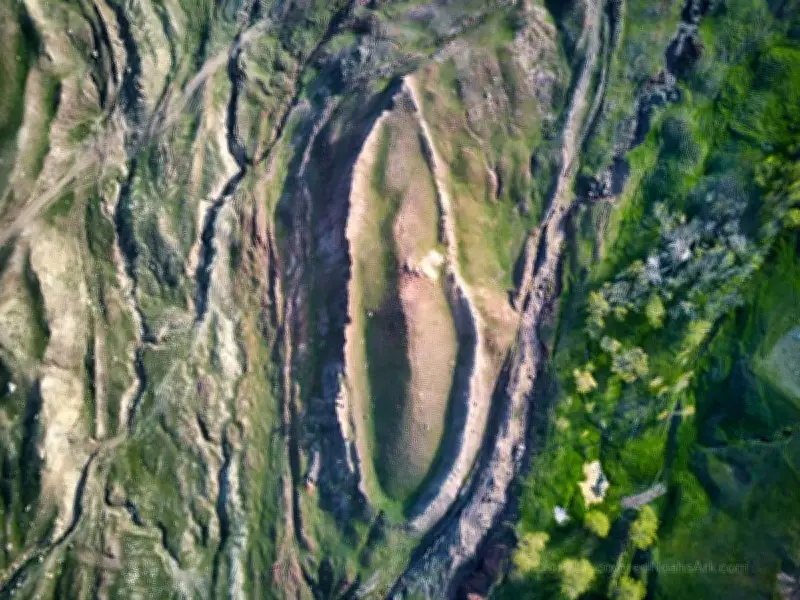
Researchers who claim to have "100% confirmed" the resting place of Noah's Ark are testing mysterious material discovered during their probe at the Durupinar Formation in Turkey. The ground has proven incredibly difficult to penetrate, with a drill bit breaking on a hard layer at about 4–5 meters inside the 515-foot underground structure.
Drilling and Radar Surveys Underway
Archaeologists, geologists and soil scientists have been drilling into the find using radars, drills and drones. They have also deployed a Gopher drone, an "underground robot built to go where a person cannot," to help collect core samples, and the work is ongoing.
So far, no wooded debris has been found in the oddly shaped structure. However, researchers are struggling to come up with a simple explanation for the rock matter they have uncovered and are baffled as to what the ground contains.
Organic Material and Broken Drill Bit
Andrew Jones, founder of Noah's Ark Scans, said: "Preliminary radar data do not show a simple homogeneous solid-rock signature." His U.S.-based group is working with Bakhtar Research and Engineering LLC, whose scientist, Dr. Khosrow Bakhtar, led the radar survey.
Bakhtar said: "We have so far recovered layers of rich organic material that we believe could be the decayed top-tier remains of the Ark. No bedrock or solid limestone has so far been identified in the holes drilled inside the formation. These current findings challenge claims that this is simply a natural shape made of limestone or bedrock."
He added that they have not yet identified any material as ancient wood or been able to establish its age, as none of the lab results have come back as yet. He said: "In one hole inside the formation, at about 4–5 meters, the drill bit broke on a hard layer. We do not yet know what it was. Petrified or heavily mineralized wood is one possibility we want tested; a hard rock block within the surrounding debris is another.
"When I said in our release that these layers could be the decayed top-tier remains of the Ark, I was describing the hypothesis we are testing, not a finding."
First Look Inside the Structure
The team has released what it calls a "first look" inside the mysterious underground structure it believes sits beneath the Durupinar formation. In the video, researchers are seen drilling and lowering the custom-built miniature subterranean robot into freshly made core holes.