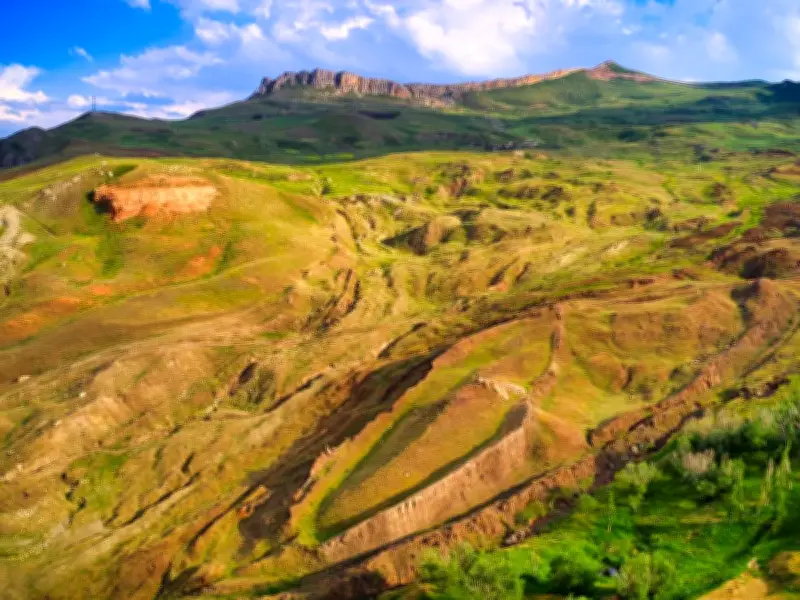
Experts claim they have '100% confirmed' the remains of Noah's Ark, a mystery for hundreds of thousands of years, after finding a boat-shaped formation high in the mountains of Turkey. The team believes the mound is not a natural geological feature but a 'man-made object' located in the Durupınar Formation near Mount Ararat.
Scans reveal man-made structures
Using laser technology and radar surveys, the researchers say they found structural layers, straight lines, right-angle intersections and large cavity-like spaces at multiple depths, suggesting something man-made once lay there. The scans also show potential chambers, corridors and tunnels, along with a thick underground layer dividing into three parts – a feature they compared to God's command in Genesis for Noah to build the Ark with three decks.
According to the Bible, the massive vessel saved humanity and every kind of animal from annihilation during a catastrophic flood that some biblical chronologies place more than 4,300 years ago.
Expert rejects natural formation theory
Independent researcher Andrew Jones, founder of Noah's Ark Scans, has investigated the area for nearly 30 years. He said neither the radar surveys nor drilling conducted inside the formation detected limestone or solid bedrock.
Jones added: "This destroys the theory the site is a solid limestone block shaped into a boat by glaciers and weathering after coming down the mountainside, and it also refutes the theory that this is bedrock around which mud flowed to form the shape. I firmly believe the Durupınar Formation represents the buried remains of Noah's Ark."
Further investigations and findings
The research team recently drilled into the formation, collecting samples that may contain vital evidence, and is the latest hunt to find the illusive, formerly mythical, boat. The first major radar survey in 2019 detected linear and angular anomalies the team interpreted as possible walls, passageways and separate compartments.
A deeper investigation conducted in 2026 by Dr Khosrow Bakhtar used an advanced radar system developed through US Air Force research, finding massive layered reflectors, underground boundaries that bounce radar signals back toward the surface, as well as sediment-filled cavities in the same area. Five prominent anomalies appeared to form a possible tunnel system extending across roughly 151 feet, with an average structural height of over 14 feet. The team is now searching for traces of decayed wood to further substantiate their claims.